OpenTerrace
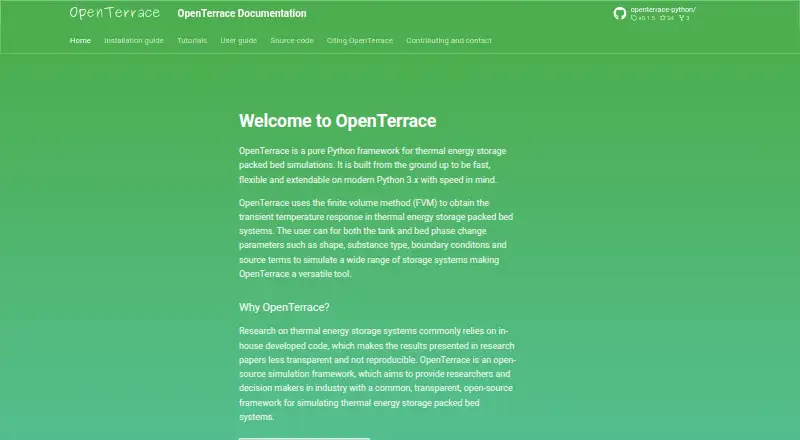
The facts below are what the maker publishes about OpenTerrace, checked and dated. Our editors have not written about it yet.
The facts
Each one read from OpenTerrace's own pages, with the date it was checked.
What it does
- 3D visuals
- Nochecked 23 Sep 2026
- Audience
- The project aims to give researchers and industry decision makers a shared, transparent, open-source simulation framework.checked 12 Oct 2026
- Authoring tools
- Yeschecked 23 Sep 2026
- Configurable models
- Users can configure tank and bed shape, substance type, boundary conditions, and source terms.checked 12 Oct 2026
- Contact
- The contact page names Jakob Hærvig, Associate Professor at Aalborg University's Department of Energy, and gives an Aalborg East address in Denmark.checked 12 Oct 2026
- Contributions
- OpenTerrace is open source and welcomes contributions, with larger changes to core functionality requested to be discussed in advance.checked 12 Oct 2026
- Delivery mode
- desktopchecked 23 Sep 2026
- Dependencies
- The project says it uses Numba, NumPy, and SciPy.checked 11 Oct 2026
- Developer use
- The installation guide recommends editable installation for people who plan to extend or modify OpenTerrace.checked 12 Oct 2026
- Extensibility
- The framework supports adding modules for materials such as non-spherical rocks and phase change materials.checked 11 Oct 2026
- Installation
- Regular users can install OpenTerrace with pip, which the guide says resolves dependencies automatically.checked 12 Oct 2026
- Intended users
- The project describes its intended audience as researchers and industry decision makers working with thermal energy storage packed bed simulations.checked 11 Oct 2026
- Maintainer
- The contact page names Jakob Hærvig, Associate Professor at Aalborg University’s Department of Energy.checked 11 Oct 2026
- Materials
- Documented fluid substances include air, water, and Nak2278, while bed materials include Swedish diabase, magnetite, ATS50, and ATS58.checked 12 Oct 2026
- Materials and geometries
- The user guide lists fluid and bed substances and domain types including cylinders, blocks, spheres, and hollow spheres.checked 11 Oct 2026
- Model options
- The documentation lists cylinder, block, sphere, hollow sphere, and lumped domain types.checked 12 Oct 2026
- Numerical method
- It uses the finite volume method to calculate transient temperature response in packed bed systems.checked 12 Oct 2026
- Numerical schemes
- The documentation includes a central difference scheme for diffusion and an upwind scheme for convection.checked 11 Oct 2026
- Purpose
- OpenTerrace is a pure Python framework for simulating thermal energy storage packed bed systems.checked 12 Oct 2026
- Python version
- The developer setup instructions create a Conda environment with Python 3.12.checked 12 Oct 2026
- Simulation method
- It uses the finite volume method to calculate transient temperature responses in the storage tank and bed phases.checked 11 Oct 2026
- Support and contributions
- The project welcomes contributions and invites students interested in semester projects on thermal energy storage to contact the maintainer.checked 11 Oct 2026
- Supported development environment
- For editable installation, the guide recommends Linux or WSL on Windows.checked 12 Oct 2026
Money
- Free plan
- Yeschecked 23 Sep 2026
Alternatives to OpenTerrace
- 1

SimFlow
Free planWebLinuxmacOSWindows8.2From €8,000 a year - 2

COMSOL Multiphysics
WebAPILinuxmacOS7.7 - 3
FeenoX
Free planWebAPILinuxSelf-hosted7.5Free plan - 4
myPhysicsLab
Free planWebLinuxmacOSSelf-hosted7.5Free plan - 5

OpenFOAM
Free planLinuxmacOSSelf-hostedWindows7.3Free plan - 6
MPTRAC
Free planWebLinuxSelf-hosted7.2Free plan