OpenBRM
OpenBRM is an open-source billing and subscription management platform for telecom operators, internet service providers, MVNOs, SaaS businesses and enterpri…
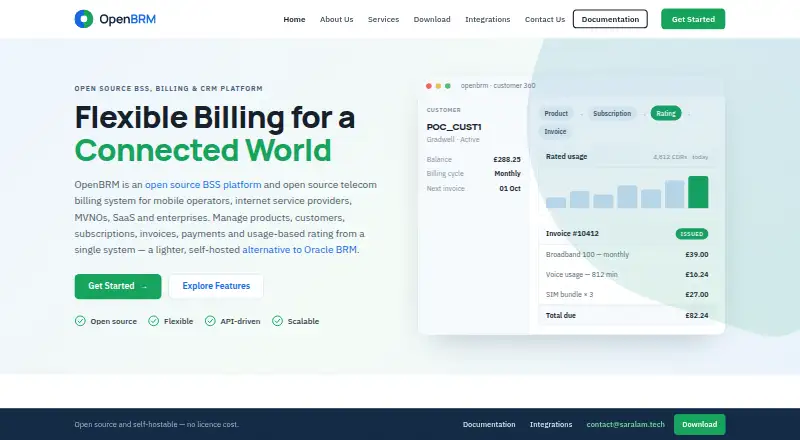
What OpenBRM is
OpenBRM is an open-source billing and subscription management platform for telecom operators, internet service providers, MVNOs, SaaS businesses and enterprises. It brings recurring subscriptions, one-time charges, prepaid balances and usage rating into a customer-cycle invoice that can be sent by email or PDF. Teams can manage activations, cancellations, plan changes, upgrades and downgrades, with provisioning hooks; inventory tools track SIMs, MSISDNs, modems and IP pools. An ecommerce storefront supports subscription sales with recurring billing and payment processing.
The platform integrates OpenRate for rating call-detail records (CDRs). Its site says the engine handles around 1,000 CDRs per second and accepts delimited, fixed-length, binary, TAP and ASN.1 formats. A built-in CRM supports quotes, support tickets, bulk SMS and email notifications, and automatic customer reminders. Default payment gateways include Authorize.Net, PayPal, FirstData, DIBS, PayWay and Chase Paymentech, among others. GUI functions are available through SOAP and REST APIs. The self-hosted package is free of licence fees; hosted SaaS trials are also offered. Saralam Technologies develops and supports OpenBRM and provides implementation, integration and custom development services.
Good
- Combines recurring, one-off, prepaid and rated usage billing.
- Tracks SIMs, MSISDNs, modems and IP pools.
- Includes an ecommerce storefront for subscription sales.
- Offers SOAP and REST APIs.
- Self-hosted package has no licence fee.
Watch out
- The complete package requires self-hosting.
Who it suits
OpenBRM suits telecom, ISP, MVNO and SaaS teams that need billing, subscription operations and customer management in one platform. It is also a fit for organizations prepared to run the complete package themselves or evaluate a hosted trial.
Verdict
Choose OpenBRM if your organization needs subscription billing, usage rating, inventory and CRM capabilities together, especially if you want a self-hosted package without licence fees. Look elsewhere if you need a published hosted SaaS price or a stated operating-system support matrix before deciding.
Plans and prices
From OpenBRM's own pricing page, checked 7 Oct 2026.
| Plan | Price | What it gives you |
|---|---|---|
| Hosted SaaS trial | Free | Full system in browser with sample data loaded · trial duration not stated |
| Self-hosted OpenBRM | Free | Complete platform, including OpenRate rating engine and ecommerce component · no licence fee |
The facts
Each one read from OpenBRM's own pages, with the date it was checked.
What it does
- APIs and stack
- GUI functions are available through SOAP and REST APIs; the listed stack includes Java 17, Grails 6.2.2, Spring Boot 2.7, PostgreSQL 18 and Tomcat.checked 7 Oct 2026
- CRM
- Its built-in CRM generates quotes, manages support tickets, sends bulk SMS and email notifications, and supports automatic customer reminders.checked 7 Oct 2026
- Deployment
- The complete package is self-hosted and has no licence fee; the maker also offers hosted SaaS trials, but does not state the operating-system support matrix on the page.checked 7 Oct 2026
- Other integrations
- The integrations page lists vTiger, SugarCRM, SuiteCRM, Westpac, Nedbank, eWAY, Ezidebit, PayFast, EasyPay, KashFlow, Joomla and RADIUSdesk.checked 7 Oct 2026
- Payment gateways
- Gateways supported by default include Authorize.Net, PaymentsGateway, PayPal, FirstData, DIBS, PayWay and Chase Paymentech.checked 7 Oct 2026
- Pricing details
- The maker states there is no licence cost for the self-hosted source and package; it does not publish a price for the hosted SaaS option on the pages reviewed.checked 7 Oct 2026
- Purpose
- OpenBRM is an open source billing and subscription management platform for telecom, ISPs, MVNOs, SaaS businesses and enterprises.checked 7 Oct 2026
- Rating
- OpenBRM integrates the OpenRate engine, which the site says processes around 1,000 CDRs per second and accepts delimited, fixed-length, binary, TAP and ASN.1 formats.checked 7 Oct 2026
- Security and privacy
- The privacy policy says the product installation is operated by the customer or a third party, who controls the data it holds; the site does not state security certifications or compliance attestations.checked 7 Oct 2026
- Storefront
- The platform includes an ecommerce storefront for selling subscriptions with recurring billing and payment processing.checked 7 Oct 2026
- Subscriptions and inventory
- Subscription operations include plan changes, upgrades, downgrades, cancellation and activation, with provisioning hooks; the inventory manager tracks SIMs, MSISDNs, modems and IP pools.checked 7 Oct 2026
- Support and services
- Saralam Technologies develops and supports OpenBRM and offers implementation, integration and custom development services.checked 7 Oct 2026
Money
- Billing
- It combines recurring subscriptions, one-off charges, prepaid balances and rated usage on a customer-cycle invoice delivered by email or PDF.checked 7 Oct 2026
The full review of OpenBRM
OpenBRM is a self-hosted billing and subscription platform for telecom operators, ISPs, MVNOs, SaaS businesses and enterprises. It suits organizations that need usage rating and communications inventory alongside customer billing. Its breadth is a strong fit for operationally complex services, but it is a poor match for buyers who need a priced hosted service or clearly defined OS support before committing.
Overview
OpenBRM brings billing, subscriptions, inventory, ecommerce and CRM into one system. Its standout advantage is the combination: communications providers can manage rated usage, customer plans and assets such as SIMs and IP pools alongside invoices. The complete self-hosted package carries no licence fee, though the organization or a third party must operate the installation. Saralam Technologies also offers implementation, integration and custom development services.
Key features
Billing handles recurring subscriptions, one-off charges, prepaid balances and rated usage, combining them on customer-cycle invoices sent by email or PDF. That flexibility matters to providers whose customers pay both fixed fees and consumption charges; businesses with simple recurring plans may not benefit enough to justify the wider system.
Subscription operations cover activation, cancellation, upgrades, downgrades and plan changes, with provisioning hooks. The inventory manager tracks SIMs, MSISDNs, modems and IP pools, making the package particularly relevant to communications providers managing services and related equipment together. An ecommerce storefront supports subscription sales, recurring billing and payment processing.
OpenBRM integrates the OpenRate rating engine. The site says it processes around 1,000 CDRs per second and accepts delimited, fixed-length, binary, TAP and ASN.1 formats. That range makes it relevant to telecom usage records in multiple formats, although the throughput figure is a vendor claim rather than a guarantee for a particular deployment.
The built-in CRM generates quotes, manages support tickets, sends bulk SMS and email notifications, and issues automatic customer reminders. Automated retries and email and SMS notifications support payment follow-up. Default payment gateways include Authorize.Net, PaymentsGateway, PayPal, FirstData, DIBS, PayWay and Chase Paymentech; integrations also include Westpac, Nedbank, eWAY, Ezidebit, PayFast and EasyPay. Other named integrations include vTiger, SugarCRM, SuiteCRM, KashFlow, Joomla and RADIUSdesk.
GUI functions are exposed through SOAP and REST APIs, and APIs and webhooks are supported. The listed stack includes Java 17, Grails 6.2.2, Spring Boot 2.7, PostgreSQL 18 and Tomcat. This technical profile and the self-hosted model favor organizations able to manage a substantial software deployment rather than teams seeking a turnkey billing service.
Pricing
Self-hosted OpenBRM — free. This includes the complete platform, OpenRate rating engine and ecommerce component, with no licence fee. It is the clearest fit for organizations prepared to run their own installation and wanting the full feature set without software licence charges. The price does not remove the operational responsibility of hosting and maintaining the system.
Hosted SaaS trial — free. It provides the full system in a browser with sample data loaded.
The maker also says it offers hosted SaaS trials, but does not publish the hosted option's price. The privacy policy says the customer or a third party operating an installation controls its data. The site does not state security certifications or compliance attestations, so organizations with formal procurement requirements should assess those separately.
Platforms
OpenBRM is presented for API, Linux, macOS, web, Windows and self-hosted use.
Who it's for
OpenBRM is strongest for telecom operators, ISPs and MVNOs that need subscription billing, usage rating and communications inventory in one system. SaaS businesses and enterprises with mixed recurring and metered billing may also find its combination useful. It is less suitable for teams that only need straightforward subscription invoicing, cannot take responsibility for a self-hosted installation, or require a published SaaS price and defined OS support before evaluating a product.
Pros and cons
- Pros: Combines recurring, one-off, prepaid and rated-usage billing, giving providers one invoicing flow for several charge types.
- Pros: Pairs telecom-specific inventory tracking with subscription operations and provisioning hooks, reducing the need to separate those functions across tools.
- Pros: The complete self-hosted package, including rating and ecommerce, has no licence fee.
- Cons: Self-hosting makes the customer or a third party responsible for operating the installation.
- Cons: Hosted SaaS has no published price, and the trial duration is unstated, limiting cost comparisons.
Alternatives
For a narrower focus on payment recovery, compare Dunning Management Software.
Kill Bill is another self-hosted open-source billing option, with its core offering described as giving users control of infrastructure and data. Lago offers an AGPLv3-licensed, self-hosted open-source plan at no cost, with a premium option for cloud or self-hosted deployment. Choose between them and OpenBRM based on which platform's billing scope best fits your operations.
Airwallex Billing has a free invoicing plan and usage-based billing priced at $0.50 per successful transaction; it may suit teams looking for transaction-priced usage billing rather than OpenBRM's complete self-hosted package. Billsby has a Core plan at $45 a month, plus 0.4% on revenue exceeding $15,000/mo, including five users, one payment gateway and one tax region. It is a more defined paid-plan option for teams whose needs fit those limits.
Churn Buster offers free recovery analytics and a Dunning or Cancel Flows plan starting at $269 a month, making it the more focused choice when recovery workflows are the priority. Lemon Squeezy has ecommerce with no monthly fee and charges 5% + $0.50 when sales are generated; it may suit sellers seeking a transaction-fee model instead of running a self-hosted billing stack.
NovaBilling offers a free self-hosted Community plan with all features, unlimited tenants and customers, six payment providers and GitHub community support. It is worth comparing for teams seeking a self-hosted billing system with those stated community-plan terms. Pabbly Subscriptions has a free plan capped at 50 customers, with revenue limited and team members and the affiliate module excluded; it is a more bounded option for smaller subscription operations.
Verdict
Choose OpenBRM when your organization needs subscription billing, usage rating, communications inventory and CRM together, and can operate a self-hosted platform. Its no-licence-fee complete package is compelling for that combination. Look elsewhere if you need a published hosted SaaS price or a stated operating-system support matrix before making a decision.
Getting started
- Visit the OpenBRM website.
- Choose the self-hosted package or a hosted SaaS trial.
- For self-hosting, deploy the complete package in your environment.
- For hosted evaluation, use the browser-based trial with sample data.
Questions
Is OpenBRM free?
The self-hosted source and complete package have no licence fee. A hosted SaaS trial is offered, but no hosted SaaS price is published on the product pages.
Which platforms does it support?
Listed platforms are API, Linux, macOS, self-hosted, web and Windows. The maker does not state the operating-system support matrix for the package.
What payment integrations are available?
Default gateways include Authorize.Net, PaymentsGateway, PayPal, FirstData, DIBS, PayWay and Chase Paymentech. Other listed payment integrations include Westpac, Nedbank, eWAY, Ezidebit, PayFast and EasyPay.
Who develops and supports OpenBRM?
Saralam Technologies develops and supports the platform, and offers implementation, integration and custom development services.
Alternatives to OpenBRM
- 1

WooCommerce
Free planOpen sourceAndroidiOSWebAPI8.8From $29 a year - 2
Kill Bill
Free planOpen sourceWebAPILinuxmacOS8.3From $9,999 a month - 3

Airwallex Billing
Free planAndroidiOSWebAPI8.0From $12 a month - 4
Flexprice
Free planOpen sourceWebAPILinuxSelf-hosted8.0Free plan - 5
UniBee
Free planOpen sourceWebAPISelf-hosted7.9From $99 a month - 6

Recurly
AndroidiOSWebAPI7.8From $249 a month