
OpenAI Guardrails
OpenAI Guardrails adds configurable safety and compliance checks to LLM applications by validating inputs and outputs.
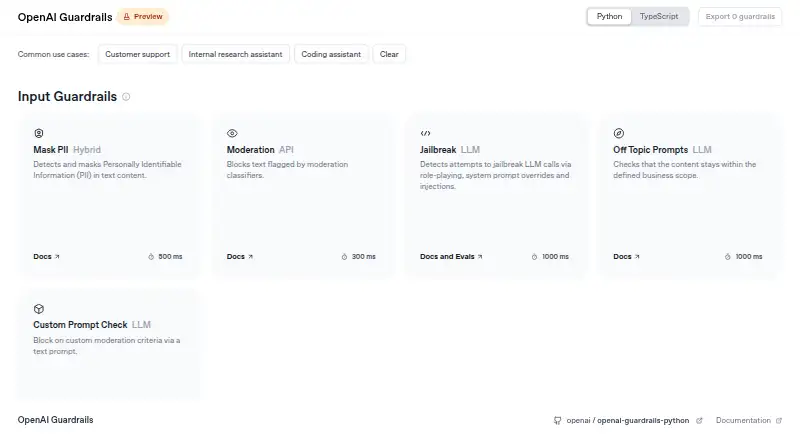
What OpenAI Guardrails is
OpenAI Guardrails adds configurable safety and compliance checks to LLM applications by validating inputs and outputs. Its open-source Python project is labeled Preview and available under the MIT license. Built-in checks cover PII masking, moderation, jailbreaks, off-topic prompts, URLs, and hallucinations; prompt-injection detection for agent tool calls is experimental.
The Python SDK supplies wrapped OpenAI clients for Chat Completions and Responses API calls and integrates with the OpenAI Agents SDK through GuardrailAgent. The quickstart documents Azure OpenAI clients and compatibility with OpenAI-compatible APIs, including a local Ollama example. Developers can create pipeline configurations in the Guardrails Wizard or define them manually as JSON, then evaluate performance on labeled datasets. Python and TypeScript/JavaScript SDKs are available for applications. The Python package requires Python 3.11 or newer, and configurations using Contains PII also require its spaCy model during build or deployment. Guardrails calls paid OpenAI APIs, with charges paid by developers. It may use third-party services such as Presidio, which OpenAI says it does not develop or verify.
Good
- Checks inputs and outputs for several safety concerns.
- Offers OpenAI client wrappers and Agents SDK integration.
- Supports Azure OpenAI and compatible APIs.
- Configurations can be created in a wizard or JSON.
- Evaluation tooling measures performance on labeled datasets.
Watch out
- The Python project is labeled Preview.
- Python package requires Python 3.11 or newer.
- Guardrails calls paid OpenAI APIs.
- Contains PII configurations need a spaCy model.
Who it suits
It suits developers building LLM applications who want configurable checks and evaluation tooling. Python users need Python 3.11 or newer, and developers should account for API charges and any third-party service terms.
Verdict
OpenAI Guardrails provides configurable checks, integrations, and evaluation tools for LLM applications. Its Preview status, Python requirements, API charges, and possible third-party services are important considerations.
The facts
Each one read from OpenAI Guardrails's own pages, with the date it was checked.
What it does
- Agents integration
- The Python SDK integrates with the OpenAI Agents SDK through GuardrailAgent.checked 4 Oct 2026
- Availability
- The Python project is labeled Preview and is available under the MIT license.checked 4 Oct 2026
- Checks
- Available checks include moderation, jailbreak detection, PII detection, URL filtering, secret key detection, hallucination detection, prompt injection detection, and custom prompt checks.checked 4 Oct 2026
- Client integration
- The Python package provides drop-in replacements for OpenAI clients and integrates with the OpenAI Agents SDK.checked 4 Oct 2026
- Configuration
- The Guardrails Wizard creates pipeline configurations that can be exported for use with the SDK.checked 4 Oct 2026
- Evaluation
- Guardrail performance can be measured on labeled datasets using the exported configuration and the evaluation dependencies.checked 4 Oct 2026
- Evaluations
- The Python package includes evaluation tooling for measuring guardrail performance on labeled datasets.checked 4 Oct 2026
- Maturity
- The Python repository labels OpenAI Guardrails as a preview.checked 4 Oct 2026
- OpenAI clients
- The Python SDK provides wrapped OpenAI clients for Chat Completions and Responses API calls.checked 4 Oct 2026
- Other providers
- The quickstart documents Azure OpenAI clients and compatibility with OpenAI-compatible APIs, including a local Ollama example.checked 4 Oct 2026
- Provider compatibility
- The quickstart documents Azure OpenAI clients and compatibility with OpenAI-compatible APIs, including a local Ollama example.checked 4 Oct 2026
- Purpose
- OpenAI Guardrails adds configurable safety and compliance checks to LLM applications by validating inputs and outputs.checked 4 Oct 2026
- Requirements
- The Python package requires Python 3.11 or newer; configurations using Contains PII also require its spaCy model during build or deployment.checked 4 Oct 2026
- Third-party component
- Guardrails may use third-party services such as the Presidio open-source framework, which OpenAI says it does not develop or verify.checked 4 Oct 2026
- Third-party services
- Guardrails may use third-party services such as the Presidio open-source framework, which is subject to its own terms and is not developed or verified by OpenAI.checked 4 Oct 2026
The company
- Founded
- 2015checked 28 Sep 2026
- Headquarters
- San Francisco, California, United Stateschecked 28 Sep 2026
- Maker
- OpenAI describes itself as an AI research and deployment company; it was founded in 2015 and is based in San Francisco.checked 4 Oct 2026
Where it runs
- Platform support
- The maker provides Python and TypeScript/JavaScript Guardrails SDKs for use in applications.checked 4 Oct 2026
Money
- Usage costs
- Guardrails calls paid OpenAI APIs, and developers are responsible for the associated charges.checked 4 Oct 2026
Alternatives to OpenAI Guardrails
- 1

PromptGuard
Free planWebAPIExtensionLinux7.9From $19 a month - 2
CyberSecEval
Free planOpen sourceWebAPILinuxmacOS7.5Free plan - 3

NVIDIA NeMo Guardrails
Free planOpen sourceAPILinuxmacOSSelf-hosted7.4Free plan - 4
Oracle Mobile Authenticator
Free planAndroidiOSWindows6.9Free plan - 5

Enkrypt AI Guardrails
Free planWebAPISelf-hosted6.8From $1,608 a year - 6
OpenSecureAI Prompt Firewall
Free planWebSelf-hosted6.7From $49 a month