
NVIDIA NeMo Guardrails
NVIDIA NeMo Guardrails is a free, open-source Python package for adding configurable controls to applications built with large language models.
What NVIDIA NeMo Guardrails is
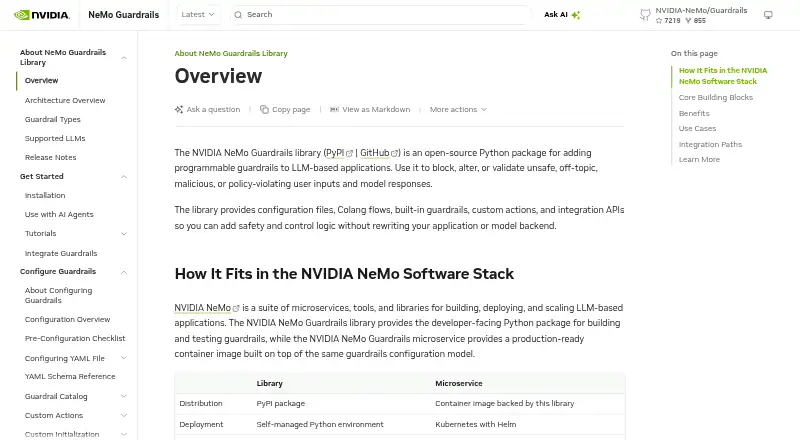
NVIDIA NeMo Guardrails is a free, open-source Python package for adding configurable controls to applications built with large language models. It can block, alter, or validate inputs and model responses that are unsafe, off-topic, malicious, or against policy. Its rails cover input, retrieval, dialog, execution, and output stages, configured with YAML files, Colang flows, built-in guardrails, or custom actions. Available checks include content safety, jailbreak protection, topic control, PII detection, agentic security, tool calling, hallucination and fact-checking, and model self-checks. Applications can use the Python SDK or a Guardrails server exposing HTTP endpoints, including OpenAI-style chat completions. Listed integrations include safety and community models, third-party APIs, Python actions, LangChain tools, and the LangChain and LangGraph frameworks; LangGraph workflow support has additional package and opt-in requirements. The self-hosted library supports Windows, Linux, and macOS, with Python 3.10 through 3.13 and at least one CPU with 4GB RAM listed as requirements. External models may require separately deployed GPUs. NVIDIA cautions that no single rail addresses every adversarial prompt, and application logs need separate PII controls.
Good
- Provides rails for five stages of an LLM interaction.
- Configuration supports YAML, Colang, built-in rails, and custom actions.
- Offers a Python SDK and HTTP server interface.
- Supports Windows, Linux, and macOS.
Watch out
- Requires Python 3.10 through 3.13.
- Minimum listed hardware is one CPU with 4GB RAM.
- External models may require separately deployed GPUs.
- PII rails do not sanitize all logs or telemetry.
Who it suits
NeMo Guardrails suits developers and teams building LLM applications that need configurable policy enforcement and safety checks. It is relevant to projects using Python, supported frameworks, or a self-managed deployment.
Verdict
NeMo Guardrails offers multiple configurable checks and integration paths for self-hosted LLM applications. Treat generated content as untrusted, use defense in depth, and configure logging controls separately.
Plans and prices
From NVIDIA NeMo Guardrails's own pricing page, checked 15 Oct 2026.
| Plan | Price | What it gives you |
|---|---|---|
| Open-source NeMo Guardrails library | Free | Python package · self-managed deployment · external model/API costs may apply · Free access for research, development and testing |
| NeMo Guardrails microservice | Priced on request | Helm/container deployment · production licensing required · Production use requires an NVIDIA AI Enterprise License |
The facts
Each one read from NVIDIA NeMo Guardrails's own pages, with the date it was checked.
What it does
- Agentic security
- Tool-call validation, execution rails, LangGraph integration and action monitoring are provided for agent workflows.checked 15 Oct 2026
- Build endpoint limitation
- The project states that NVIDIA Build is intended only for evaluation and testing and should not receive confidential or personal data.checked 15 Oct 2026
- CLI
- The package includes a nemoguardrails command-line interface with chat, server, actions-server and evaluation commands.checked 15 Oct 2026
- Configuration
- Guardrails can be configured with YAML files, Colang flows, built-in guardrails, and custom actions.checked 9 Oct 2026
- Content safety
- The library supports content-safety checks using LLM self-checks, NVIDIA safety models, community models and third-party moderation APIs.checked 15 Oct 2026
- Controls
- It can block, alter, or validate unsafe, off-topic, malicious, or policy-violating inputs and model responses.checked 9 Oct 2026
- Deployment
- The library can run in a self-managed Python environment, while the separate NeMo Guardrails microservice uses a container image and Kubernetes with Helm.checked 9 Oct 2026
- Deployment options
- The same YAML and Colang configurations can run in a self-managed Python environment, Docker, or the Kubernetes-based microservice.checked 15 Oct 2026
- Documentation depth
- The documentation covers installation, configuration, Colang, APIs, evaluation, vulnerability scanning, observability, Docker, microservices, troubleshooting and security.checked 15 Oct 2026
- Framework integrations
- Official documentation lists integrations for LangChain, LangGraph and LlamaIndex, plus third-party moderation and validation APIs.checked 15 Oct 2026
- Frameworks
- Framework integrations include LangChain and LangGraph, with LangGraph agent workflow support requiring the LangChain opt-in and matching packages.checked 9 Oct 2026
- GPU requirement
- The core library runs on CPU, while external models connected to it may require separately deployed GPUs.checked 15 Oct 2026
- HTTP API
- The Guardrails server exposes OpenAI-style /v1/chat/completions endpoints through a local FastAPI service.checked 15 Oct 2026
- Installation
- The documented installation command is pip install nemoguardrails, with source installation available from GitHub.checked 15 Oct 2026
- Integrations
- The documentation lists integrations with NVIDIA safety models, community models, third-party APIs, Python actions, and LangChain tools.checked 9 Oct 2026
- Intended users
- The library is presented for developers and teams building LLM applications who need configurable policy enforcement and safety checks.checked 9 Oct 2026
- Interfaces
- Applications can use the Python SDK or a Guardrails server that exposes HTTP endpoints such as OpenAI-style chat completions.checked 9 Oct 2026
- Jailbreak protection
- Jailbreak defenses include LLM self-checking, heuristic detection, NVIDIA NemoGuard NIM and third-party security integrations.checked 15 Oct 2026
- License
- The NeMo Guardrails library is licensed under the Apache License 2.0.checked 15 Oct 2026
- Limit: documentation and maturity
- G2 feedback cites documentation gaps for indexing and deployment, limited community support, early-stage maturity and substantial memory needs.checked 15 Oct 2026
- Microservice lifecycle
- The NGC page says NeMo microservices were sunset on October 1, 2026 and will receive no new releases.checked 15 Oct 2026
The company
- Company profile
- LinkedIn lists NVIDIA as a public computer-hardware company headquartered in Santa Clara, California, with 10,001+ employees and founded in 1993.checked 15 Oct 2026
- Founded
- 1993checked 23 Sep 2026
- Headquarters
- Santa Clara, California, United Stateschecked 23 Sep 2026
The full review of NVIDIA NeMo Guardrails
NVIDIA NeMo Guardrails is a free, open-source Python library for adding policy checks to LLM applications. It suits developers and teams managing their own AI systems who need controls across multiple stages of an interaction. Its breadth and deployment flexibility are real strengths, but it takes engineering to configure and evaluate, and no single rail can guarantee protection.
Overview
NeMo Guardrails can block, change, or validate inputs and model responses that are unsafe, off-topic, malicious, or against policy. Its five rail stages—input, retrieval, dialog, execution, and output—let developers place checks at different points in an interaction. That flexibility helps teams apply policies where they matter in an application, while requiring them to choose and maintain the rules.
Configuration combines YAML files, Colang flows, built-in guardrails, and custom actions. The catalog covers content safety, jailbreak protection, topic control, PII detection, agentic security, tool calling, hallucination and fact-checking, and LLM self-checks. That range is useful for applications with varied requirements, but it does not make safety automatic: NVIDIA recommends defense in depth and evaluating both bypasses and false positives.
Key features
Integrations and interfaces
Integrations span NVIDIA safety models, community models, third-party APIs, Python actions, and LangChain tools. Framework support includes LangChain and LangGraph; LangGraph agent workflows require the LangChain opt-in and matching packages. Applications can use the Python SDK or a Guardrails server with HTTP endpoints, including OpenAI-style chat completions. This gives teams multiple ways to fit the library into an existing stack, though LangGraph support has an additional setup requirement.
Deployment and requirements
The library runs in a self-managed Python environment. The separate NeMo Guardrails microservice uses a container image and Kubernetes with Helm. The installation guide supports Windows, Linux, and macOS, requires Python 3.10 through 3.13, and sets a minimum of one CPU and 4GB RAM; external models may need separately deployed GPUs. This suits teams comfortable operating their own software and infrastructure, but it is a substantial fit for application developers rather than a ready-made consumer app.
Security boundaries
NVIDIA advises treating model-generated content as untrusted, using allow-lists where possible, and keeping authentication information away from the LLM. PII rails do not automatically sanitize every application log or external telemetry backend, so teams must configure logging and retention separately. NeMo Guardrails can add useful controls, but it cannot replace broader security practices or guarantee that adversarial prompts will be stopped.
Pricing
The open-source NeMo Guardrails library costs nothing. It includes the Python package; external models and services may require separate setup. There are no paid tiers or stated seat or usage caps for the library in this plan, making it a practical starting point for teams able to supply and operate any supporting services they need.
Platforms
NeMo Guardrails supports API use, Linux, macOS, Windows, and self-hosted deployment. Its self-managed installation works across the three listed operating systems, while the separate microservice route uses containers and Kubernetes with Helm.
Who it's for
This is a strong fit for developers and teams building LLM applications that need configurable policy enforcement and safety checks at multiple interaction stages. It is less suitable for readers looking for a turnkey service: configuration, deployment, evaluation, and logging controls all require application-level work.
Pros and cons
Pros
- Five rail stages cover inputs, retrieval, dialog, execution, and outputs, giving teams several places to enforce policy.
- Configuration options include YAML, Colang flows, built-in guardrails, and custom actions, supporting both standard and application-specific rules.
- Open-source and self-hosted, with Windows, Linux, and macOS support and multiple model and framework integrations.
Cons
- Teams must configure and evaluate policies themselves; NVIDIA warns that no single rail catches every adversarial prompt.
- PII controls do not automatically cover all application logs or external telemetry, so logging and retention need separate configuration.
- External models and services may require separate setup, and some external models may need separately deployed GPUs.
Alternatives
For a broader comparison, see LLM Security Tools and AI Guardrail Software.
- PromptGuard is a freemium alternative with a free tier capped at 20,000 scans a month, one API key, one project, and 24-hour log retention; choose it if those stated limits and its extension and web platforms suit your needs.
- Prompt Inspector offers a free plan with 1,000 detections per month, a REST API, SDK, and MCP; it may suit teams seeking those interfaces and a defined monthly detection allowance.
- Amazon Bedrock Guardrails is a paid, web-based alternative; consider it if you are comparing paid guardrail software.
- Openlayer Guardrails has a free Basic plan with one member, five projects, 20,000 inference logs a month, 20 tests per project, and three months of data retention; it may suit teams looking for a hosted workspace with those limits.
- GLACIS offers a free account and supports API, self-hosted, and web use; consider it as another freemium option.
- LLM Guard is a free, open-source option for API, Linux, and self-hosted use, though its repository is archived and no longer actively maintained.
- CyberSecEval is a free, open-source benchmark suite for API, Linux, and self-hosted use; consider it when a benchmark suite fits your needs.
- Sanctum Runtime is an open-core alternative with an MIT-licensed repository and Android and iOS support alongside API, Linux, self-hosted, and web platforms.
Verdict
Choose NVIDIA NeMo Guardrails if you are building an LLM application you can manage and want configurable checks across its interaction stages without a library fee. Its broad rail catalog and integration paths are the main reasons to choose it; the need to configure, evaluate, and secure the surrounding system is the main reason to look elsewhere.
Getting started
- Open the NVIDIA NeMo Guardrails website
- Install the open-source package in a self-managed Python environment
- Use Python 3.10 through 3.13 on Windows, Linux, or macOS
- Configure rails with YAML, Colang flows, built-in guardrails, or custom actions
- Connect through the Python SDK or run the Guardrails server
- Deploy the microservice with its container image and Kubernetes Helm when needed
Limits worth knowing
The free open-source package may require separately deployed external models and services, including GPUs for some models. NVIDIA states that no single rail covers every adversarial prompt, and logging or telemetry sanitization requires separate controls.
Questions
Is NVIDIA NeMo Guardrails free?
Yes. The open-source NeMo Guardrails library is listed as free plan.
Which operating systems are supported?
The installation guide lists Windows, Linux, and macOS. The deployment model is self-hosted.
What interfaces can applications use?
Applications can use the Python SDK or a Guardrails server with HTTP endpoints such as OpenAI-style chat completions.
Does it support prompt injection and PII controls?
Yes. Its catalog includes jailbreak protection and PII detection, and the listed capabilities include prompt-injection defense and PII redaction.
What frameworks integrate with it?
Listed framework integrations include LangChain and LangGraph. LangGraph agent workflow support requires the LangChain opt-in and matching packages.
What runtime is required?
The installation guide lists Python 3.10 through 3.13 and at least one CPU with 4GB RAM. External models may require separately deployed GPUs.
Alternatives to NVIDIA NeMo Guardrails
- 1

PromptGuard
Free planWebAPIExtensionLinux7.9From $19 a month - 2
Prompt Inspector
Free planOpen sourceWebAPILinuxmacOS7.6Free plan - 3
CyberSecEval
Free planOpen sourceWebAPILinuxmacOS7.5Free plan - 4
Openlayer Guardrails
Free planWebAPISelf-hosted6.9Free plan - 5
GuardionAI
WebAPILinuxmacOS6.8 - 6
Google Cloud Secret Manager
Free planWeb6.5From $0.02 a month