Openlayer Guardrails
Openlayer Guardrails inspects live AI inputs and outputs and can block, redact, escalate, or send policy violations for review.
What Openlayer Guardrails is
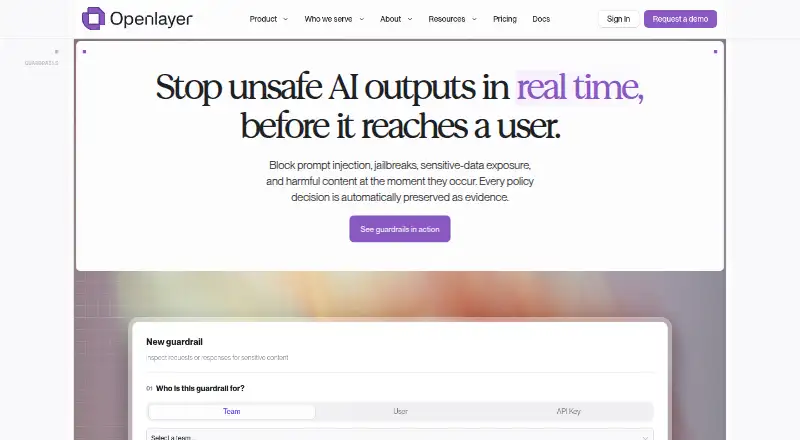
Openlayer Guardrails inspects live AI inputs and outputs and can block, redact, escalate, or send policy violations for review. It targets prompt injection, jailbreak attempts, exposure of personally identifying or health information, and harmful or toxic content. Openlayer says it can detect and block more than 50 PII and PHI entity types inline. Teams can configure which sensitive-data categories to block and which topics an assistant should avoid. Guardrails are commonly applied through the Gateway, or directly through the SDK, and the product connects through SDKs, framework integrations, a network-level gateway, a CLI, and a REST API. Each decision can be logged with its timestamp, system version, owner, trace, and reason for blocking. Openlayer says this activity contributes compliance evidence and names the EU AI Act, ISO/IEC 42001, NIST AI RMF, and OSFI E-23. Deployment options include customer VPC and air-gapped environments; on-premise deployment is available on Enterprise. Basic is free but limited to one member, five projects, one inference pipeline per project, 20,000 logs per month, 20 tests per project, one workspace, and three months of data retention.
Good
- Can block, redact, escalate, or route policy violations.
- Detects over 50 PII and PHI entity types inline.
- Decision records include traces and blocking reasons.
- Supports customer VPC and air-gapped deployment.
- Basic plan includes 20 tests per project.
Watch out
- Basic allows one member and five projects.
- Basic limits logs to 20,000 per month.
- Basic data retention is three months.
- Enterprise pricing is custom.
Who it suits
Openlayer Guardrails suits engineering, AI, security, compliance, and finance teams that need runtime controls for AI inputs and outputs. The listed use cases include regulated fields such as healthcare and financial services.
Verdict
Openlayer Guardrails offers configurable runtime checks and records the reasons behind decisions. The free Basic plan has defined member, project, log, and retention limits; Enterprise pricing is custom.
Plans and prices
From Openlayer Guardrails's own pricing page, checked 21 Oct 2026.
| Plan | Price | What it gives you |
|---|---|---|
| Basic | Free | 1 member · 5 projects · 1 inference pipeline per project · 20,000 inference logs/month · 20 tests/project · 3-month retention · CLI, SDK and API · community support |
| Enterprise | Priced on request | Unlimited members/projects/tests · custom inference volume · team access controls · on-premise deployment · explainability · SAML SSO · 99.99% SLA · white-glove onboarding · advanced support |
The facts
Each one read from Openlayer Guardrails's own pages, with the date it was checked.
What it does
- Audit evidence
- Each policy evaluation and enforcement result is recorded with decision evidence for later audit use.checked 21 Oct 2026
- Changelog update
- The 2026 changelog describes a remote OAuth-protected MCP connector usable from Claude Code and claude.ai.checked 21 Oct 2026
- Compliance evidence
- Openlayer says guardrail activity feeds into compliance evidence, and its page names the EU AI Act, ISO/IEC 42001, NIST AI RMF, and OSFI E-23.checked 4 Oct 2026
- Data retention
- Basic retention is three months, while Enterprise retention can be customized.checked 21 Oct 2026
- Deployment options
- Openlayer supports customer VPC, on-premise and air-gapped deployment options for enterprise use.checked 21 Oct 2026
- Encryption and availability
- The security page states 99.9% platform availability, AES-256 encryption at rest and TLS 1.2 or higher in transit.checked 21 Oct 2026
- Evidence logging
- Each guardrail decision can be recorded with a timestamp, system version, owner, supporting trace, and the reason a request or response was blocked.checked 4 Oct 2026
- Framework coverage
- Traffic routed through Openlayer can be protected regardless of the underlying AI framework or model provider.checked 21 Oct 2026
- Funding and accelerator
- Y Combinator lists Openlayer as a Summer 2021 company based in San Francisco and identifies it as active.checked 21 Oct 2026
- Gateway and SDK enforcement
- Guardrails can be enforced through Openlayer Gateway or applied directly through the SDK.checked 21 Oct 2026
- Harmful-output filtering
- Configurable policies can block toxic, harmful and malicious generated content inline.checked 21 Oct 2026
- Identity controls
- Security features include RBAC, Google SSO, SAML, OIDC and directory synchronization.checked 21 Oct 2026
- Integrations
- Openlayer advertises SDKs, a network gateway, CLI, REST API, Git, OpenTelemetry and Snowflake connectivity.checked 21 Oct 2026
- Intended users
- Openlayer says engineering, AI, security, compliance, and finance teams use the platform, including in regulated industries such as healthcare and financial services.checked 4 Oct 2026
- Java SDK
- The official Java library is generated for the Openlayer REST API, supports Java 8 or later and is installable through Maven or Gradle.checked 21 Oct 2026
- Legal entity
- The privacy policy identifies Unbox Inc. as the legal entity doing business as Openlayer.checked 21 Oct 2026
- Limit: Basic collaboration
- The Basic plan is limited to one member, which constrains free-team collaboration.checked 21 Oct 2026
- Limit: Basic retention
- The Basic plan retains data for only three months.checked 21 Oct 2026
- Limit: Enterprise gating
- On-premise deployment, explainability and SAML SSO are reserved for Enterprise customers.checked 21 Oct 2026
- Notable limits
- The Basic plan is limited to one member, five projects, one inference pipeline per project, 20,000 inference logs per month, and one workspace.checked 4 Oct 2026
The company
- Company founding
- LinkedIn lists Openlayer as founded in 2021.checked 21 Oct 2026
- Company headquarters and size
- LinkedIn lists San Francisco, California headquarters and a company size of 11–50 employees.checked 21 Oct 2026
- Founded
- 2021checked 28 Sep 2026
Where it runs
- Evaluation platform
- Openlayer combines pre-release testing, production monitoring and runtime policy enforcement in one platform.checked 21 Oct 2026
The full review of Openlayer Guardrails
Openlayer Guardrails is a runtime policy layer for applications that send requests to AI models. It is best suited to teams that need configurable checks and decision records across live traffic. Its free plan is useful for a tightly scoped evaluation, but its single-member limit makes it a poor fit for a shared production workflow.
Overview
Guardrails can block, redact, escalate, or send policy violations for review as an application processes AI inputs and outputs. Teams can set which sensitive-data categories to block and which topics an assistant should avoid, so enforcement can reflect their own policies rather than a single fixed rule set.
Its checks target prompt injection, jailbreak attempts, PII and PHI exposure, and harmful or toxic content. Openlayer says it detects and blocks more than 50 PII and PHI entity types inline. That breadth is relevant to teams handling sensitive information, but it does not remove the need to decide which categories and topics their policies should cover.
Key features
Teams can enforce guardrails through the Gateway or apply them directly with the SDK. SDKs, framework integrations, a CLI, and a REST API provide additional ways to connect; the network-level Gateway is designed to work across LLM providers. This flexibility suits teams with varied integration needs, while the enforcement point still needs to fit their application architecture.
Each decision can include a timestamp, system version, owner, supporting trace, and reason for a block. Openlayer says this activity feeds compliance evidence and names the EU AI Act, ISO/IEC 42001, NIST AI RMF, and OSFI E-23. Those records can help teams explain and investigate policy decisions; they are not a substitute for their own compliance work.
Deployment options include a customer's VPC and air-gapped environments, with on-premise deployment reserved for Enterprise. Openlayer states that it has SOC 2 Type II certification and GDPR compliance, supports HIPAA-aligned use cases, and encrypts data at rest with AES-256 and in transit with TLS 1.2 or higher. These provisions may suit organizations with deployment or security constraints, though the on-premise option requires Enterprise.
Pricing
The freemium model starts with Basic at free. It includes one member, one workspace, five projects, one inference pipeline per project, 20,000 inference logs per month, 20 tests per project, three months of data retention, and community support through Discord. This is enough to assess the product on a small footprint, but the member, project, pipeline, and log caps constrain wider evaluation and ongoing team use.
Enterprise has custom pricing and includes unlimited members and projects, custom inference pipelines and logs, unlimited tests, custom data retention, SAML SSO, on-premise deployment, white-glove onboarding, and direct Slack access to Openlayer's team. It is the relevant tier for organizations that need those deployment or access controls and room to scale; teams without those requirements may find Basic's strict caps a limiting ceiling.
Platforms
Openlayer Guardrails is available through API, self-hosted, and web options. Its hybrid deployment model and Gateway, SDK, and integration routes give teams choices for fitting enforcement into their setup, while on-premise deployment is an Enterprise feature.
Who it's for
Openlayer says engineering, AI, security, compliance, and finance teams use the platform, including in healthcare and financial services. Guardrails is a stronger fit for organizations that need to govern live model traffic and preserve decision evidence than for an individual looking for a standalone prompt filter. Basic's one-member cap is especially restrictive for cross-functional evaluation; Enterprise is better suited to a team that needs shared access or custom deployment.
Pros and cons
- Pros: Policies can be tailored to sensitive-data categories and prohibited topics, with inline detection for more than 50 PII and PHI entity types.
- Pros: Decision records can retain the reason, trace, owner, timestamp, and system version, supporting investigation and compliance evidence.
- Pros: Gateway, SDK, framework, CLI, and REST API connections offer multiple integration paths, and the Gateway is designed for use across LLM providers.
- Cons: Basic allows only one member and one workspace, with five projects and 20,000 inference logs per month, limiting collaboration and scale.
- Cons: On-premise deployment, SAML SSO, custom retention, and advanced support require custom-priced Enterprise.
Alternatives
PromptGuard is worth considering for teams that want a freemium option with API, extension, desktop, self-hosted, and web platforms. Its Free plan allows 20,000 scans a month, one API key, one project, and 24-hour log retention; Team costs $19 a month.
Prompt Inspector offers a free plan with 1,000 detections per month, a REST API, SDK, and MCP. It may suit a smaller detection workload where those connection options meet the need.
NVIDIA NeMo Guardrails is a free, open-source Python package for teams that prefer that model; external models and services may require separate setup.
Amazon Bedrock Guardrails is a paid, web-based option for readers considering that product instead.
GLACIS has a free account with no card required and setup described as taking about a minute, making it an alternative for readers who want to begin with a free account.
LLM Guard is free and open source, but its repository is archived and no longer actively developed or maintained.
CyberSecEval is a free open-source benchmark suite, a different option for readers seeking benchmarks rather than this product's runtime guardrails.
Sanctum Runtime is another alternative; its documentation describes an MIT-licensed repository and an open-core product.
For broader category comparisons, see LLM Security Tools and AI Governance Software.
Verdict
Openlayer Guardrails is a good fit for organizations that need configurable runtime controls across AI traffic and records that explain decisions. Its integration choices and detailed decision evidence are the main reasons to choose it; the single-member Basic plan and custom-priced Enterprise tier are the main reasons to look elsewhere, especially if a shared team workspace is essential from the outset.
Alternatives to Openlayer Guardrails
- 1
CognitiveView
Free planAndroidiOSWebAPI8.0Free plan - 2
ComplyLayer
Free planWebAPIExtension7.4From $99 a month - 3
Trusys AI
Free planWebAPISelf-hosted7.0From $69 a month - 4
Verisum
Free planWebAPI6.8From £129 a month - 5
AIGovernr
Web6.4From $79 a month - 6
Confir
Web6.3From €29 a month