OpenSecureAI Prompt Firewall
OpenSecureAI Prompt Firewall evaluates text before it reaches an LLM and applies a policy to allow, flag, or block it.
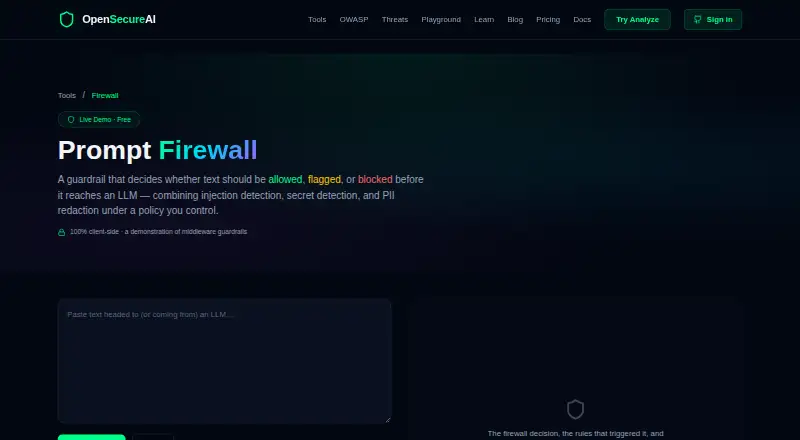
What OpenSecureAI Prompt Firewall is
OpenSecureAI Prompt Firewall evaluates text before it reaches an LLM and applies a policy to allow, flag, or block it. It combines prompt-injection detection with secret detection and PII redaction: injection or secrets trigger a block, while PII is redacted and flagged. The live firewall demonstration processes text entirely in the browser and says nothing is uploaded. Developers can also use the open-source, dependency-free engine as an npm package or CLI in applications and CI. The CLI reads files or standard input and can return a nonzero exit code when findings meet a selected threshold. The middleware can be applied to model inputs and outputs. An API key adds hosted detections for obfuscation or encoding evasions, indirect injection, tool abuse, multilingual overrides, and de-obfuscation. The Free plan is $0/month and includes 2,000 API requests monthly; Pro is $49/month and includes 50,000 requests monthly. The product is positioned for AI application teams shipping LLM features and developers building agents.
Good
- Combines injection and secret detection with PII redaction.
- CLI can scan files or standard input.
- Can be used on model inputs and outputs.
- Core engine and npm packages are open source.
Watch out
- Free plan includes 2,000 API requests per month.
- Hosted evasion detections require an API key.
- Team features and SLA are listed as planned.
Who it suits
Prompt Firewall may suit AI application teams preparing LLM features for production and developers building agents. Developers can use the npm package or CLI in applications and CI, while the browser demonstration processes text client-side.
Verdict
Prompt Firewall offers policy-based text checks through a browser demonstration, npm package, and CLI. Hosted detection enhancements and higher request limits are on paid plans, with Pro listed at $49/month.
Plans and prices
From OpenSecureAI Prompt Firewall's own pricing page, checked 2 Oct 2026.
| Plan | Price | What it gives you |
|---|---|---|
| Free | Free | All in-browser tools and npm packages · 2,000 API requests/month · 30 requests/minute/key · Account-synced scan history · BYOK LLM Gateway · BYOK AI remediation · $0/month |
| Pro | $49 a month | Everything in Free · 50,000 API requests/month · 120 requests/minute/key · Hosted AI remediation and LLM Gateway completions · Priority email support · $49/month |
| Team | Priced on request | Everything in Pro · 250,000 API requests/month · 300 requests/minute/key · Team seats and SSO (planned) · Custom rules and SLA (planned) · Custom |
The facts
Each one read from OpenSecureAI Prompt Firewall's own pages, with the date it was checked.
What it does
- Audience
- The product is positioned for AI application teams shipping LLM features to production and for developers building agents.checked 2 Oct 2026
- CI integration
- The CLI can read files or stdin and return a nonzero exit code when findings meet a selected threshold.checked 2 Oct 2026
- Client-side processing
- The live firewall demonstration is 100% client-side and states that nothing is uploaded.checked 2 Oct 2026
- Credential handling
- OpenSecureAI states that gateway provider keys are never stored or logged.checked 2 Oct 2026
- Detection
- It combines prompt-injection detection, secret detection, and PII redaction under a user-controlled policy.checked 2 Oct 2026
- Developer use
- The same engine is available as the free @opensecureai/firewall npm package and CLI for application and CI use.checked 2 Oct 2026
- Hosted enhancements
- An API key unlocks hosted detections for obfuscation or encoding evasions, indirect injection, tool abuse, multilingual overrides, and de-obfuscation.checked 2 Oct 2026
- Inputs and outputs
- OpenSecureAI describes the firewall logic as middleware usable on both model inputs and model outputs.checked 2 Oct 2026
- Model integrations
- The LLM Gateway supports OpenAI, Anthropic, xAI, and Groq providers with bring-your-own-key operation.checked 2 Oct 2026
- Open source model
- The core engine and npm packages are open source and dependency-free.checked 2 Oct 2026
- Policy behavior
- Injection or secrets trigger a block, while PII is redacted and flagged.checked 2 Oct 2026
- Purpose
- Prompt Firewall decides whether text is allowed, flagged, or blocked before it reaches an LLM.checked 2 Oct 2026
- Scanning engines
- The firewall runs separate prompt-injection and PII/secrets engines over text before applying policy.checked 2 Oct 2026
- Security contact
- OpenSecureAI says it responds to responsible vulnerability reports within 48 hours.checked 2 Oct 2026
- Support
- The pricing page lists Community support for Free, Priority email support for Pro, and Priority plus SLA planned for Team.checked 2 Oct 2026
The company
- Founded
- 2026checked 28 Sep 2026
- Headquarters
- Global — Remote Firstchecked 28 Sep 2026
The full review of OpenSecureAI Prompt Firewall
OpenSecureAI Prompt Firewall is a text-screening layer for LLM applications, available as a browser demo and as a TypeScript package and CLI. It is best suited to developers who want an open-source policy engine they can run in an app or CI pipeline. Its strongest case is flexible, self-hostable screening; its main compromise is that broader hosted detections and higher quotas require Pro.
Overview
The firewall classifies text as allowed, flagged, or blocked using separate prompt-injection and PII/secrets engines, then applies a user-controlled policy. Injection and secrets trigger a block, while PII is redacted and flagged. Middleware can screen both model inputs and outputs, making it useful for teams that want one policy layer on either side of a model call.
The browser demonstration runs entirely on the client and says it uploads nothing. Developers can use the same dependency-free, open-source engine through the npm package or CLI. In CI, the CLI reads files or stdin and can fail a job with a nonzero exit code when findings meet a chosen threshold.
Key features
- Policy-based injection and privacy checks: Blocking injection and secrets while redacting and flagging PII gives teams a distinct response for sensitive data rather than treating every finding as a hard rejection. Custom policies let teams shape those decisions.
- Local package and CI workflow: The open-source TypeScript engine and CLI provide an option for teams that want screening in their own application or build pipeline. The core is dependency-free, but the hosted detection enhancements are not part of that local-only setup.
- Hosted detection enhancements: An API key unlocks detection for obfuscation or encoding evasions, indirect injection, tool abuse, multilingual overrides, and de-obfuscation. Those capabilities address more varied threat patterns, but they make the most advanced coverage dependent on hosted access.
- BYOK model gateway: The LLM Gateway supports OpenAI, Anthropic, xAI, and Groq with bring-your-own-key operation. OpenSecureAI says provider keys are neither stored nor logged.
Pricing
The Free plan costs nothing, billed $0/month. It includes the in-browser tools and npm packages, 2,000 API requests per month, 30 requests per minute per key, account-synced scan history, and the BYOK LLM Gateway and AI remediation. Community support is included. This is a reasonable starting point for individual development or modest usage, but the request ceiling and rate limit may constrain production traffic.
Pro costs $49 a month, billed $49/month. It raises the allowance to 50,000 API requests per month and 120 requests per minute per key, adds hosted AI remediation and LLM Gateway completions, and includes priority email support. It is the more practical fit for teams that need those hosted capabilities or a larger request budget; the higher quota does not remove the monthly price commitment.
Team has custom pricing. It includes everything in Pro and raises the allowance to 250,000 requests per month and 300 requests per minute per key. Team seats and SSO, plus custom rules and an SLA, are planned. The plan is aimed at larger deployments, but those planned capabilities should not be treated as current features.
Platforms
Prompt Firewall supports web and self-hosted deployment, with a hybrid deployment model. The browser demo offers a client-side way to examine text, while the package and CLI support application and CI use. TypeScript is the listed SDK language.
Who it's for
This is a good fit for AI application teams shipping LLM features and developers building agents who want an inspectable policy engine they can integrate into their own workflow. It is less compelling for users seeking broad hosted threat coverage without an API key, or for teams whose traffic quickly exceeds the Free plan's 2,000 monthly requests.
Pros and cons
- Pro: Open-source, dependency-free core can be used in applications and CI, giving developers more control over where the screening logic runs.
- Pro: Separate handling for injection, secrets, and PII supports blocking threats while redacting and flagging sensitive personal data.
- Pro: Middleware can check both inputs and outputs, so teams can apply the same policy at both stages.
- Con: Free API use is capped at 2,000 requests per month and 30 per minute per key, which can be limiting for production workloads.
- Con: Evasion, indirect-injection, tool-abuse, and multilingual detections require hosted access, making the local core less comprehensive for those risks.
- Con: Team seats, SSO, custom rules, and SLA are planned rather than current plan benefits.
Alternatives
For a broader category comparison, see AI Guardrail Software.
Choose PromptGuard if a larger free scan allowance matters more than Prompt Firewall's stated policy workflow: its free plan allows 20,000 scans a month, one API key, one project, and 24-hour log retention; Team costs $19 a month.
Enkrypt AI Guardrails is another freemium option, with an Explore plan offering 500 starting credits, 50 credits per month, seven-day data retention, and community support; Launch costs $149 a month.
Pick NVIDIA NeMo Guardrails if you want a free open-source Python package and are prepared to set up external models and services separately.
Fiddler Guardrails is an alternative for teams looking for real-time controls covering harmful exposure, hallucinations, toxicity, PII/PHI, prompt injection, and jailbreak attempts.
Amazon Bedrock Guardrails is a paid option with content-filter and denied-topic pricing at $0.15 a month for text filters and denied topics in Standard and Classic tiers.
Consider Openlayer Guardrails if its Basic plan's free starting allowance of 20,000 inferences per month, five projects, and one member better suits your evaluation workflow.
PII Firewall is a free, self-hosted Linux option built as an Apache 2.0 Python package, with a regex-only install that needs no ML dependencies.
CyberSecEval is a free, open-source benchmark suite rather than the policy firewall described here.
Verdict
Choose OpenSecureAI Prompt Firewall if you are a developer or AI application team that wants an open-source, self-hostable screening engine with a CLI for CI and policies that distinguish blocking from redaction. The main reason to look elsewhere is the gap between the local core and the hosted detection enhancements, alongside a Free API allowance that may be too small for sustained production use.
Alternatives to OpenSecureAI Prompt Firewall
- 1

PromptGuard
Free planWebAPIExtensionLinux7.9From $19 a month - 2
CyberSecEval
Free planOpen sourceWebAPILinuxmacOS7.5Free plan - 3

NVIDIA NeMo Guardrails
Free planOpen sourceAPILinuxmacOSSelf-hosted7.4Free plan - 4
Oracle Mobile Authenticator
Free planAndroidiOSWindows6.9Free plan - 5

Enkrypt AI Guardrails
Free planWebAPISelf-hosted6.8From $1,608 a year - 6
Google Cloud Secret Manager
Free planWeb6.5From $0.02 a month