Open Cluster Management
Open Cluster Management (OCM) is an open-source project for managing Kubernetes applications across multiple clusters and cloud environments.
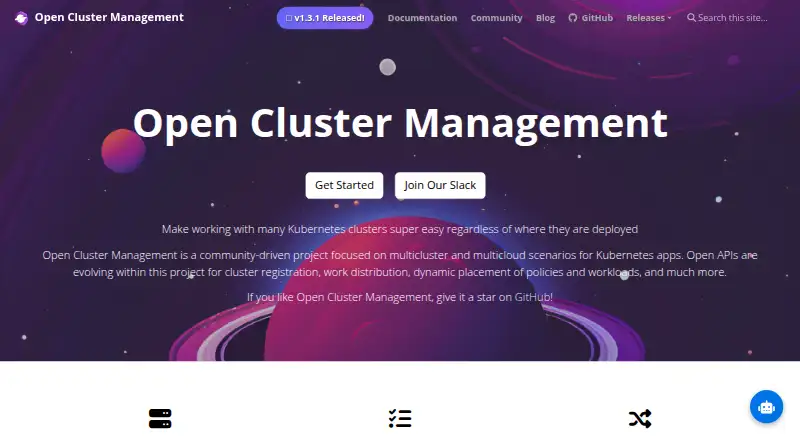
What Open Cluster Management is
Open Cluster Management (OCM) is an open-source project for managing Kubernetes applications across multiple clusters and cloud environments. It registers clusters with a hub, where its Work API applies Kubernetes resources to managed clusters and its Placement API chooses clusters for content and behavior. OCM uses a hub-and-spoke design: the core control plane runs on the hub, while a klusterlet agent on each managed cluster pulls instructions. Registration needs approval from administrators on both sides and establishes an mTLS connection. The work agent retrieves resources from its dedicated hub namespace, so managed-cluster credentials do not need to be kept on the hub. Prebuilt policy and configuration controllers can audit or enforce declared policies. A built-in application-management add-on uses Argo CD for declarative GitOps lifecycle management. OCM supports Kubernetes clusters on GKE, EKS, and AKS, as well as local kind and on-premises environments. It is a CNCF sandbox project, licensed under Apache License 2.0, and is free to use.
Good
- Free and open source under Apache License 2.0
- Work and Placement APIs distribute and target resources
- Policy controllers can audit or enforce declared policies
- Argo CD supports application lifecycle management
- Supports cloud, local, and on-premises Kubernetes clusters
Watch out
- Requires a hub and an agent on each managed cluster
- Cluster registration requires approval from administrators on both sides
- Production and other Kubernetes setups need separate guides
Who it suits
OCM suits teams managing Kubernetes applications and policies across multiple clusters or environments. It may also suit developers who want to extend multicluster workflows through its listed integrations and APIs.
Verdict
Open Cluster Management brings cluster registration, resource placement, policy controls, and application lifecycle management into a hub-and-spoke model. Its setup involves a hub and managed-cluster agents, so it is intended for multicluster Kubernetes operations rather than a single standalone application.
The facts
Each one read from Open Cluster Management's own pages, with the date it was checked.
Where it runs
- Application lifecycle
- The built-in application management add-on uses Argo CD for declarative GitOps-based application lifecycle management across multiple Kubernetes clusters.checked 5 Oct 2026
What it does
- Architecture
- OCM uses a hub and spoke model, with a klusterlet agent on each managed cluster pulling instructions from the hub.checked 5 Oct 2026
- Argo CD integration
- The Argo CD integration uses OCM Placement to select managed clusters for application deployment.checked 5 Oct 2026
- Cluster inventory
- It registers multiple clusters to a hub cluster for management.checked 5 Oct 2026
- Content placement
- Its Placement API dynamically selects clusters for content and behavior across multiple clusters.checked 5 Oct 2026
- Credential handling
- The work agent pulls resources from its dedicated hub namespace, avoiding the need to store managed cluster credentials on the hub.checked 5 Oct 2026
- Deployment model
- Installation uses a hub cluster running the core control plane and a klusterlet agent on each managed cluster.checked 5 Oct 2026
- EKS support
- The documented EKS hub solution uses AWS IAM roles and supports managed clusters running on EKS.checked 5 Oct 2026
- Getting started
- The quick start sets up one hub and two managed clusters using clusteradm and kind, and asks users to consult separate guides for production or other Kubernetes distributions.checked 5 Oct 2026
- Installation
- Installation involves putting the core control plane on a hub cluster and the klusterlet agent on each managed cluster.checked 5 Oct 2026
- Integrations
- The project lists integrations with Argo CD, Argo Workflows, Cluster API, Clusternet, Fluid, Flower, Helm, Istio, KubeStellar, KubeVela, Kueue, Meshery, OpenTelemetry, RamenDR, and Submariner.checked 5 Oct 2026
- License
- The project is licensed under Apache License 2.0.checked 5 Oct 2026
- Policy and configuration
- Policy and configuration management uses labels to deploy policies and control consistently across resources, and supports access control, quota, and cost management.checked 5 Oct 2026
- Policy management
- Prebuilt security and configuration controllers can audit or enforce declared policies across managed clusters.checked 5 Oct 2026
- Project status
- Open Cluster Management is a Cloud Native Computing Foundation sandbox project.checked 5 Oct 2026
- Purpose
- Open Cluster Management is a community-driven project for multicluster and multicloud scenarios for Kubernetes applications.checked 5 Oct 2026
- Security
- Cluster registration requires approval from both hub and managed cluster administrators and creates an mTLS connection.checked 5 Oct 2026
- Security reporting
- The community welcomes responsible disclosure of security vulnerabilities.checked 5 Oct 2026
- VS Code extension
- The VS Code extension offers OCM resource snippets, local environment creation, and a cluster resource monitoring view; its documented minimum VS Code version is 1.71.0.checked 5 Oct 2026
- Work distribution
- Its Work API lets a hub apply Kubernetes resources to managed clusters.checked 5 Oct 2026
Alternatives to Open Cluster Management
- 1
Kyverno
Free planOpen sourceWebAPILinuxmacOS7.7Free plan - 2

CGPulse
Free planWebAPI7.3From €99 a month - 3

OmniGCloud
Free planWebAPISelf-hosted7.3From $39 a month - 4

Open Policy Agent Gatekeeper
Free planOpen sourceAPILinuxSelf-hosted7.2Free plan - 5
Google Cloud Organization Policy
Free planWebAPILinuxmacOS7.1Free plan - 6

Powerpipe
Free planWebLinuxmacOSSelf-hosted7.1Free plan