OER Commons
OER Commons is a free web-based library where educators can find open educational resources and collaborate around their use, evaluation, and improvement.
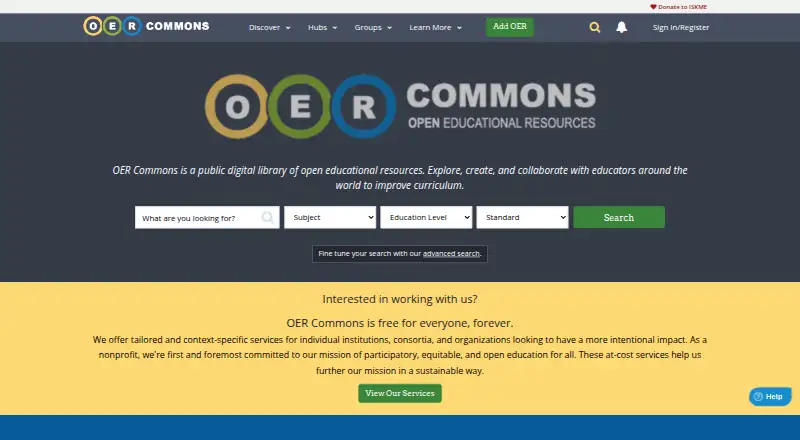
What OER Commons is
OER Commons is a free web-based library where educators can find open educational resources and collaborate around their use, evaluation, and improvement. It serves K–12 and higher education educators, librarians, and homeschooling parents. A free account provides access to the library, Open Author for creating or publishing resources, groups, collaboration tools for curating or remixing content, and a personal profile for saved resources. Organizations can use Hubs to organize collections, manage content, and facilitate conversations. Custom microsites can have independent libraries and domains, tailored metadata and content creation, and analytics dashboards. Open Author includes an accessibility checker, requires alt text for embedded images, and automatically captions videos uploaded to a resource. ISKME offers data and API integration services for learning management systems, while its tools can receive and provide harvestable content feeds in Dublin Core, IEEE Learning Object Metadata, and RSS. Accessibility audits have been completed, with another review underway, but authors and users remain responsible for accessibility; many indexed materials are hosted elsewhere. Resources made with the legacy Open Author 1 editor are scheduled for removal on December 31, 2026; Open Author 2 resources are unaffected.
Good
- Free account includes Open Author and groups.
- Hubs support collection management and conversation.
- Open Author provides an accessibility checker.
- Tools support Dublin Core, IEEE LOM, and RSS feeds.
Watch out
- Legacy Open Author 1 resources are scheduled for removal December 31, 2026.
- Authors and users are responsible for resource accessibility.
- Many indexed resources are hosted by external providers.
Who it suits
OER Commons suits educators, librarians, and homeschooling parents looking for open learning materials. Organizations can also use its hubs and microsites to curate and share collections.
Verdict
OER Commons combines a free resource library with tools for creating, curating, and sharing materials. Check the editor version and accessibility of resources you plan to rely on.
Plans and prices
From OER Commons's own pricing page, checked 30 Sep 2026.
| Plan | Price | What it gives you |
|---|---|---|
| OER Commons free account | Free | Access the digital library · Open Author · Create groups · Collaborate to curate or remix content · Save resources to a personal profile |
The facts
Each one read from OER Commons's own pages, with the date it was checked.
What it does
- Accessibility
- Open Author includes an accessibility checker, requires alt text for embedded images, and automatically captions videos uploaded to an Open Author resource.checked 30 Sep 2026
- Accessibility responsibility
- ISKME states that authors and users are responsible for ensuring resources meet accessibility requirements, and that many indexed resources are hosted by external providers.checked 30 Sep 2026
- Accessibility review
- ISKME says it has completed two full platform accessibility audits meeting WCAG 2.1 AA standards and is conducting another review.checked 30 Sep 2026
- Audience
- The library serves K–12 and higher education educators, librarians, and homeschooling parents.checked 30 Sep 2026
- Hubs
- Hubs let organizations develop collections, manage content, facilitate conversations, and share information about their work.checked 30 Sep 2026
- Legacy content limit
- OER Commons says it will remove resources created in the legacy Open Author 1 editor on December 31, 2026; Open Author 2 resources are not affected.checked 30 Sep 2026
- LMS integration
- ISKME offers data integration and API integration services to connect OER Commons with learning management systems.checked 30 Sep 2026
- Metadata formats
- ISKME says its tools can receive OER feeds in Dublin Core, IEEE Learning Object Metadata, and RSS, and provide targets for harvesting content in those formats.checked 30 Sep 2026
- Microsites
- Custom microsites can have independent libraries and domains, tailored metadata and content creation, and analytics dashboards.checked 30 Sep 2026
- Open Author
- A free account enables users to create or publish open educational resources using tools such as Open Author.checked 30 Sep 2026
- Purpose
- OER Commons is an openly accessible digital library for educators to find high-quality open educational resources and collaborate around their use, evaluation, and improvement.checked 30 Sep 2026
- Support
- ISKME provides content curation by digital librarians and directs organizations to contact [email protected] about product and service offerings.checked 30 Sep 2026
The company
- Founded
- 2007checked 23 Sep 2026
- Maker
- OER Commons was created by ISKME, which describes itself as a global nonprofit.checked 30 Sep 2026
The full review of OER Commons
OER Commons is a resource library and authoring platform for educators, librarians, and homeschooling parents. It is especially well suited to people who want to adapt, publish, and curate open materials with others. Its free account makes that collaborative workflow accessible, though organizations seeking a tailored site or LMS connection may need additional services.
Overview
Created by the global nonprofit ISKME in 2007, OER Commons brings together digital and print resources for learners from birth through graduate and professional study, across subjects ranging from applied science to arts and humanities, business and communication, and career and technical education. Formats include PDF, DOCX, ODF, Google Docs, video, images, and textbooks. Editable files and school licensing are supported, with a mixed access model.
This is more than a download library: an account also supports creating and publishing resources, forming groups, and collaborating on curation or remixing. That makes it a stronger fit for educators who want to adapt and share materials than for those looking only for a ready-made set of classroom worksheets.
Key features
Authoring and collaboration
Open Author lets account holders create or publish open educational resources, while groups support collaborative curation and remixing. These tools are useful when educators want to build or improve materials together rather than keep resources in isolated folders.
Organizational collections
Hubs let organizations develop collections, manage content, host conversations, and share information about their work. Organizations that need a more distinct presence can use custom microsites with independent libraries and domains, tailored metadata and content creation, and analytics dashboards. Those options provide more structure than an individual account, but they are aimed at organizations rather than casual users.
Integration and accessibility
ISKME offers data and API integration services to connect OER Commons with learning management systems. Its tools can receive OER feeds and provide harvesting targets in Dublin Core, IEEE Learning Object Metadata, and RSS formats, which is relevant to organizations maintaining or exchanging resource catalogs.
Open Author includes an accessibility checker, requires alt text for embedded images, and automatically captions videos uploaded to an Open Author resource. ISKME says it has completed two full platform accessibility audits meeting WCAG 2.1 AA standards and is conducting another review. That platform work does not guarantee that every resource is accessible: authors and users remain responsible, and many indexed resources are hosted by external providers.
Content continuity
Resources created in the legacy Open Author 1 editor are scheduled for removal on December 31, 2026; Open Author 2 resources are unaffected. Anyone relying on older authored materials should account for that deadline and preserve or recreate affected resources before then.
Pricing
The OER Commons free account costs nothing. It includes access to the digital library, Open Author, groups, collaborative curation or remixing, and the ability to save resources to a personal profile. For individual educators, this is a substantial set of creation and collaboration tools without a paid entry tier to weigh against it.
ISKME also provides digital-librarian content curation and invites organizations to contact [email protected] about product and service offerings. Custom microsites and integration services are organizational options; the free account's stated inclusions do not promise those services.
Platforms
OER Commons is web-based. Its supported resource formats span documents, Google Docs, video, images, and textbooks, so the library can accommodate more than one kind of teaching material.
Who it's for
K–12 and higher education educators, librarians, and homeschooling parents are the core audience. Educators who value editable resources and collaborative remixing will get more from the account than users who only need a single ready-to-use item. Organizations managing collections or connecting catalogs to an LMS may find Hubs, microsites, and integration services more relevant. It is a less straightforward choice for anyone who needs every indexed resource to meet a consistent accessibility standard, since external-hosted materials and author-created resources still require scrutiny.
Pros and cons
- Pros: The free account includes authoring, groups, collaboration, and personal saving as well as library access, making it practical for educators who want to adapt and share materials.
- Pros: Hubs and customizable microsites give organizations options for managed collections and a more independent web presence.
- Pros: Open Author's accessibility checker, alt-text requirement, and automatic captions support more accessible creation workflows.
- Cons: Accessibility of the wider library is not assured; users and authors remain responsible, and many resources come from external providers.
- Cons: Legacy Open Author 1 resources face a December 31, 2026 removal deadline, requiring action from people who depend on them.
- Cons: LMS integration and organizational services are offered by ISKME, rather than included among the stated free-account features.
Alternatives
For another web-based free resource library aimed at preK–12 educators and students, choose PBS LearningMedia; its features require a free account. Share My Lesson is another free, web-based option when a different educator resource destination is preferred.
Tes Resources suits users who want a marketplace where authors decide whether to charge for materials; joining is free, while individual paid resources are available. Classroom Secrets may suit someone who wants a paid monthly option for one user, with its Flexible Monthly plan at $6.56 a month, billed every 30 days.
Twinkl is worth considering for users who want Android, iOS, and web access and a membership with unlimited downloads; its listed membership is $7.49 a month, and a free trial is offered. Teach Starter distinguishes a free tier with non-editable resources and downloads limited to its free collection from a paid Plus plan at $6.08 a month, billed $73 billed yearly; it is a better fit when that tier structure matches the user's needs.
CommonLit is a more focused choice for teachers and students seeking its free text library and CommonLit 360 curriculum; its Spark plan is $4,200 a year for a school. Teachit is another web option with a free tier and a paid subscription for readers who prefer that service.
For broader discovery, browse Teacher Resource Libraries or Open Educational Resource Platforms.
Verdict
Choose OER Commons if you want a free, collaborative home for finding, creating, and adapting open educational materials, especially across an organization or teaching community. Its combination of library access and authoring makes it more useful than a passive catalog for that work. Look elsewhere if you need an assured accessibility level across every resource, or if your priority is a polished, ready-made collection rather than a platform for curation and remixing.
Alternatives to OER Commons
- 1

OpenStax
Free planAndroidiOSWebAPI7.9Free plan - 2

DIKSHA
Free planOpen sourceAndroidiOSWebAPI7.8Free plan - 3
CK-12 FlexBook 2.0
Free planAndroidiOSWebExtension7.6Free plan - 4

Pressbooks
Open sourceWebAPILinuxSelf-hosted7.5From $120 a year - 5
LibreTexts
Free planAndroidiOSWeb7.4From $1,250 a year - 6

African Storybook
Free planAndroidiOSWeb7.3Free plan