LibreTexts
LibreTexts is an open education platform for creating, adapting, and sharing learning materials, including interactive textbooks and homework.
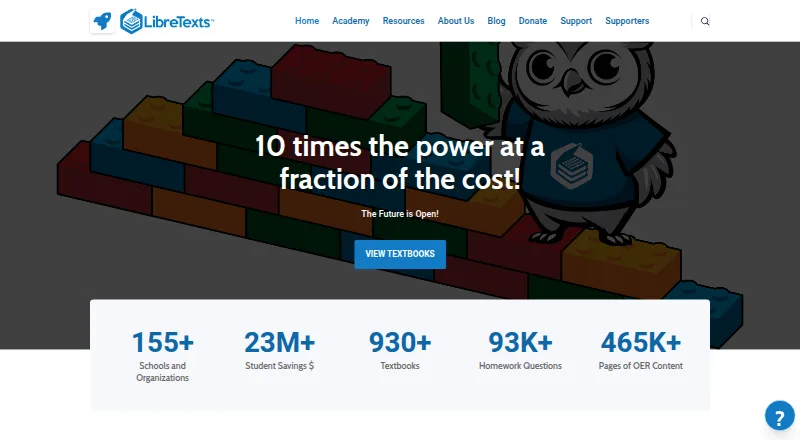
What LibreTexts is
LibreTexts is an open education platform for creating, adapting, and sharing learning materials, including interactive textbooks and homework. Its libraries span 17 subject fields and contain more than 2,000 textbooks; instructors can remix chapters to build custom books. Pages can incorporate Jupyter Notebooks, ADAPT questions, 3D visualizations, and videos. ADAPT supports formative and summative assessment and includes a shared bank of more than 240,000 openly licensed elements. LibreTexts can be embedded in institutional learning management systems, with optional exchange of grades and assessment data. Guides cover imports to Canvas, Moodle, and D2L, and mention Blackboard support. Book pages may offer PDF, EPUB, and editable downloads. Educators can create, adapt, and host open educational resources at no charge. The platform is available on the web, Android, and iOS, with offline access and annotation tools. A free plan is available; the listed starting paid rate is $15/mo. Support includes tickets, webinars, office hours, and Academy lessons.
Good
- Remix chapters from over 2,000 textbooks.
- ADAPT offers more than 240,000 question elements.
- Supports LMS embedding and optional grade exchange.
- Books may be downloaded in PDF or EPUB.
- Free support tickets, webinars, and office hours.
Watch out
- Security policy cannot guarantee protection from unauthorized disclosure.
- Free core plan allows up to five custom textbooks per institution.
- Some consortium memberships are listed at $1,250 or $2,500 per year.
Who it suits
LibreTexts suits educators who want to create or adapt open learning materials, and institutions seeking textbook and homework resources that can connect with an LMS. Students and instructors can access materials on web and mobile devices, including offline.
Verdict
LibreTexts brings open textbooks, assessment, and authoring tools together, with LMS connections and downloadable books. Check the limits and consortium options if an institution needs expanded access.
Plans and prices
From LibreTexts's own pricing page, checked 29 Sep 2026.
| Plan | Price | What it gives you |
|---|---|---|
| LibreTexts core platform | Free | Textbook access, instructor ADAPT access, general use textbooks, H5P and ADAPT authoring free · Up to 5 custom textbooks per institution |
| All-Access | Free | Per student, unlimited courses · ADAPT Homework, Jupyter Hub, and The Forge · 30$/ 6 months |
| Jupyter Hub | Free | Per student, unlimited courses · Collaborative notebooks for coding courses · 15$/ 6 months |
| ADAPT | Free | Per student, unlimited courses · California institutions: free · 15$/ 6 months |
| The Forge | Free | Per student, unlimited courses · Student writing platform with word processor, slide decks, spreadsheets, and process analytics · 15$/ 6 months |
| LibreNet Consortium (affiliate) | $1,250 a year | Available only with full membership at the campus or system level · $1250/year, per campus |
| LibreNet Consortium (full) | $2,500 a year | Unlimited custom textbooks at an institution · Early access to new technologies · Branded Campus Commons page · Two Academy Online training seats · 2500$/ year |
The facts
Each one read from LibreTexts's own pages, with the date it was checked.
What it does
- Accessibility
- LibreTexts states a goal for its platform and features to meet or exceed Revised Section 508 Standards and WCAG 2.1 AA, and says it audits accessibility at major development milestones.checked 29 Sep 2026
- ADAPT
- ADAPT supports formative and summative assessment, including a shared question bank of more than 240,000 openly licensed elements.checked 29 Sep 2026
- Audience
- LibreNet membership is open to institutions in K-12 and higher education, while individual educators can use LibreTexts to create, adapt, and host OER free of charge.checked 29 Sep 2026
- Downloads
- LibreTexts book pages can provide downloads including PDF, EPUB, and editable file formats.checked 29 Sep 2026
- Interactive content
- Textbook pages can embed Jupyter Notebooks, ADAPT homework questions, 3D visualizations, and videos.checked 29 Sep 2026
- Libraries
- The site describes 17 subject field libraries and over 2,000 textbooks, with chapters that instructors can remix into custom textbooks.checked 29 Sep 2026
- LMS compatibility
- A LibreTexts guide describes importing books into Canvas, Moodle, and D2L using IMS Common Cartridge 1.1, and also mentions Blackboard support.checked 29 Sep 2026
- LMS integration
- LibreTexts says its platform and homework services can be embedded in institutional LMS platforms over a secure connection, with optional grade and assessment exchange.checked 29 Sep 2026
- Privacy
- LibreTexts says it does not accept advertising or sell, rent, or lease user lists to third parties, and it describes collection of voluntarily provided personal information and anonymous Google Analytics demographics.checked 29 Sep 2026
- Purpose
- LibreTexts is a nonprofit open education resource platform for creating, customizing, and sharing accessible, interactive textbooks, adaptive homework, and ancillary materials.checked 29 Sep 2026
- Security limitation
- The privacy policy says LibreTexts makes efforts to safeguard data but cannot guarantee protection against unauthorized disclosure.checked 29 Sep 2026
- Sign-in
- Users may sign in through their educational institution's Google Workspace or Microsoft Active Directory; the policy says those services share only the user's email with LibreTexts.checked 29 Sep 2026
- Support
- LibreTexts offers free support tickets, monthly webinars, weekly office hours, and free Academy lessons.checked 29 Sep 2026
The company
- Founded
- 2008checked 28 Sep 2026
- Headquarters
- Davis, California, United Stateschecked 28 Sep 2026
The full review of LibreTexts
LibreTexts is a nonprofit platform for finding, adapting, and creating open textbooks and course materials. It suits educators and institutions that want remixable resources, assessment, and LMS connections; its free core is compelling, though expanded institutional access can bring per-student or consortium costs.
Overview
LibreTexts brings together 17 subject libraries and more than 2,000 textbooks, with chapters instructors can combine into custom books. Educators can add assessment and interactive content rather than treating a textbook as a static file. Readers can download books in PDF, EPUB, and editable formats, which makes the platform useful both for course delivery and offline reading.
Its strongest case is for teaching teams building courses around open materials. Individual educators can create, adapt, and host OER free, while institutional LibreNet membership is open to K–12 and higher education. The trade-off is that some services and expanded institutional capabilities have per-student or campus-level charges.
Key features
Assessment and interactive materials
ADAPT supports formative and summative assessment, backed by a shared bank of more than 240,000 openly licensed question elements. Textbook pages can also incorporate Jupyter Notebooks, ADAPT questions, 3D visualizations, and video. That mix gives instructors ways to connect reading with practice, but courses that need the full suite should account for the relevant paid plans.
LMS, access, and support
LibreTexts can be embedded in institutional LMS platforms over a secure connection, with optional exchange of grades and assessment. Its import guide covers Canvas, Moodle, and D2L through IMS Common Cartridge 1.1, and also mentions Blackboard support. Users can sign in through an institution’s Google Workspace or Microsoft Active Directory; those services share only the user’s email with LibreTexts.
Free support tickets, monthly webinars, weekly office hours, and Academy lessons offer educators several routes to help. LibreTexts states an accessibility goal aligned with Revised Section 508 Standards and WCAG 2.1 AA, with audits at major development milestones. Its privacy policy says it does not accept advertising or sell, rent, or lease user lists; it describes collection of voluntarily provided information and anonymous Google Analytics demographics. It also cautions that it cannot guarantee protection against unauthorized disclosure.
Pricing
The core platform is free and includes textbook access, instructor ADAPT access, general-use textbooks, H5P and ADAPT authoring, and up to five custom textbooks per institution. That cap makes the free tier a practical starting point, but institutions building more than five custom books need another arrangement.
ADAPT, The Forge, and Jupyter Hub each show free access alongside a charge of $15 per student per six months for unlimited courses; California institutions get ADAPT free. The Forge adds a writing platform with a word processor, slide decks, spreadsheets, and process analytics. Jupyter Hub is for collaborative coding-course notebooks. All-Access costs $30 per student per six months for unlimited courses and combines ADAPT Homework, Jupyter Hub, and The Forge. These student-based options suit course deployments that need those tools, but cost more than the core platform as student participation grows.
LibreNet affiliate membership costs $1,250 per campus per year and is available only with full membership at the campus or system level. Full membership costs $2,500 per year and includes unlimited custom textbooks at an institution, early access to new technologies, a branded Campus Commons page, and two Academy Online training seats. The annual campus pricing is aimed at institutions seeking a broader commitment rather than an individual educator’s free OER use.
Platforms
LibreTexts supports Android, iOS, and web. Downloadable PDF, EPUB, and editable book formats support offline use; the platform also offers annotation tools, institutional administration, and read-aloud support.
Who it's for
LibreTexts is best suited to educators and institutions that want open, adaptable course texts and can benefit from integrated assessment or LMS delivery. It is also useful for individual educators who want to create or adapt OER without paying for the core platform. Readers looking only for a conventional purchased eTextbook may prefer a dedicated bookstore or textbook reader instead.
Pros and cons
- Pros: A large, subject-organized open library gives instructors a substantial base for custom books without starting from scratch.
- Pros: ADAPT, interactive embeds, and LMS connections bring reading, practice, and course delivery into one platform.
- Pros: Free core access and downloadable formats make it accessible to educators and readers who need offline copies.
- Cons: The free core limits each institution to five custom textbooks, which can constrain broader course adoption.
- Cons: Expanded tools carry per-student charges, while consortium membership adds annual campus costs.
- Cons: LibreTexts acknowledges it cannot guarantee protection from unauthorized disclosure, a consideration for institutions assessing data risk.
Alternatives
For a purchased eTextbook reader with Android, iOS, Mac, web, and Windows support, consider VitalSource Bookshelf; its app is free to install, though content may require purchase or an active license, and its plan permits two computers and two mobile devices.
DIKSHA is a free Android, iOS, and web option built on MIT-licensed Sunbird technology. BibliU offers an institutional Universal Learning plan charged as a flat fee per student per text, with institutions charged for course sections using content. Kortext has a free plan and institutional pricing tailored to needs and budget.
Cambridge Aspire is a paid option with a three-month Instructor eTextbook Collection trial. KITABOO has a $1 per user per month Lite plan, billed monthly, for up to 1,000 active users, 30 titles, and 200 GB storage. Opiq is another freemium option, while eLibro offers institutional subscriptions by quote from a country representative. For broader comparisons, see Digital Textbook Platforms and Open Educational Resource Platforms.
Verdict
Choose LibreTexts if you are an educator or institution building courses around open textbooks and want assessment, interactive materials, and LMS delivery in the same ecosystem. The free core and remixable library are its strongest reasons to start; look elsewhere if you need a straightforward commercial eTextbook catalog or cannot accommodate per-student and campus membership costs for expanded access.
Getting started
- Visit https://libretexts.org/
- Use the web, Android, or iOS platform
- Sign in through an educational institution's Google Workspace or Microsoft Active Directory
- Use free educator access to create, adapt, or host OER
- Review student service and consortium plans if you need paid options
Limits worth knowing
The free core platform allows up to five custom textbooks per institution. ADAPT and several other services have paid plans; the listed starting paid rate is $15/mo.
Questions
Is LibreTexts free?
Yes. Individual educators can create, adapt, and host OER free of charge, and the core platform has a free plan. Paid options are also available.
What does the free core platform include?
It includes textbook access, instructor ADAPT access, general-use textbooks, and free H5P and ADAPT authoring. It is limited to up to five custom textbooks per institution.
What platforms can I use?
LibreTexts is listed for web, Android, and iOS. It also supports offline access and annotation tools.
Can LibreTexts work with an LMS?
The platform and homework services can be embedded in institutional LMS platforms over a secure connection, with optional grade and assessment exchange. Guides describe Canvas, Moodle, and D2L imports, and mention Blackboard support.
What accessibility and privacy practices does LibreTexts describe?
LibreTexts aims to meet or exceed Revised Section 508 and WCAG 2.1 AA standards and audits accessibility at major development milestones. It says it does not accept advertising or sell, rent, or lease user lists to third parties.
What is the starting paid rate?
The listed starting paid rate is $15/mo. Plans include student services and institutional LibreNet consortium memberships.
Alternatives to LibreTexts
- 1

OpenStax
Free planAndroidiOSWebAPI7.9Free plan - 2

DIKSHA
Free planOpen sourceAndroidiOSWebAPI7.8Free plan - 3
CK-12 FlexBook 2.0
Free planAndroidiOSWebExtension7.6Free plan - 4
VitalSource Bookshelf
Free planAndroidiOSWebmacOS7.4Free plan - 5
ePathshala
Free planAndroidiOSWebWindows7.3Free plan - 6

Top Hat
AndroidiOSWeb7.2