
African Storybook
African Storybook is a free initiative that develops and publishes picture storybooks in African languages to support children’s literacy, enjoyment, and ima…
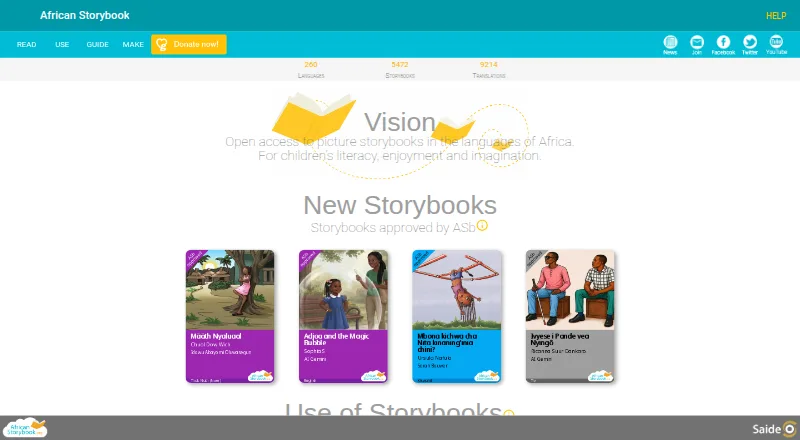
What African Storybook is
African Storybook is a free initiative that develops and publishes picture storybooks in African languages to support children’s literacy, enjoyment, and imagination. Its stories and tools are intended for children aged two to ten, including early childhood and the first three years of primary school. Families can use the free Reader app to access stories offline, and the Maker app lets users create books offline on a phone or tablet and publish them to the website when connected. Website tools support creating, translating, and adapting storybooks; readers can also download books for offline reading or print them. Stories may be read, copied, adapted, and translated without payment or permission, subject to attribution and any non-commercial restriction attached to a story. The site offers video and written guidance for using and developing picture books. Creating, adapting, or translating requires registration, and users must be at least 18 or have parent or guardian permission. African Storybook distinguishes ASb-approved titles from stories made on the site or in the Maker app that have not been checked.
Good
- Free Reader and Maker apps.
- Offline reading and story creation are supported.
- Stories can be downloaded or printed.
- Tools support translation and adaptation.
- Stories are openly reusable subject to stated restrictions.
Watch out
- Creating or adapting stories requires registration.
- Users must be 18 or have guardian permission.
- Some user-created stories are not checked.
- No free trial is listed.
Who it suits
African Storybook is for families and educators seeking picture books in African languages for children aged two to ten. Its creation tools also suit adults, or younger users with parent or guardian permission, who want to adapt or publish stories.
Verdict
African Storybook combines a free multilingual picture-book library with tools for creating and adapting stories. Check each story’s licensing restriction and review status before reuse.
Plans and prices
From African Storybook's own pricing page, checked 28 Sep 2026.
| Plan | Price | What it gives you |
|---|---|---|
| African Storybook | Free | Thousands of openly licensed free picture storybooks · free Reader and Maker apps |
| Free access | Free | openly licensed storybooks · online/offline reading · downloads and printing · creation, translation and adaptation tools |
The facts
Each one read from African Storybook's own pages, with the date it was checked.
What it does
- Audience
- The materials target children from about age two through the first three years of primary school.checked 15 Oct 2026
- Collections
- Users can assemble anthologies by language, theme, reading level or category, with collections of up to five stories described in the usage guidance.checked 15 Oct 2026
- Content review status
- Only ASb-approved books appear in the Reader app; books created on the website or Maker app are identified as not checked.checked 15 Oct 2026
- Create and adapt
- Website tools let users create, translate and adapt picture storybooks.checked 28 Sep 2026
- Current catalog
- The homepage displays 5,502 storybooks, 9,216 translations and 261 languages.checked 15 Oct 2026
- Data practices
- Google Play listings for both apps state that no data is collected and no data is shared with third parties, based on developer-provided disclosures.checked 15 Oct 2026
- Documentation
- Official documentation includes guides for creating, translating, adapting, using both apps, reading offline, downloading and printing, and registering and publishing.checked 15 Oct 2026
- Guidance
- The site offers video, how-to and in-depth guides for using and developing picture storybooks.checked 28 Sep 2026
- Guide feature
- The GUIDE area contains video guides, how-to guides and in-depth guides about using and developing picture storybooks.checked 15 Oct 2026
- Independent description
- The U.S. Department of State’s American English site describes the project as illustrated stories about African children, available at different English levels for parents and people working with children.checked 15 Oct 2026
- Integrations and partners
- The initiative lists support from Lenovo Foundation, MC2H Foundation, Cameron Schrier USA, Oppenheimer Memorial Trust, Zenex Foundation, Comic Relief UK and Google.org.checked 15 Oct 2026
- Licence
- Storybooks use Creative Commons Attribution or Non-Commercial terms, allowing reuse, distribution and adaptation with required attribution and any applicable non-commercial restriction.checked 15 Oct 2026
- Limit: uneven language coverage
- An independent review notes that some languages listed in the selector have no texts and that coverage is stronger for languages in Kenya, Uganda and South Africa.checked 15 Oct 2026
- Make feature
- The MAKE area supports creating new picture storybooks, translating, adapting for reading levels and building collections.checked 15 Oct 2026
- Open licensing
- Stories can be read, downloaded, printed, copied, adapted and translated without permission or a fee, subject to attribution and any non-commercial restriction attached to a story.checked 28 Sep 2026
- Praise: educational value
- Chrome-Stats summarizes users’ positive comments about African-language learning, children’s literacy, simple navigation and culturally diverse content.checked 15 Oct 2026
The company
- Company legal identity
- Saide identifies itself as a South African NGO with registration number 1355/92 and NPO 041-137.checked 15 Oct 2026
- Founded
- 2014checked 28 Sep 2026
- Founded and headquarters
- LinkedIn lists Saide as founded in 1992, headquartered in Braamfontein, Johannesburg, and employing 11–50 people.checked 15 Oct 2026
- Headquarters
- Johannesburg, South Africachecked 28 Sep 2026
- Maker and owner
- African Storybook is an initiative of Saide, the South African Institute for Distance Education, rather than a separately identified commercial software company.checked 15 Oct 2026
Where it runs
- Limit: Maker app complaints
- AppBrain user comments report missing or invisible saved text, inability to save reliably, questions about finding published books and frustration with short per-page text limits.checked 15 Oct 2026
- Limit: Reader app issues
- Chrome-Stats reports complaints about freezing, difficulty reaching additional books, lack of audio narration and published stories sometimes not displaying.checked 15 Oct 2026
- Maker app
- The Maker app works offline, accepts users’ photographs or pictures from the African Storybook library, and uploads completed books when connectivity returns.checked 15 Oct 2026
The full review of African Storybook
African Storybook is a picture-book library and story-making platform focused on African languages and early literacy. It suits families, teachers and community educators supporting children aged two to ten, especially where internet access is intermittent.
Overview
The initiative develops and publishes picture storybooks intended to support children’s literacy, enjoyment and imagination. Its age range spans early childhood through the first three years of primary school, giving it a clear role in early reading rather than general-purpose education. Readers can access books online, download them for offline reading or print them.
Reuse is unusually flexible: stories may be copied, adapted and translated without permission or a fee, subject to attribution and any non-commercial restriction attached to an individual story. That makes the collection useful for adapting literacy material to local needs, but users must check the terms of each story before reusing it.
Key features
Offline reading and creation
The free Reader app gives parents and children offline access to storybooks. The free Maker app lets contributors create books offline on a phone or tablet and publish them to the website once connected. This is a meaningful advantage for families and educators with unreliable connectivity; the website also provides tools to create, translate and adapt stories.
Licensing and review status
Attribution and any story-specific non-commercial restriction still apply when copying or adapting a book. The site distinguishes ASb-approved stories from those created on the website or in the Maker app that have not been checked. That distinction helps readers judge what they are using, but contributors should not treat every published story as approved.
Guidance
Video, how-to and in-depth guides support using and developing picture storybooks. These resources are useful for educators and creators who need direction beyond simply browsing the collection.
Pricing
African Storybook costs nothing. The free plan includes thousands of openly licensed picture storybooks and the Reader and Maker apps; there is no free trial because the service is free. No paid plan is described, so it is a strong fit for readers and contributors seeking free access rather than a service with paid tiers.
Creating, adapting or translating stories requires registration. Users must be 18 or older, or have parent or guardian permission. For reuse, attribution is required, and a story’s non-commercial restriction may rule out some uses.
Platforms
African Storybook supports Android, iOS and the web. The Reader app supports offline reading, while the Maker app supports offline authoring on phones and tablets, with publishing to the website when connected. Downloads are offered as PDF and booklet formats for reading or printing.
Who it's for
Families looking for picture books for children aged two to ten can use the Reader app and downloads to read at home or offline. Teachers and early-years educators can draw on the African-language focus, printing, and adaptation tools for literacy activities. Creators with limited connectivity benefit from offline making, though registration and age or guardian requirements apply.
It is less suitable for anyone who needs every story to be reviewed: website- and Maker-created books may not be checked. It is also not the right source for unrestricted commercial reuse, since individual stories can carry non-commercial restrictions.
Pros and cons
- Pros: Thousands of free picture storybooks, plus free Reader and Maker apps, support both reading and creation without a subscription cost.
- Pros: Offline reading and authoring, with later publishing when connected, help users working with unreliable internet.
- Pros: Copying, adapting and translating are permitted without a fee, subject to attribution and each story’s restrictions.
- Cons: Some website- and Maker-created stories are unchecked, so users must distinguish them from ASb-approved books.
- Cons: Registration is required for creation, adaptation and translation, and users need to be 18 or have parent or guardian permission.
- Cons: Story-specific non-commercial restrictions can limit reuse in commercial contexts.
Alternatives
For another free platform centered on children’s stories with reading, creation and translation, consider StoryWeaver. Its maker is Pratham Books, a not-for-profit children’s book publisher, and access is web-only; African Storybook is the better fit if Android or iOS access and offline making matter.
SkillsCommons is a free repository for browsing and downloading public learning and workforce materials without an account; choose it for those materials rather than early-childhood picture books.
LibreTexts offers free textbook access, instructor ADAPT access, general-use textbooks, and H5P and ADAPT authoring, with up to five custom textbooks per institution. It suits textbook and course-material needs; African Storybook is more focused on picture books for young children.
CK-12 FlexBook 2.0 provides free customizable digital textbooks whose content varies by subject and book, making it a better fit for subject-based textbook material.
DIKSHA is a free platform built using Sunbird, which is described as MIT-licensed open-source technology. Choose it when that platform is a better fit for your needs.
OpenStax provides free online textbook access and PDF downloads, with low-cost print editions available; its OpenStax Assignable plan costs $15, paid once. It is the alternative for textbook study rather than early-literacy picture books.
TU Delft OpenCourseWare offers free course materials without registration, university credit or a certificate. It suits readers looking for course materials rather than children’s storybooks.
BCcampus Open Collection makes materials free to use, customize and share; choose it for open collection materials instead of African-language picture books.
Browse Open Educational Resource Platforms for more options.
Verdict
African Storybook is a strong choice for families and educators who need free, multilingual picture books for children aged two to ten, particularly when offline reading or story adaptation matters. Its main strengths are the open reuse terms and offline Reader and Maker apps; look elsewhere if you need every contribution reviewed or commercial reuse without story-specific restrictions.
Getting started
- Open the website or use the Reader or Maker app on Android or iOS.
- Read stories online, or download them for offline reading or printing.
- Use website tools to create, translate, or adapt a story after registering.
- To create, adapt, or translate, be 18 or older or have parent or guardian permission.
- Use the Maker app offline on a phone or tablet, then publish to the website when connected.
Limits worth knowing
Creating, adapting, or translating stories requires registration, and users must be 18 or older or have parent or guardian permission. Attribution and any non-commercial restriction attached to a story apply when reusing it.
Questions
Is African Storybook free?
Yes. The service, Reader app, Maker app, and picture storybooks are free.
Which platforms are available?
African Storybook is available on the web, Android, and iOS.
Can stories be used or adapted without permission?
Stories can be read, downloaded, printed, copied, adapted, and translated without permission or a fee, subject to attribution and any non-commercial restriction attached to a story.
Can I create stories offline?
Yes. The Maker app lets people create storybooks offline on a phone or tablet and publish them to the website when connected to the internet.
Do I need to register to create or adapt stories?
Yes. Creating, adapting, or translating requires registration. Users must be 18 or older or have parent or guardian permission.
Are all stories checked?
No. The site distinguishes ASb-approved stories from website-created and Maker-app-created stories that have not been checked.
Alternatives to African Storybook
- 1

OpenStax
Free planAndroidiOSWebAPI7.9Free plan - 2

DIKSHA
Free planOpen sourceAndroidiOSWebAPI7.8Free plan - 3
CK-12 FlexBook 2.0
Free planAndroidiOSWebExtension7.6Free plan - 4

Pressbooks
Open sourceWebAPILinuxSelf-hosted7.5From $120 a year - 5
LibreTexts
Free planAndroidiOSWeb7.4From $1,250 a year - 6

Saylor Academy
Free planAndroidiOSWeb7.3$5 one-time