ocrs
ocrs is an open-source Rust library and command-line tool for extracting text from images with OCR.
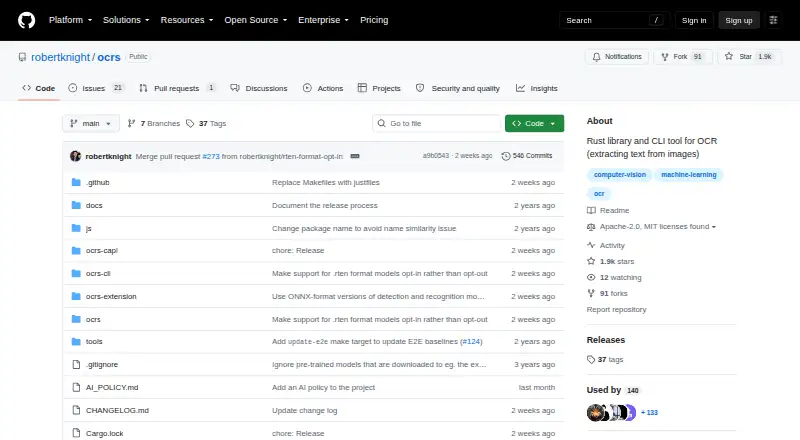
What ocrs is
ocrs is an open-source Rust library and command-line tool for extracting text from images with OCR. It is intended for scanned documents, text-containing photos, and screenshots, with a goal of needing less preprocessing than older engines such as Tesseract. The CLI can save recognized text, return text and layout details as JSON, or create an annotated image showing detected words and lines. An optional clipboard feature enables OCR on images from the system clipboard. Developers can use the Rust library in their applications, or the ocrs-capi component, which provides a C ABI for creating an engine and returning recognized text with line bounding boxes. Its neural models are trained in PyTorch, exported to ONNX, and run using the RTen engine. On first run, the CLI downloads required models to `~/.cache/ocrs`. Installing the CLI requires Rust and Cargo, with the command `cargo install ocrs-cli --locked`. The project describes itself as an early preview and warns that it may make more errors than commercial OCR engines. It currently recognizes the Latin alphabet, while wider language support is planned. The repository lists Apache-2.0 and MIT licenses.
Good
- CLI offers text, JSON layout, or annotated image output.
- Optional feature supports clipboard images.
- Rust library and C ABI are available.
- Models download automatically on first CLI run.
- Apache-2.0 and MIT licenses are listed.
Watch out
- Project is an early preview and may make more errors than commercial OCR engines.
- Currently recognizes only the Latin alphabet.
- CLI installation requires Rust and Cargo.
- C API callers must decode PNG or JPEG images.
Who it suits
ocrs suits developers who want an open-source OCR library or CLI for image text extraction, particularly in Rust or C projects. It may also fit users comfortable installing tools with Rust and Cargo.
Verdict
ocrs offers several ways to extract and represent recognized text, along with Rust and C interfaces for developers. Its early-preview status and current Latin-alphabet support are important limits to weigh for a project.
The facts
Each one read from ocrs's own pages, with the date it was checked.
What it does
- Automatic model download
- On first run, the CLI downloads required models automatically and stores them in `~/.cache/ocrs`.checked 5 Oct 2026
- C interface
- The project provides a C ABI with functions to recognize text and retrieve lines with bounding boxes.checked 9 Oct 2026
- CLI
- The CLI can extract text from image files and write text, JSON layout data, or annotated PNG output.checked 9 Oct 2026
- Clipboard
- The CLI supports reading an image from the system clipboard when installed with its clipboard feature.checked 9 Oct 2026
- Clipboard input
- An optional `clipboard` feature enables OCR on images from the system clipboard.checked 5 Oct 2026
- Image types
- The project aims to handle scanned documents, photos containing text, and screenshots with little or no preprocessing.checked 9 Oct 2026
- Implementation
- Its neural network models are trained in PyTorch, exported to ONNX, and run using the RTen engine.checked 5 Oct 2026
- Installation
- The CLI can be installed with Cargo using `cargo install ocrs-cli --locked`; installing it requires Rust and Cargo.checked 5 Oct 2026
- JavaScript
- An alpha WebAssembly build is available for Node, browsers, and other WebAssembly runtimes.checked 9 Oct 2026
- Language support
- It currently recognizes the Latin alphabet only, with support for more languages planned.checked 9 Oct 2026
- Library API
- The project provides an OCR engine as a Rust library for use in Rust applications.checked 5 Oct 2026
- License
- The repository lists Apache-2.0 and MIT licenses.checked 9 Oct 2026
- Maturity
- The project describes itself as an early preview and says it may make more errors than commercial OCR engines.checked 9 Oct 2026
- Model customization
- The C API can load custom models in ONNX format when built with the onnx feature.checked 9 Oct 2026
- Model data
- The project says it uses open and liberally licensed datasets, and links to a separate repository with model, dataset, and custom training details.checked 5 Oct 2026
- OCR engine
- Its neural network models are trained in PyTorch, exported to ONNX, and run using the RTen engine.checked 9 Oct 2026
- Output options
- The CLI can save extracted text, return text and layout information as JSON, or create an annotated image showing detected words and lines.checked 5 Oct 2026
- Project status
- The project describes itself as an early preview and cautions that it may make more errors than commercial OCR engines.checked 5 Oct 2026
- Purpose
- ocrs is a Rust library and CLI tool for extracting text from images using OCR.checked 9 Oct 2026
- Supported image input
- The C API accepts raw 8-bit grayscale, RGB, or RGBA pixels, and callers are responsible for decoding PNG or JPEG images.checked 9 Oct 2026
- Training data
- The project goal includes training on open and liberally licensed datasets.checked 9 Oct 2026
Where it runs
- Platform support
- The project says it is intended to compile and run across platforms, including WebAssembly.checked 5 Oct 2026
Alternatives to ocrs
- 1

Veryfi Invoices OCR API
Free planAndroidiOSWebAPI8.2From $500 a month - 2
OCR.space
Free planAndroidiOSWebAPI8.1From $30 a month - 3

Amazon Textract AnalyzeExpense
Free planWebAPISelf-hosted7.6From $0.01 a month - 4
 7.2From $8.99 a month
- 5
Tesseract OCR
Free planAndroidiOSAPILinux7.2Free plan - 6

Taggun
WebAPI7.1From $28 a month