
ObjectBox
ObjectBox is an embedded, object-oriented NoSQL database for mobile apps and IoT devices.
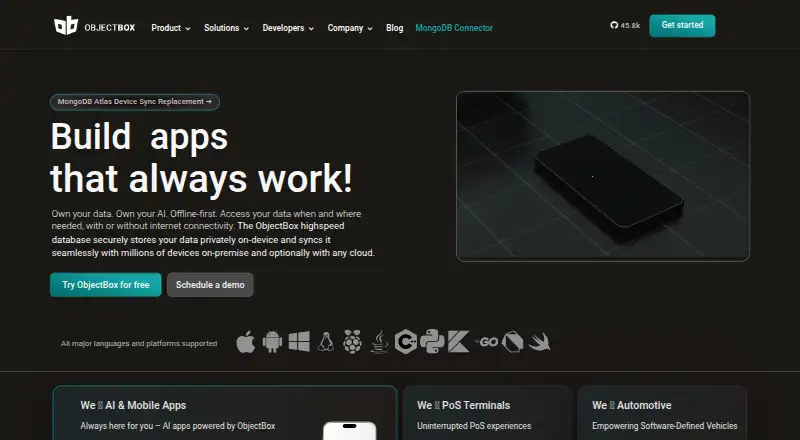
What ObjectBox is
ObjectBox is an embedded, object-oriented NoSQL database for mobile apps and IoT devices. Its database provides native object APIs, relationships, reactive observers, ACID transactions, and automatic schema migration. ObjectBox Sync can synchronize data between devices and a backend or server, including in offline-first use cases. The product supports vector search, and its FAQ says embedding-column dimensions have no set limit. Listed language APIs include Java, Kotlin, Swift, Flutter/Dart, Go, Python, and C/C++. ObjectBox supports direct synchronization to MongoDB; connectors for other backend databases may need custom development. Its Sync Server can be self-hosted on POSIX systems and cloud providers, though ObjectBox does not currently provide cloud hosting. The core database plan is free, while Sync pricing is quoted per project. The company describes its focus as mobile and IoT development, especially decentralized systems of restricted devices and offline scenarios. Mesh Sync is available for Android Java/Kotlin and Flutter/Dart starting with version 6.0.0-beta, and those APIs may change before final release.
Good
- Core database is free
- Supports ACID transactions and schema migration
- Provides APIs for several languages
- Supports vector search
- Sync supports offline-first use cases
Watch out
- ObjectBox does not provide cloud hosting
- Other backend connectors may need custom development
- Mesh Sync APIs may change before final release
- Sync pricing is quoted per project
Who it suits
It suits mobile and IoT developers building data-heavy or offline-first applications, particularly decentralized systems with restricted devices. Teams needing Sync can self-host the server, but should account for the need to arrange hosting themselves.
Verdict
ObjectBox combines an embedded database with synchronization options for mobile and IoT applications. The core database is free, while Sync requires a project-specific quote and self-hosting if cloud infrastructure is needed.
Plans and prices
From ObjectBox's own pricing page, checked 29 Sep 2026.
| Plan | Price | What it gives you |
|---|---|---|
| ObjectBox Database | Free | Core database; fundamental capabilities · No cost |
| ObjectBox Sync | Priced on request | Pricing varies by users, devices, sync instances, business model, support, and additional needs · Per project; personalized quote |
The facts
Each one read from ObjectBox's own pages, with the date it was checked.
What it does
- Certification
- The company’s About page states that ObjectBox is ISO-certified and links to its quality policy.checked 29 Sep 2026
- Database features
- The database offers native object APIs, object relationships, reactive observers, ACID transactions, and automatic schema migration.checked 29 Sep 2026
- Data sync
- ObjectBox Sync synchronizes data between devices and a backend or server, including for offline-first use cases.checked 29 Sep 2026
- Hosting
- The Sync Server can be self-hosted on POSIX systems and cloud providers; the FAQ says ObjectBox does not currently provide cloud hosting.checked 29 Sep 2026
- Integrations
- ObjectBox says it supports directly syncing to MongoDB; other backend database connectors may need to be custom built.checked 29 Sep 2026
- Intended users
- ObjectBox describes its focus as mobile and IoT development, particularly decentralized systems of restricted devices and offline scenarios.checked 29 Sep 2026
- Languages
- ObjectBox lists APIs for Java, Kotlin, Swift, Flutter/Dart, Go, Python, and C/C++.checked 29 Sep 2026
- Limits
- The FAQ says Mesh Sync is currently available for Android Java/Kotlin and Flutter/Dart starting with version 6.0.0-beta, with APIs potentially changing before final release.checked 29 Sep 2026
- Product
- ObjectBox is an embedded, object-oriented NoSQL database for mobile apps and IoT devices.checked 29 Sep 2026
- Security
- ObjectBox Sync Server supports JWT authentication and can use TLS by supplying a certificate; its documentation describes no-authentication mode as insecure.checked 29 Sep 2026
- Support
- The FAQ directs questions to documentation and Stack Overflow, and says professional support is offered to paying customers.checked 29 Sep 2026
- Vector search
- The FAQ says ObjectBox supports vector search and that there are no limits on embedding-column dimensions.checked 29 Sep 2026
The company
- Headquarters
- Germany, Europechecked 28 Sep 2026
Where it runs
- Platforms
- ObjectBox lists Android, iOS, Windows, macOS, Linux, POSIX systems, and Raspberry Pi among supported platforms or devices.checked 29 Sep 2026
The full review of ObjectBox
ObjectBox is a local, object-oriented database for mobile and IoT software that needs dependable device-side data. It suits developers building offline-first or decentralized systems, especially when they want to run synchronization infrastructure themselves. The main decision is whether its capable embedded core and 1 GB database ceiling fit your application before committing to separately quoted Sync.
Overview
ObjectBox uses a document model and an API query interface, storing application data inside the device rather than behind a separate database server. That architecture is a strong match for restricted devices and applications that must remain useful during connectivity gaps. The maximum database size is 1 GB, however, which rules it out for local datasets expected to grow beyond that limit.
ObjectBox Sync can move data between devices and a backend or server, including offline-first deployments. The Sync Server runs on POSIX systems and cloud providers, but ObjectBox does not provide cloud hosting. Self-hosting gives teams deployment control, while also making server operation and security their responsibility.
Key features
Embedded database
Native object APIs, relationships between objects, ACID transactions, reactive observers and automatic schema migration cover substantial application data work without forcing developers into a server-centric design. Vector search is supported, with no limit on embedding-column dimensions, making the database relevant to applications that store and search embeddings as well as ordinary records.
Synchronization and integrations
Sync connects device data with another device or a backend and is designed for intermittent connectivity. Direct synchronization to MongoDB is supported; other backend database connections may require custom connectors. Mesh Sync is currently limited to Android Java/Kotlin and Flutter/Dart from version 6.0.0-beta, and its APIs may change before release, so it is not a stable cross-platform foundation yet.
Languages and security
APIs are available for Java, Kotlin, Swift, Flutter/Dart, Go, Python and C/C++, covering the main mobile stacks and several server or embedded environments. Sync Server supports JWT authentication and TLS when a certificate is supplied. Its documented no-authentication mode is insecure and should not be treated as a production shortcut. ObjectBox states that it is ISO-certified, while professional support is reserved for paying customers; other users are directed to documentation and Stack Overflow.
Pricing
| Plan | Price | What it includes |
|---|---|---|
| ObjectBox Database | free | No cost; core database and fundamental capabilities |
| ObjectBox Sync | Custom pricing | Per-project quote. Pricing varies by users, devices, sync instances, business model, support and additional needs. |
The free database is the sensible starting point for individual developers and teams that only need local storage, and there is no charge for its core capabilities. It does not include a predictable price for connected deployments: Sync is quoted per project, so budgets depend on scale and commercial requirements. A free trial is offered, but no duration is stated. Teams needing hosted infrastructure should also budget for their own cloud provider, since ObjectBox supplies no cloud hosting.
Platforms
ObjectBox supports Android, iOS, Linux, Windows, macOS, Raspberry Pi and POSIX systems. Its language coverage spans Java, Kotlin, Swift, Flutter/Dart, Go, Python and C/C++. That breadth is useful for products sharing a data approach across mobile, desktop, gateway and embedded targets, while Mesh Sync's current Android and Flutter beta scope is considerably narrower.
Who it's for
Choose ObjectBox for mobile and IoT applications that keep important state on devices, need transactions and schema evolution, and may synchronize after going offline. It is particularly suitable for decentralized systems of constrained devices and for teams comfortable operating a self-hosted Sync Server. It is a weaker fit for applications requiring local databases larger than 1 GB, turnkey managed synchronization, or a mature Mesh Sync API across every supported platform.
Pros and cons
Pros
- Free core database removes licensing cost for local-only applications.
- Object relationships, ACID transactions, observers and automatic migration provide a substantial embedded feature set.
- Vector search has no stated embedding-column dimension limit.
- Broad language and platform coverage supports mixed mobile and embedded estates.
- Self-hostable Sync Server and JWT/TLS options give teams control over deployment and authentication.
Cons
- The 1 GB maximum database size can constrain data-heavy devices.
- Sync has custom, project-based pricing rather than a published plan.
- No ObjectBox cloud hosting means customers operate the Sync infrastructure themselves.
- Non-MongoDB backend integrations may need custom development.
- Mesh Sync is still a beta, currently restricted to Android Java/Kotlin and Flutter/Dart.
Alternatives
For a wider directory of choices, see Mobile Databases and Embedded Databases.
- Espresso is a free Android UI-testing tool, so choose it for single-target Android testing rather than database storage.
- Hive is a free-forever option with 1,000 AI credits per month, 200 MB storage and up to 10 workspace members; choose it when those workspace-style limits fit better.
- RxDB offers a free core with replication and realtime sync; choose it when that web-inclusive replication model is preferable.
- Ditto has a free tier with 10 cloud device connections, 2 GB storage and 5 GB transfer, making it an alternative for a defined managed-cloud allowance.
- Realm is a free open-source database now associated with MongoDB Atlas Device SDKs; choose it when that ecosystem is the priority.
- Sparksee offers a free academic licence for eligible institutions.
- SQLDelight is a free open-source Kotlin SQL code-generation library for teams wanting SQL-oriented development.
- WCDB is a free open-source mobile database framework.
Verdict
ObjectBox is a strong recommendation for mobile and IoT developers who need a capable, free embedded database and can operate their own synchronization server. Its object APIs, offline orientation and broad platform support are compelling. Look elsewhere if a 1 GB local ceiling, custom Sync pricing, self-hosting duties or Mesh Sync's beta status conflicts with your product requirements.
Alternatives to ObjectBox
- 1
Hive
Free planOpen sourceAndroidiOSWebAPI8.6From $5 a month - 2

Firestore
Free planAndroidiOSWebAPI8.1$0.03 usage-based - 3
SQLDelight
Free planOpen sourceAndroidiOSWebAPI7.9Free plan - 4
PouchDB
Free planOpen sourceAndroidiOSWebAPI7.8Free plan - 5

Sparksee
Free planAndroidiOSAPILinux7.6Free plan - 6

RxDB
Free planAndroidiOSWebAPI7.5From $99 a month