NodeDR OrderRestro
NodeDR OrderRestro is a free, open-source restaurant management system for orders, billing, tables, kitchen display, reservations, and customer loyalty.
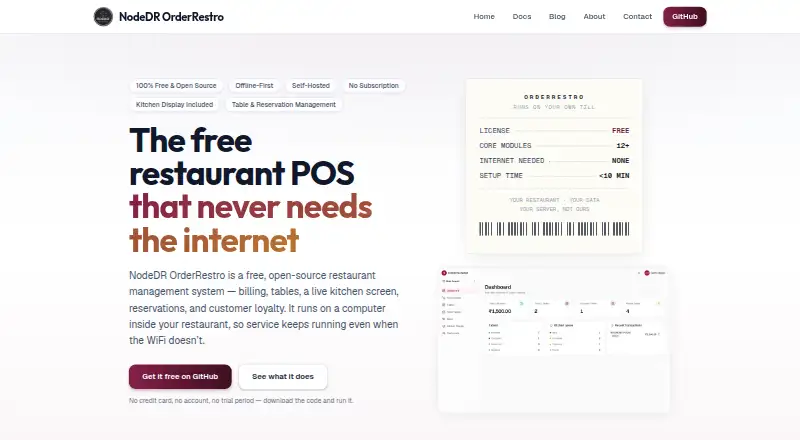
What NodeDR OrderRestro is
NodeDR OrderRestro is a free, open-source restaurant management system for orders, billing, tables, kitchen display, reservations, and customer loyalty. It runs on a computer at the restaurant, allowing order-taking, billing, kitchen display, and printing to continue across the local network without internet. Its POS supports dine-in, takeaway, and delivery, along with split or merged bills, discounts, gift cards, tips, refunds, mixed payments, and regional tax setups. Kitchen tools include station routing, priority tickets, and timers; floor tools cover a visual plan, reservations, and a waitlist. Guests can scan a table QR code to view the menu and order in English, Spanish, or French without installing an app. Inventory functions include ingredient tracking, recipe costing, purchasing, batch and expiry tracking, waste logging, and automatic stock deduction when orders are billed. Customer profiles, loyalty points, gift cards, and role-based staff accounts are included. The server runs on Linux, macOS, or Windows, while other devices connect through a browser on the same network. Its free plan is billed free forever under AGPL-3.0, with no subscription or per-seat fees.
Good
- Local-network order-taking works without internet.
- Supports several order types and tax setups.
- Includes kitchen routing and visual floor tools.
- Free forever with no per-seat fees.
Watch out
- The server must be deployed on a computer or server.
- Some features, including payroll and branch management, are planned for later.
Who it suits
It suits restaurants seeking self-hosted order, floor, kitchen, and inventory management, including local-network operation without internet. It may also suit operators who want guests to place QR-code orders without an app.
Verdict
OrderRestro covers restaurant sales, kitchen, floor, and stock workflows in a self-hosted system. Its local-network operation and free plan stand out, while deployment is the operator's responsibility.
Plans and prices
From NodeDR OrderRestro's own pricing page, checked 15 Oct 2026.
| Plan | Price | What it gives you |
|---|---|---|
| Free | Free | AGPL-3.0 · self-hosted · kitchen display included · free forever; no subscription or per-order fee |
| Free / AGPL-3.0 | Free | Restaurant POS and management system · self-hosted · AGPL-3.0 · Free forever; no subscription or per-seat fees |
The facts
Each one read from NodeDR OrderRestro's own pages, with the date it was checked.
What it does
- Backups
- Administrators can back up and restore data to any S3-compatible bucket.checked 15 Oct 2026
- Backups and updates
- Users can connect an S3-compatible bucket for backups and restore, and the Settings page includes a one-click update button.checked 4 Oct 2026
- Cloud deployment
- The same installation can run on a VPS or cloud server such as DigitalOcean, Hetzner or AWS.checked 15 Oct 2026
- Customer and staff tools
- The system provides customer profiles, loyalty points, gift cards, and staff accounts with role-based permissions.checked 4 Oct 2026
- Customer loyalty
- Customer profiles store visit history and loyalty balances, and the system supports gift cards and checkout redemption.checked 15 Oct 2026
- Development status
- The maker lists delivery management and additional QR ordering controls as planned, and employee records, payroll, accounting, and branch management as planned for a later phase.checked 4 Oct 2026
- Email and messaging
- Email can use the restaurant’s SMTP server, while SMS and WhatsApp are connected through messaging-tool webhooks.checked 15 Oct 2026
- Installation
- The documented installation clones the GitHub repository, runs install.sh, builds Docker images, starts the stack and serves the app at port 1995.checked 15 Oct 2026
- Integrations
- A website Integration API can place orders and bookings into OrderRestro, and an MCP server lets Claude or another MCP-compatible AI access permitted order and reservation functions.checked 4 Oct 2026
- Inventory
- Ingredient inventory uses recipe costing, purchase orders, goods receipts, batch and expiry tracking, FIFO waste logging and automatic stock deduction.checked 15 Oct 2026
- Kitchen and floor
- It includes a live kitchen display with station routing, priority tickets, and timers, plus a visual floor plan, reservations, and waitlist.checked 4 Oct 2026
- Kitchen display
- Kitchen tickets are routed to stations and shown with priority flags and elapsed-time timers.checked 15 Oct 2026
- Licence
- The project is licensed under AGPL-3.0; modified versions offered as a network service must share their changes under the same licence.checked 15 Oct 2026
- Limit: barcode support
- The repository feature checklist marks barcode scanning as planned and says the restaurant app has no barcode field or scanner.checked 15 Oct 2026
- Limit: hardware printing
- The repository roadmap states that direct USB ESC/POS printing and a dedicated PDF endpoint remain planned hardware work.checked 15 Oct 2026
- Limit: ingredient units
- The documentation says unit conversion, such as buying kilograms while costing grams, is not yet built and each ingredient uses one base unit.checked 15 Oct 2026
- Limit: station views
- The repository roadmap says the kitchen display groups tickets by status rather than providing frontend station-specific columns or tabs.checked 15 Oct 2026
- MCP server
- The built-in MCP endpoint exposes 40 tools over Streamable HTTP and checks every request against the personal key holder’s permissions.checked 15 Oct 2026
- Offline operation
- After installation, billing, order-taking, kitchen display and printing continue on the local network without internet access.checked 15 Oct 2026
The company
- Company capital
- Tofler reports authorised capital of INR 15 lakh and paid-up capital of INR 1 lakh.checked 15 Oct 2026
- Company directors
- Tofler lists Raktim Ranjit and Debabrata Das as the company’s two directors.checked 15 Oct 2026
- Company incorporation
- Tofler lists NODEDR INFOTECH PRIVATE LIMITED as an active unlisted private company incorporated on 13 May 2026.checked 15 Oct 2026
- Maker
- The product is made and maintained by NODEDR INFOTECH PRIVATE LIMITED; the maker page identifies Raktim Ranjit as OrderRestro's lead developer.checked 4 Oct 2026
Where it runs
- Deployment and devices
- The server runs on Linux, macOS, or Windows, while tills, tablets, and phones on the same network access it through a browser; deployments can also run on a VPS or cloud server.checked 4 Oct 2026
The full review of NodeDR OrderRestro
NodeDR OrderRestro is a free, open-source restaurant management system for venues that want sales, kitchen, floor, and stock tools on their own server. Its strongest case is keeping core service running over the local network without internet; the trade-off is that the restaurant must operate the installation.
Overview
OrderRestro brings point of sale, kitchen display, reservations, customer loyalty, and inventory into one self-hosted system. A computer at the restaurant runs the server, while tills, tablets, and phones on the same network connect through a browser. This suits operators who value local control and continued service through internet outages, but it is not a hands-off hosted service.
The POS handles dine-in, takeaway, and delivery orders, along with split or merged bills, discounts, gift cards, tips, mixed payments, and refunds. Regional tax setups include GST, US Sales Tax, EU VAT, and Spain IVA. These options cover varied checkout needs, though delivery management is still planned rather than part of the current workflow.
Key features
Kitchen and floor operations
The live kitchen display routes tickets by station and adds priority tickets, timers, and order-status tracking. A visual floor plan, reservations, and a waitlist help connect table management with kitchen flow. Together these make OrderRestro broader than a kitchen screen alone, particularly for restaurants seeking one system across front and back of house.
Guest ordering and stock
Guests can scan a table QR code to view the live menu and order in English, Spanish, or French without installing an app. Inventory tools track ingredients, calculate recipe costs, manage purchase orders and batches, record expiry and waste, and deduct stock when orders are billed. That can give operators a tighter view of consumption, though it also means the system's value depends on maintaining useful ingredient and recipe records.
Customer tools, integrations, and upkeep
Customer profiles, loyalty points, gift cards, and staff accounts with role-based permissions cover basic retention and access-control needs. A website Integration API can send orders and bookings to OrderRestro, and an MCP server exposes permitted order and reservation functions to Claude or other MCP-compatible AI. S3-compatible backup and restore support and a one-click update button are useful operational provisions for a self-hosted product.
The maker says only port 1995 is exposed; the API and Swagger documentation are reached through the web app proxy rather than published directly to the network. The server can run on Linux, macOS, or Windows, and can also be deployed on a VPS or cloud server. The maker describes a one-command install taking under 10 minutes, but responsibility for the host and its ongoing operation remains with the venue.
Pricing
Free / AGPL-3.0: free. It is billed Free forever, with no subscription or per-seat fees, and includes a self-hosted restaurant POS and management system under the AGPL-3.0 license. There is no paid lower tier to trade features for a lower bill: the practical cost is operating the server and devices yourself. No free trial is offered, and the plan's defining constraint is self-hosting rather than a stated seat quota.
Platforms
The server runs on Linux, macOS, or Windows. Staff use the web interface from devices on the same network; the product also supports offline mode and local-network operation for order-taking, billing, kitchen display, and printing. Browser access avoids requiring a separate client app for each till or tablet, while putting server setup and continuity in the operator's hands.
Who it's for
OrderRestro is best for independent restaurants that want a broad service toolkit, local-network resilience, and no subscription or per-seat charge, and have someone able to manage a self-hosted installation. It is a weaker fit for operators who want a hosted, centrally maintained service or need delivery management, employee records, payroll, accounting, or branch management now; those capabilities are planned, not current features.
Pros and cons
- Pros: Core service functions work on the local network without internet, which helps venues where connectivity is unreliable.
- Pros: The free-forever AGPL-3.0 plan has no subscription or per-seat fees, while covering POS, kitchen, floor, QR ordering, and inventory workflows.
- Pros: Browser access from networked tills, tablets, and phones lets a venue use different device types without dedicated client apps.
- Cons: Self-hosting makes server operation the restaurant's responsibility, unlike a managed hosted service.
- Cons: Delivery management and several back-office functions remain planned, limiting its fit for venues that need those workflows today.
Alternatives
Kitchen Display System Software is a useful category page for comparing kitchen display options. Consider Baresto Manager for another free, locally run open-source restaurant system; it uses the MIT license and offers optional paid installation support. Odoo Restaurant may suit readers who want a broader platform spanning Android and iOS as well as desktop and web; its One App Free plan is free for one app and unlimited users, while Standard covers all apps on Odoo Online at custom pricing.
FloCafe KDS is a free, MIT-licensed, self-hosted option for a narrower kitchen-display need, with hardware and operating costs separate. Ordering.Tools is a better match for readers prioritizing online ordering on Android, iOS, or web: its Free plan is free for 20 orders per month with no commission, while AI use has limits. HungerRush offers a qualified Starter option from $0 / Month for one location and one POS terminal, so it may suit an eligible operator seeking a different POS offering.
Lightspeed Restaurant is a paid alternative at $69 a month for Starter, which includes a customizable POS, menu manager, floor plans, Advanced Insights, offline mode, and 24/7 support. ZeusPOS KDS is a focused paid KDS choice at $150, paid once for a single license supporting up to four stations plus one special station, and requires ZeusPOS version 6.0.6 or higher. ChefDesk is another paid restaurant software option, with pricing based on outlets and modules.
Verdict
Choose OrderRestro if you want a free, locally resilient system that combines restaurant sales, kitchen, floor, and stock workflows and can take responsibility for your own server. Its breadth and lack of subscription or per-seat fees are compelling; look elsewhere if you need managed hosting or delivery and back-office capabilities that are still planned.
Getting started
- Open the OrderRestro website.
- Choose a Linux, macOS, or Windows computer, or a VPS or cloud server for the server.
- Use the maker's one-command installation and setup process.
- Connect tills, tablets, or phones on the same network through a browser.
- Configure the restaurant's POS and regional tax setup.
- Use the Settings page's one-click update button when updates are needed.
Limits worth knowing
The free AGPL-3.0 plan has no subscription or per-seat fees. Delivery management and additional QR controls are planned, while employee records, payroll, accounting, and branch management are planned for a later phase.
Questions
How much does NodeDR OrderRestro cost?
The Free / AGPL-3.0 plan is free forever, with no subscription or per-seat fees.
Does OrderRestro work without internet?
Yes. Order-taking, billing, kitchen display, and printing can work on the restaurant's local network without internet.
What platforms does it support?
The server runs on Linux, macOS, or Windows. Tills, tablets, and phones on the same network access it through a web browser.
Is OrderRestro open source?
Yes. Its free plan is under the AGPL-3.0 license.
Who makes OrderRestro?
It is made and maintained by NODEDR INFOTECH PRIVATE LIMITED. The maker page identifies Raktim Ranjit as its lead developer.
Can guests place orders by QR code?
Guests can scan a table QR code to view the live menu and place orders in English, Spanish, or French without installing an app.
Alternatives to NodeDR OrderRestro
- 1

HungerRush
Free planAndroidiOSWebAPI8.1From $149 a month - 2
Slant KDS
Free planAndroidWebAPImacOS7.8From $32 a month - 3

Baresto Manager
Free planOpen sourceAndroidiOSWebAPI7.7Free plan - 4
Toast
Free planAndroidiOSWebAPI7.6From $69 a month - 5

Ordering.Tools
Free planAndroidiOSWeb7.5From €30 a month - 6

ChefDesk
AndroidiOSWebLinux7.3