Nixpacks
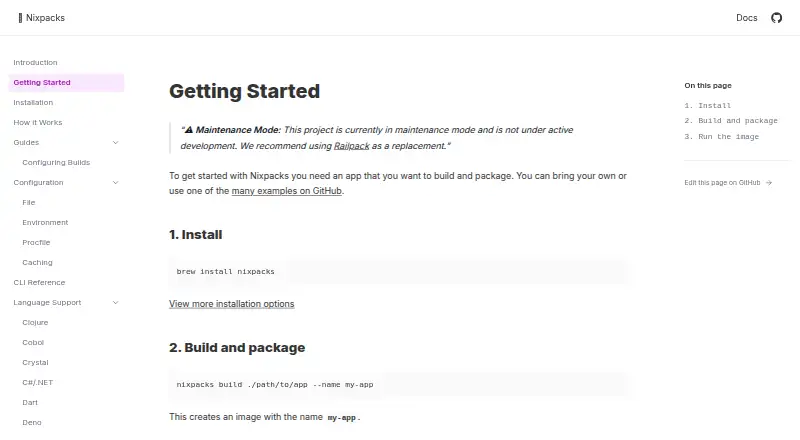
Nixpacks converts an application source directory into an OCI-compliant image for deployment.
What Nixpacks is
Nixpacks converts an application source directory into an OCI-compliant image for deployment. It analyzes the directory, matches language providers, suggests Nix packages and install, build, and start commands, then builds with Docker BuildKit. Documented providers include Clojure, .NET, Deno, Elixir, Go, Java, Node, PHP, Python, Ruby, Rust, Swift, and Zig. Suggestions can be overridden, with Nix or Apt packages and custom commands added through TOML, JSON, environment variables, or CLI flags. Providers cache directories during installation and builds by default; cache keys can be changed or caching disabled. Plans can be saved and reused with the same configuration. Nixpacks runs on Linux, macOS, Windows, and self-hosted setups, and integrates with Railway and a GitHub Action for container publishing. Docker is required to build and run images. Nixpacks is open source, but the project is in maintenance mode, not active development, and recommends Railpack as a replacement.
Good
- Automatic language and package detection
- Custom packages and build commands
- Reusable reproducible build plans
- Railway builder and GitHub Action
- Runs on major desktop platforms
Watch out
- Project is in maintenance mode
- Railpack is recommended as replacement
- Docker is required
- One build cannot produce multiple architectures
Who it suits
Nixpacks suits developers who need automated container image creation from application source directories. It is relevant for projects using its listed language providers and Docker-based deployment workflows.
Verdict
Nixpacks provides configurable, provider-based image builds with caching and reusable plans. Its maintenance status and single-architecture build limitation should shape new adoption decisions.
The facts
Each one read from Nixpacks's own pages, with the date it was checked.
What it does
- Architecture limit
- Nixpacks does not support building multiple architectures in one build; separate builds are required before creating a multi-architecture image.checked 4 Oct 2026
- Automatic detection
- Language providers are matched against the app source directory and suggest Nix packages and install, build, and start commands.checked 4 Oct 2026
- Build limitation
- Nixpacks does not support producing multiple architectures in a single build.checked 9 Oct 2026
- Build process
- It generates a reproducible build plan from detected language providers and uses Docker BuildKit to create an OCI image.checked 9 Oct 2026
- Caching
- Providers cache directories during install and build phases by default, and users can change the cache key or disable caching.checked 4 Oct 2026
- Configuration
- Builds can be customized with Nixpacks TOML or JSON configuration files, environment variables, or CLI flags.checked 9 Oct 2026
- Customization
- Users can override provider suggestions, add Nix or Apt packages, and customize build and start commands.checked 4 Oct 2026
- Distribution
- Install options include Homebrew and MacPorts for macOS, Scoop and MSI packages for Windows, Debian packages, shell scripts, and building from source.checked 9 Oct 2026
- GitHub Actions
- The documentation includes a GitHub Actions deployment guide for Nixpacks.checked 9 Oct 2026
- Integrations
- Nixpacks is available as a builder on Railway and Coolify.checked 9 Oct 2026
- Language support
- The documentation lists providers for languages including Python, Node, Go, Java, Ruby, Rust, and Swift.checked 9 Oct 2026
- Maintenance status
- Nixpacks is in maintenance mode and is not under active development; its documentation recommends Railpack as a replacement.checked 9 Oct 2026
- Open source
- The project describes itself as open source on GitHub and says it was started by Railway.checked 9 Oct 2026
- Packages and commands
- Users can add Nix or Apt packages and override build and start commands.checked 9 Oct 2026
- Purpose
- Nixpacks analyzes an application source directory and produces an OCI-compliant image that can be deployed anywhere.checked 9 Oct 2026
- Python support
- The Python provider detects files such as main.py, requirements.txt, pyproject.toml, and Pipfile, and supports multiple package managers including pip, Poetry, PDM, and uv.checked 9 Oct 2026
- Runtime requirement
- Building and running the output image uses Docker, and the documentation describes image creation with docker build.checked 4 Oct 2026
Where it runs
- Installation platforms
- Installation options include macOS through Homebrew or MacPorts, Windows through Scoop or MSI releases, and Debian or Ubuntu through .deb releases.checked 4 Oct 2026
Money
- Reproducible plans
- A build plan can be saved and reused later to build the image with the same configuration.checked 4 Oct 2026
Alternatives to Nixpacks
- 1
Garden
Free planOpen sourceWebAPILinuxmacOS8.3From $50 a month - 2

AWS CodeBuild
Free planWebAPILinuxmacOS7.9From $0.01 a month - 3

Amazon EC2
Free planAndroidiOSWebAPI7.6Free plan - 4
Source-to-Image
Free planOpen sourceLinuxmacOSSelf-hostedWindows7.2Free plan - 5
Dagger
Free planWebLinuxmacOSSelf-hosted7.1From $50 a month - 6
BuildKit
Free planAPILinuxmacOSSelf-hosted6.8Free plan