Source-to-Image
Source-to-Image (S2I) is a toolkit for making reproducible container images from source code.
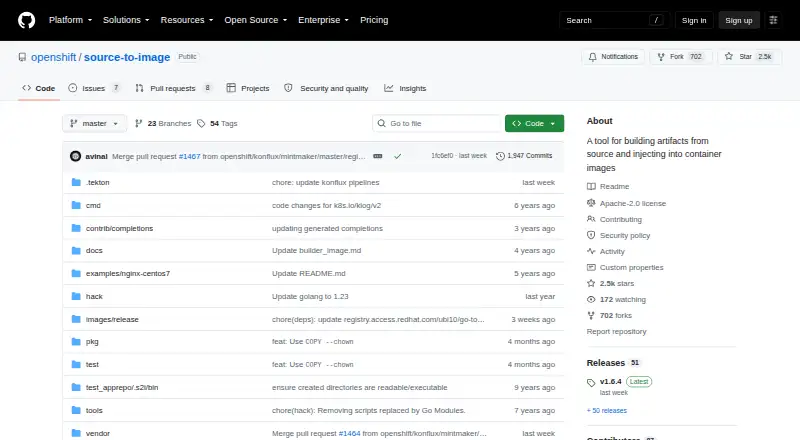
What Source-to-Image is
Source-to-Image (S2I) is a toolkit for making reproducible container images from source code. It places source in a builder image, where the container prepares the application for execution, then produces an image ready to run. The documented workflow can build from a Git repository without a Dockerfile. Builder images can provide assemble and run scripts, with optional scripts for saving artifacts and describing usage. When the builder image supports it, S2I can reuse artifacts from an earlier build with a previous output image and the incremental-build option. A `.s2iignore` file can exclude source files or directories from the resulting image, while `.s2i/environment` passes build variables that also appear in the output image. S2I can use an OnBuild strategy with images containing Dockerfile `ONBUILD` instructions. Its documented examples cover Docker and OpenShift, UBI, Ruby, and WildFly images. The toolkit is free and listed for Linux, macOS, and Windows. Dependencies listed are Docker 1.6 or later and Go 1.7.1 or later; Git is optional. The repository identifies its license as Apache-2.0.
Good
- Free plan; no paid plans stated.
- Builds from a Git repository without a Dockerfile.
- Can reuse artifacts with a compatible builder image.
- Supports Linux, macOS, and Windows.
- Offers scripts and source filtering for customization.
Watch out
- Requires Docker 1.6 or later and Go 1.7.1 or later.
- Incremental builds require a compatible builder image and prior artifacts.
- Git is optional, but it is still a listed dependency.
Who it suits
S2I suits developers who want a repeatable way to turn source into runnable container images, including workflows that build from Git without a Dockerfile. Teams can also use its builder-image scripts and supported incremental builds to customize that process.
Verdict
Source-to-Image provides a configurable build workflow for producing runnable container images from source. Its builder-image requirements and listed dependencies are worth checking before choosing it.
Plans and prices
From Source-to-Image's own pricing page, checked 7 Oct 2026.
| Plan | Price | What it gives you |
|---|---|---|
| Source-to-Image | Free | Open-source toolkit; no paid plans stated |
The facts
Each one read from Source-to-Image's own pages, with the date it was checked.
What it does
- API and SDK surface
- The published interface is a Go-based CLI with documented subcommands; the README does not describe a hosted HTTP API or official SDKs.checked 15 Oct 2026
- Build customization
- Builder images can supply assemble and run scripts, with optional save-artifacts and usage scripts.checked 7 Oct 2026
- Builder customization
- OpenShift documentation says teams can customize S2I builder images and wrap embedded scripts to add application-specific behavior.checked 15 Oct 2026
- Builder scripts
- Builder images use assemble and run scripts, with optional save-artifacts and usage scripts.checked 15 Oct 2026
- Build inputs
- s2i build accepts a source location, builder image and optional output tag, with flags for environment, users, scripts and destinations.checked 15 Oct 2026
- CLI commands
- The CLI documents create, build, rebuild, generate, usage, version and help commands.checked 15 Oct 2026
- Dependencies
- The README lists Docker 1.6 or later and Go 1.7.1 or later as dependencies, with Git optional.checked 7 Oct 2026
- Docker access warning
- The security notes say Docker group membership effectively grants root access and recommend sudo on recent Fedora/RHEL systems as more auditable and secure.checked 7 Oct 2026
- Dockerfile alternative
- The README demonstrates building and running an image from a Git repository without a Dockerfile.checked 7 Oct 2026
- Docker integration
- The documented default Docker socket is unix:///var/run/docker.sock, and S2I uses Docker client functionality for builds.checked 15 Oct 2026
- Environment variables
- Values in .s2i/environment are passed into the build and remain available in the resulting application image.checked 15 Oct 2026
- How it works
- It injects source code into a builder container image, lets the container prepare the source for execution, and produces a ready-to-run image.checked 7 Oct 2026
- Image support
- S2I recognizes container images with Dockerfile ONBUILD instructions and can use an OnBuild strategy.checked 7 Oct 2026
- Incremental builds
- When a compatible prior image and save-artifacts script exist, S2I can reuse streamed build artifacts for incremental builds.checked 15 Oct 2026
- Independent comparison criticism
- Northflank describes OpenShift, where S2I is a developer workflow, as potentially expensive, complex and tied to the Red Hat ecosystem.checked 15 Oct 2026
- Independent praise
- Northflank credits OpenShift's S2I tooling and web console with improving developer workflows and application delivery.checked 15 Oct 2026
- Installation methods
- The project documents Go installation, Homebrew on macOS, downloadable Linux and Windows binaries, and building from source.checked 15 Oct 2026
The company
- Company founding
- Red Hat says it was founded in 1993.checked 15 Oct 2026
- Company headquarters
- Red Hat lists its headquarters address as 100 E. Davie Street, Raleigh, North Carolina 27601.checked 15 Oct 2026
- Company legal name
- Crunchbase identifies the maker as Red Hat Inc., an IBM subsidiary.checked 15 Oct 2026
- Company ownership
- Red Hat says it has been joined with IBM since 2019, while IBM's acquisition announcement says Red Hat would remain a distinct unit.checked 15 Oct 2026
- Company size
- LinkedIn lists Red Hat as having more than 10,001 employees and headquarters in Raleigh, North Carolina.checked 15 Oct 2026
- Company workforce fact
- Red Hat's company brief reports more than 19,000 employees across 100 locations in over 40 countries.checked 15 Oct 2026
Money
- Dockerfile-free builds
- The project can build an application image directly from a Git repository without requiring a Dockerfile.checked 15 Oct 2026
Alternatives to Source-to-Image
- 1
Momentum
Free planWebmacOSWindows7.6From $99.95 a year - 2

Decent Sampler
Free planiOSLinuxmacOSWindows7.1Free plan - 3
sfizz
Free planWebAPILinuxmacOS6.9Free plan - 4
Quanta 2
iOSLinuxmacOSWindows6.6$99 one-time - 5
Vaporizer 2
Free planLinuxmacOSWindows6.5Free plan - 6

Atlas 2
LinuxmacOSWindows6.3$99 one-time