Nedap iD Cloud
Nedap iD Cloud gives retailers item-level inventory visibility across stores and the supply chain using RFID data.
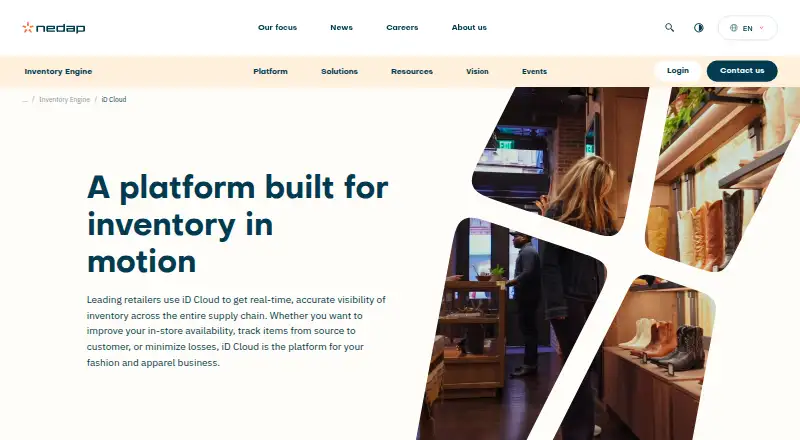
What Nedap iD Cloud is
Nedap iD Cloud gives retailers item-level inventory visibility across stores and the supply chain using RFID data. Its Store module supports inventory counts, receiving, replenishment, item search, availability, fulfillment, and item-status workflows. Store inventory information can support click-and-collect, reserve-in-store, and ship-from-store. The Supply Chain module connects RFID read points with item data and workflows to track receiving, shipments, returns, and movement. Loss Prevention uses item movement, POS transactions, stock counts, and operational data to help teams investigate suspicious events and shrink patterns.
The platform is multi-tenant SaaS, with separate EU and US hosting environments and no on-premise servers or in-store infrastructure to maintain. Nedap lists more than 15 REST/JSON APIs, OpenAPI specifications, GS1 EPCIS, and OAuth 2.0 support for connecting business systems. Android and iOS apps support RFID label tasks such as counting, programming, printing, searching, and deactivating. Prospective customers are directed to request a demo; no price or trial period is stated. Nedap was founded in 1929 and is headquartered in Groenlo, the Netherlands.
Good
- Tracks item-level inventory using RFID data.
- Supports store, supply-chain, and loss-prevention workflows.
- Provides Android and iOS apps for RFID label tasks.
- Offers more than 15 REST/JSON APIs.
Watch out
- Pricing is available only on request.
- No trial period is stated.
- The service has no on-premise deployment option.
Who it suits
It is aimed at fashion and apparel retailers, including store operations, asset protection, IT, and leadership teams. Retailers seeking RFID-based inventory workflows and integrations with business systems may find its modules relevant.
Verdict
iD Cloud combines RFID inventory workflows across stores and the supply chain with cloud hosting and system integrations. Prospective customers need to request a demo to discuss pricing and fit.
The facts
Each one read from Nedap iD Cloud's own pages, with the date it was checked.
What it does
- APIs and standards
- Nedap says iD Cloud provides over 15 REST/JSON APIs, OpenAPI specifications, OAuth 2.0 support, and GS1 EPCIS compliance.checked 8 Oct 2026
- Audience
- Nedap positions iD Cloud for fashion and apparel retailers and highlights use by store operations, asset protection, IT, and leadership teams.checked 8 Oct 2026
- Hosting
- Nedap describes iD Cloud as a multi-tenant SaaS solution with no on-premise servers or in-store infrastructure to maintain.checked 8 Oct 2026
- Hosting and data residency
- The IT page describes iD Cloud as multi-tenant SaaS with separate EU and US hosting environments and no on-premise servers or in-store infrastructure to maintain.checked 7 Oct 2026
- Integrations
- Nedap describes integrations with ERP, POS, OMS, ecommerce, replenishment, and reporting systems, and lists partners including SAP, Oracle, Microsoft Azure, Infor, Manhattan Associates, and Front Systems.checked 8 Oct 2026
- Integrations and APIs
- Nedap states iD Cloud supports more than 15 REST/JSON APIs, OpenAPI specifications, GS1 EPCIS, and OAuth 2.0 for connections to ERP, POS, OMS, and ecommerce platforms.checked 7 Oct 2026
- Intended users
- Nedap presents iD Cloud for retail operations, asset protection, IT, and leadership teams, particularly in fashion and apparel retail.checked 7 Oct 2026
- Loss prevention
- The Loss Prevention module combines item movement, POS transactions, stock counts, and operational data to help teams investigate incidents and spot suspicious patterns.checked 8 Oct 2026
- Modules
- The platform includes Store, Supply Chain, and Loss Prevention modules for inventory accuracy, end-to-end visibility, and shrink reduction.checked 8 Oct 2026
- Omnichannel
- Store inventory data can support click-and-collect, reserve-in-store, and ship-from-store fulfillment.checked 8 Oct 2026
- Pricing
- The product page directs prospective customers to request a demo and does not state a price.checked 7 Oct 2026
- Purpose
- iD Cloud gives fashion and apparel retailers real-time, item-level visibility of inventory across stores and the supply chain.checked 8 Oct 2026
- Security assurance
- Nedap says its technology is independently audited under SOC 2 Type II and that it provides an ISAE 3402 Type II assurance report for relevant processes and controls.checked 8 Oct 2026
- Store inventory
- The Store module supports inventory counts, receiving, replenishment, item search, availability, fulfillment, and item status workflows.checked 7 Oct 2026
- Store workflows
- Store features include RFID inventory counts, shipment verification, on-shelf availability, item search, and label and item-status management.checked 8 Oct 2026
- Supply chain
- iD Cloud Supply Chain connects RFID read points with workflows, item data, and APIs to show what was received, shipped, returned, misplaced, or diverted.checked 8 Oct 2026
The company
- Company
- Nedap N.V. was founded in 1929 and is headquartered in Groenlo, the Netherlands.checked 8 Oct 2026
- Founded
- 1929checked 28 Sep 2026
- Headquarters
- Groenlo, the Netherlandschecked 28 Sep 2026
Where it runs
- Mobile app
- Nedap lists the iD Cloud app for Android and iOS and says it uses a connected RFID handheld reader for inventory operations.checked 8 Oct 2026
Money
- Pricing and trial
- The product pages direct prospective customers to request a demo and do not state a price or trial period.checked 8 Oct 2026
The full review of Nedap iD Cloud
Nedap iD Cloud is a retail RFID platform that turns item reads into shared inventory and movement workflows. It is most suitable for fashion and apparel retailers coordinating store operations, supply-chain teams, asset protection, IT, and leadership. The central appeal is a connected, item-level view; the trade-off is a buying process based on a demo and custom quote rather than a published price.
Overview
iD Cloud is built around three modules: Store, Supply Chain, and Loss Prevention. Together they cover stock accuracy in shops, movement visibility from receiving through returns, and investigation of suspicious activity or shrink patterns. That retail specialization is useful when these teams need a common operating picture, but it is less compelling for a business seeking a broad, general-purpose inventory package.
The service is delivered as multi-tenant SaaS, with separate EU and US hosting environments. There are no on-premise servers or in-store infrastructure to maintain, which reduces local deployment responsibilities. Nedap says its technology is independently audited under SOC 2 Type II and provides an ISAE 3402 Type II assurance report, relevant to organizations with formal control and assurance requirements.
Key features
Store workflows
The Store module handles RFID inventory counts, receiving, replenishment, shipment verification, on-shelf availability, item search, fulfillment, and label or item-status management. In practice, this gives store teams one place for routine stock work and locating individual items. Inventory data can feed click-and-collect, reserve-in-store, and ship-from-store processes, so retailers can use more accurate store stock in omnichannel fulfillment.
Supply-chain visibility
The Supply Chain module links RFID read points to item data and operational workflows. It tracks receiving, shipments, returns, and other item movement, creating movement history across the network. That is a strong fit for retailers that need to understand where stock is between locations rather than only count it at a single store.
Loss prevention and analytics
Loss Prevention combines item movement, point-of-sale transactions, stock counts, and operational data to help teams examine suspicious events and recurring shrink patterns. Read-event analytics, exception alerts, and movement history support investigation instead of leaving teams with raw scans alone. The value is greatest for retailers with dedicated asset-protection work; smaller operators may not need a separate shrink-investigation workflow.
Mobile, integrations, and security
Nedap’s Android and iOS app supports counting, RFID-label programming and printing, searching, and label deactivation. The platform supports more than 15 REST/JSON APIs, OpenAPI specifications, OAuth 2.0, and GS1 EPCIS. Connections are described for ERP, POS, OMS, ecommerce, replenishment, and reporting systems, with partners including SAP, Oracle, Microsoft Azure, Infor, Manhattan Associates, and Front Systems. This integration breadth suits an established retail technology stack, while implementation still depends on fitting those systems together.
Pricing
iD Cloud is paid software with custom pricing. Nedap directs prospective customers to request a demo, and no public subscription amount or trial period is stated. That approach can accommodate different store counts, modules, hosting regions, and integration requirements, but buyers cannot compare an entry tier or estimate renewal cost from a price table. A demo and quote are therefore necessary before judging total cost and fit.
Platforms
iD Cloud is offered through web access, Android and iOS mobile apps, and an API. Cloud deployment means customers do not maintain local servers or in-store infrastructure. The mobile application is aimed at operational RFID tasks, while the API supports connections to surrounding retail systems.
Who it's for
Nedap positions iD Cloud for fashion and apparel retailers and for teams spanning store operations, asset protection, IT, and leadership. It is a particularly good match when item-level RFID accuracy, supply-chain movement history, omnichannel store fulfillment, and shrink investigation must work together. Retailers needing only basic stock counts, or organizations outside a retail RFID environment, may find the platform broader than necessary.
Pros and cons
Pros
- Connected retail scope: Store, Supply Chain, and Loss Prevention modules cover stock, movement, and shrink workflows in one platform.
- Useful omnichannel foundation: Store inventory can support click-and-collect, reserve-in-store, and ship-from-store decisions.
- Enterprise integration standards: REST/JSON APIs, OpenAPI, OAuth 2.0, and GS1 EPCIS support structured connections to core retail systems.
- Operational mobility: Android and iOS apps support counting and RFID-label work away from a desk.
- Cloud assurance choices: Separate EU and US hosting environments and stated SOC 2 Type II and ISAE 3402 Type II assurance address common enterprise governance concerns.
Cons
- Custom pricing: No public price or trial makes early budget comparison difficult.
- Retail-specific focus: Its module design is best aligned with fashion and apparel operations, not generic inventory use cases.
- Integration effort remains material: Broad API and partner support helps, but connecting ERP, POS, OMS, ecommerce, and reporting systems still requires implementation planning.
Alternatives
TagMatiks is a better starting point for buyers wanting freemium options, including free plans capped by scans or active assets, with broader deployment choices such as self-hosting and Windows. Choose OpenRFID Middleware when open-source, free middleware and self-hosted Linux or Windows deployment matter more than a packaged retail platform. Senitron Athena is another paid, quote-based option spanning mobile, desktop, web, API, and self-hosted environments. ClarityRFID suits qualifying retailers that want a 30-day proof of concept for up to two stores with readers and hardware included. RFTrack is worth considering when buyers need a choice between perpetual on-premise licensing and on-demand deployment. AMG Read Stream offers enterprise RFID inventory tracking in cloud or on-premises form. AssetPulse and RFID Cloud are paid alternatives that include free trials.
Verdict
Nedap iD Cloud is a strong choice for fashion and apparel retailers that want RFID-driven store accuracy, end-to-end item movement, omnichannel fulfillment support, and loss-prevention analysis connected to existing retail systems. Its main reason to choose it is the breadth of coordinated workflows and integration standards. Look elsewhere if you need transparent self-service pricing, a free tier, or a general inventory tool without a substantial retail RFID implementation.
Alternatives to Nedap iD Cloud
- 1
TagMatiks
Free planAndroidiOSWebAPI8.0Free plan - 2
OpenRFID Middleware
Free planWebAPILinuxSelf-hosted6.8Free plan - 3

AssetPulse
AndroidiOSWebAPI6.5 - 4

RIOT Insight
AndroidiOSWebAPI6.5From $25 a month - 5

RTI eP360
AndroidiOSWebAPI6.5 - 6
SimplyRFID WAVE
iOSWeb6.5From $299 a month