ClarityRFID
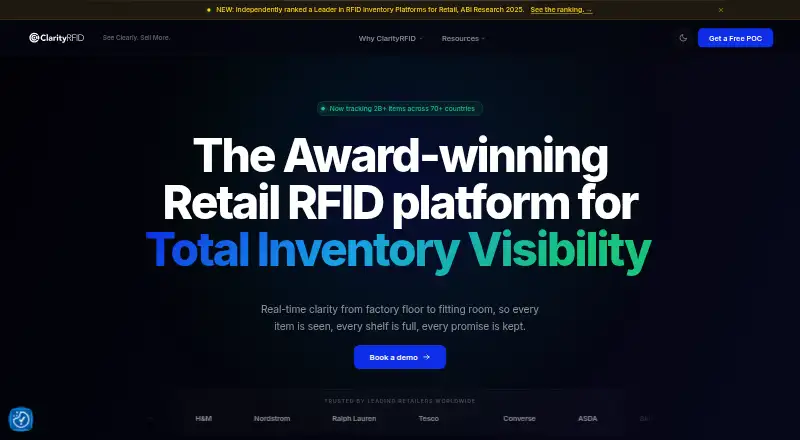
ClarityRFID provides retail RFID software for tracking item-level inventory from factory and distribution operations through stores.
What ClarityRFID is
ClarityRFID provides retail RFID software for tracking item-level inventory from factory and distribution operations through stores. Clarity Supply Chain handles carton auditing and pack verification, while Clarity Store supports store counting, replenishment, order fulfillment, pricing, promotions, shipment receipt, transfers, and tagging. Clarity Store runs on handheld devices and the web, supports RFID and non-RFID counts, and can save work offline until a connection returns. Integration choices include REST APIs, SFTP exchanges using CSV or XML, cloud blob storage, and webhooks, with inbound and outbound data flows. The maker lists ERP systems such as SAP S/4, OMS, POS feeds, WMS, warehouse control systems, 3PLs, and supplier systems. Store access controls include SSO and four roles with restricted features hidden from unauthorized users. The service is cloud deployed and offers a free 30-day proof of concept for qualifying retailers, covering up to two stores with readers and hardware included. Paid pricing is on request. The maker says SOC 1, SOC 2, and ISO 27001 audit work is underway, with certification targeted for January 2027.
Good
- Store supports RFID and non-RFID counting.
- Offline work can be saved until reconnection.
- Integrations support inbound and outbound data flows.
- Qualifying retailers can access a 30-day POC.
Watch out
- Paid pricing is available on request.
- Audit work is underway; certification is targeted for January 2027.
- Printer encoding requires a specific printer model and GS1 registration.
Who it suits
ClarityRFID is suited to retailers seeking item-level inventory visibility across supply chain and store operations. It may also fit organizations needing RFID and non-RFID counting with retail system integrations.
Verdict
ClarityRFID combines supply-chain workflows with store inventory and fulfillment tools. Consider its device support, integrations, and printer-encoding requirement when assessing fit.
Plans and prices
From ClarityRFID's own pricing page, checked 9 Oct 2026.
| Plan | Price | What it gives you |
|---|---|---|
| Free 30-day POC | Free | Qualifying retailers · up to 2 stores · 30 days · readers and hardware included |
The facts
Each one read from ClarityRFID's own pages, with the date it was checked.
What it does
- Access controls
- Clarity Store lists SSO and role-based permissions, with four roles and restricted features grayed out for unauthorized users.checked 9 Oct 2026
- Connected systems
- The maker lists ERP systems including SAP S/4, OMS, POS sales feeds, WMS, warehouse control systems including Swisslog and SYNQ, 3PLs, and supplier systems.checked 9 Oct 2026
- Hardware compatibility
- ClarityRFID describes itself as hardware-agnostic across major reader manufacturers, but says printer encoding currently requires a specific printer model and GS1 registration.checked 9 Oct 2026
- Integration limit
- ClarityRFID says specific customer architectures are covered under NDA during scoping, and customer-specific plugins are available for nonstandard data or business rules.checked 9 Oct 2026
- Integrations
- Integration options include REST APIs, SFTP file exchange using CSV or XML, cloud blob storage, and webhooks, with inbound and outbound data flows.checked 9 Oct 2026
- Pricing model
- The maker says standard pricing is per store per month, handheld devices are included, fixed readers add an uplift, and integration work is priced separately.checked 9 Oct 2026
- Purpose
- ClarityRFID provides retail RFID software for item-level inventory visibility from factory and distribution operations through stores.checked 9 Oct 2026
- Security status
- The maker says its SOC 1, SOC 2, and ISO 27001 audit work is underway, with certification targeted for January 2027.checked 9 Oct 2026
- Store features
- Clarity Store includes stock counts, replenishment, order fulfillment, promotions, shipment receipt, store transfers, tagging, and role permissions.checked 9 Oct 2026
- Support
- The maker says every account receives a named Customer Experience Consultant and monthly check-in; incidents are submitted through its support portal.checked 9 Oct 2026
- Two offerings
- Clarity Supply Chain handles carton auditing, pack verification, and related workflows, while Clarity Store supports store counting, replenishment, fulfillment, and pricing.checked 9 Oct 2026
Where it runs
- Supported devices
- Clarity Store runs on handheld devices and the web, supports RFID and non-RFID counting, and can save work offline until reconnection.checked 9 Oct 2026
The full review of ClarityRFID
ClarityRFID is retail inventory software for businesses that need item-level visibility from distribution operations through stores. It suits retailers coordinating supply-chain and store work; its broad workflows are balanced by custom pricing and a printer-encoding requirement.
Overview
ClarityRFID brings together two offerings: Clarity Supply Chain for carton auditing and pack verification, and Clarity Store for store inventory and fulfillment. The combination makes it a stronger fit for retailers seeking continuity across distribution and store operations than for teams looking only for a basic counting tool.
Cloud deployment, read-event analytics, and exception alerts support operational oversight. ClarityRFID describes itself as hardware-agnostic across major reader manufacturers, but printer encoding requires a specific printer model and GS1 registration. Retailers should confirm that constraint suits their tagging process before committing.
Key features
Store workflows and offline work
Clarity Store covers stock counts, replenishment, order fulfillment, promotions, shipment receipt, store transfers, tagging, and pricing. It supports both RFID and non-RFID counting on handheld devices and the web, and can save work offline until reconnection. That flexibility can help stores handle varied counting workflows and intermittent connectivity; businesses that need only a narrow counting function may not benefit from the wider operational scope.
Integrations and access
Integration options include REST APIs, SFTP transfers in CSV or XML, cloud blob storage, and webhooks, with inbound and outbound data flows. Connected systems include ERP platforms such as SAP S/4, OMS, POS sales feeds, WMS, warehouse control systems such as Swisslog and SYNQ, 3PLs, and supplier systems. Customer architectures are scoped under NDA, and customer-specific plugins can address nonstandard data or business rules. This breadth is useful for complex retail environments, but the need to scope each architecture makes integration planning an important part of adoption.
Clarity Store offers SSO and role-based permissions across four roles, with restricted features grayed out for unauthorized users. The maker says SOC 1, SOC 2, and ISO 27001 audit work is underway, with certification targeted for January 2027, so organizations requiring completed certifications should weigh that timing carefully.
Pricing
ClarityRFID uses paid pricing on request and has no general free plan. A qualifying retailer can use the Free 30-day POC for free, covering up to two stores for 30 days with readers and hardware included. It is a bounded evaluation rather than an ongoing free tier; retailers beyond two stores or needing a longer evaluation should discuss scope and pricing directly.
Every account receives a named Customer Experience Consultant and monthly check-in, while incidents go through a support portal. That provides a defined support contact and cadence, though incident handling is portal-based.
Platforms
ClarityRFID is available through web and API access, with Clarity Store running on handheld devices as well as the web. Its cloud deployment avoids an on-premises requirement, while the printer model and GS1 registration requirement remains a specific hardware consideration for encoding workflows.
Who it's for
ClarityRFID is best suited to retailers that want item-level inventory workflows spanning carton verification, store counts, replenishment, and fulfillment, particularly those with existing enterprise systems to connect. It is less compelling for a business seeking a low-cost, self-serve counting app or one that cannot accommodate the printer-encoding requirement.
Pros and cons
- Pro: Supply-chain and store workflows sit within one product family, covering carton auditing through store fulfillment.
- Pro: RFID and non-RFID counting, offline work, and handheld or web access give stores options across connectivity and counting needs.
- Pro: Multiple data exchange methods and support for a wide range of connected systems give retailers routes to fit established architectures.
- Con: Paid pricing is custom, and the evaluation offer is limited to qualifying retailers, two stores, and 30 days.
- Con: Printer encoding depends on a specific printer model and GS1 registration, limiting flexibility for that workflow.
- Con: Security certification work is still underway, which may not meet requirements for buyers needing completed audits now.
Alternatives
For a broader comparison, see RFID Software.
- TagMatiks is worth considering when a free tier matters: its Wedge Free plan allows up to 500 scans, while AT Lite Free supports up to 99 active assets, and it spans Android, iOS, web, Windows, API, and self-hosted platforms.
- OpenRFID Middleware is the alternative to consider for a free, open-source option across API, Linux, web, Windows, and self-hosted platforms.
- Senitron Athena is another paid RFID option, with Android, iOS, macOS, web, Windows, API, and self-hosted support.
- Nedap iD Cloud is a paid alternative spanning Android, iOS, web, and API.
- RFTrack is worth comparing if on-premise or on-demand options are relevant; its plans include an on-premise perpetual license and an on-demand option.
- AMG Read Stream offers paid enterprise inventory tracking with cloud or on-premises deployment.
- AssetPulse is another paid option with a free trial and Android, iOS, web, API, and self-hosted support.
- RFID Cloud is a paid alternative with a free trial and Android, iOS, web, and API support.
Verdict
Choose ClarityRFID if your retail operation needs a connected path from supply-chain verification to store inventory and fulfillment, and its integration approach and printer requirement fit your environment. Its breadth is the principal reason to choose it; custom pricing, the limited POC, and unfinished security audit work are sound reasons to look elsewhere if your needs are narrower or your procurement standards demand more.
Getting started
- Open the ClarityRFID website
- Request pricing or ask about the free 30-day POC
- Confirm eligibility for a POC covering up to two stores
- Choose cloud deployment and required API, SFTP, storage, or webhook connections
- Connect listed business systems or scope customer-specific plugins under NDA
- Use Clarity Store on handheld devices or the web
Limits worth knowing
The free proof of concept lasts 30 days and is limited to qualifying retailers with up to two stores. Printer encoding currently requires a specific printer model and GS1 registration.
Questions
Is there a free plan?
No. A free 30-day proof of concept is listed for qualifying retailers, covering up to two stores with readers and hardware included.
How is ClarityRFID priced?
It is paid software with pricing available on request.
Which platforms are supported?
Clarity Store runs on handheld devices and the web; the platform also provides an API.
What integrations are available?
REST APIs, SFTP with CSV or XML, cloud blob storage, and webhooks support inbound and outbound data.
Does it provide access controls?
Yes. Clarity Store lists SSO and four role-based permission levels, with unauthorized features grayed out.
Who provides support?
Each account receives a named Customer Experience Consultant and a monthly check-in; incidents go through the support portal.
Alternatives to ClarityRFID
- 1
TagMatiks
Free planAndroidiOSWebAPI8.0Free plan - 2
OpenRFID Middleware
Free planWebAPILinuxSelf-hosted6.8Free plan - 3

AssetPulse
AndroidiOSWebAPI6.5 - 4

RIOT Insight
AndroidiOSWebAPI6.5From $25 a month - 5

RTI eP360
AndroidiOSWebAPI6.5 - 6
SimplyRFID WAVE
iOSWeb6.5From $299 a month