muxterm
Muxterm is a web-first terminal multiplexer built around persistent sessions, split panes, and a browser interface.
What muxterm is
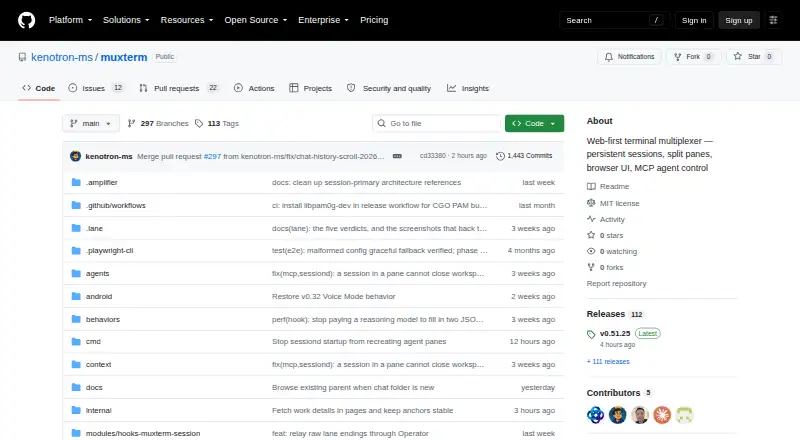
Muxterm is a web-first terminal multiplexer built around persistent sessions, split panes, and a browser interface. Its Go session daemon operates separately from the HTTP server, allowing shells to remain available across server restarts, deployments, and reboots. Users can group panes into named workspaces and switch among them from a bar. Server-side VT emulation keeps a live screen snapshot that can restore full-screen applications after reconnecting. An installable PWA supports desktop or mobile use and includes service-worker offline support. For MCP-compatible agents, its server exposes 25 tools in seven categories for managing workspaces, panes, terminals, and related functions. Documented integrations include Claude Code, OpenCode, and Amplifier, with lifecycle reporting for Claude, Codex, and Amplifier wrappers. Authentication uses HMAC tokens, with a localhost bypass for local use. A file-publishing tool can share one local file at an unguessable public URL, with a 24-hour default expiry and seven-day maximum; future reads can be revoked. Muxterm is free, MIT-licensed, and self-hosted as a single binary. Listed access includes macOS, Linux, and browser/PWA; Windows support is coming soon.
Good
- Sessions can survive server restarts, deploys, and reboots.
- Named workspaces organize split panes.
- PWA includes service-worker offline support.
- MCP server exposes 25 tools across seven categories.
- Free, MIT-licensed, and self-hosted.
Watch out
- Windows support is coming soon.
- Project has no SECURITY.md policy.
- No security advisories are published.
Who it suits
Muxterm suits people who want persistent terminal sessions managed through a browser interface, including users working with MCP-compatible agents. Its self-hosted setup may appeal to those comfortable running a single binary.
Verdict
Muxterm combines persistent shells and browser-managed workspaces with agent integrations and a free, self-hosted distribution. Windows users should note that support is still forthcoming, and the repository has no published security policy.
Plans and prices
From muxterm's own pricing page, checked 4 Oct 2001.
| Plan | Price | What it gives you |
|---|---|---|
| muxterm | Free | MIT-licensed · self-hosted · single binary |
The facts
Each one read from muxterm's own pages, with the date it was checked.
What it does
- AI integration
- Its MCP server exposes 25 tools across seven categories for MCP-compatible agents to manage workspaces, panes, terminals, and other functions.checked 4 Oct 2001
- Authentication
- The feature list describes HMAC token-based authentication with localhost bypass for local use.checked 4 Oct 2001
- License
- The repository identifies the project as MIT licensed.checked 4 Oct 2001
- Mobile and offline
- The PWA can be installed as a desktop or mobile app and includes service-worker offline support.checked 4 Oct 2001
- Persistence
- The session daemon runs separately from the HTTP server, allowing shells to survive server restarts, deploys, and reboots.checked 4 Oct 2001
- Product
- Muxterm is a web-first terminal multiplexer with persistent sessions, split panes, and a browser interface backed by a Go session daemon.checked 4 Oct 2001
- Public file sharing
- The MCP publish_file tool serves one local file at an unguessable public URL, with a 24-hour default expiry, a seven-day maximum, and revocation for future reads.checked 4 Oct 2001
- Reconnects
- Server-side VT emulation replays a live screen snapshot so full-screen apps can restore after reconnecting.checked 4 Oct 2001
- Security policy
- GitHub reports that the project has no SECURITY.md policy and no published security advisories.checked 4 Oct 2001
- Supported agent tools
- Muxterm documents integrations with Claude Code, OpenCode, and Amplifier, and native lifecycle reporting for Claude, Codex, and Amplifier wrappers.checked 4 Oct 2001
- Workspaces
- Users can organize panes into named workspaces and switch between them from a bar.checked 4 Oct 2001
Where it runs
- Platforms
- The README provides macOS Homebrew and Linux installation instructions, says Windows Scoop support is coming soon, and says binaries are attached to GitHub releases.checked 4 Oct 2001
The full review of muxterm
Muxterm is a self-hosted terminal multiplexer that brings persistent shells, split panes, and named workspaces into a browser interface. It is best suited to developers who want local session continuity or MCP-based agent control; its local scope and forthcoming Windows support narrow its appeal.
Overview
A Go session daemon runs separately from the HTTP server, allowing shells to survive server restarts, deploys, and reboots. That separation is valuable for long-running terminal work, but persistence stays local rather than following users through a hosted service. Muxterm is MIT-licensed and distributed as a single binary, a practical combination for people comfortable self-hosting.
Key features
Split panes and named workspaces help keep terminal arrangements organized by project or task, with a bar for switching between workspaces. On reconnect, server-side VT emulation replays a live screen snapshot, which can restore full-screen apps as well as shell output. That is a meaningful advantage when a browser connection drops during interactive work.
The installable PWA supports desktop and mobile use, with offline support through a service worker. Its MCP server exposes 25 tools across seven categories for managing workspaces, panes, terminals, and other functions. Muxterm documents integrations with Claude Code, OpenCode, and Amplifier, and native lifecycle reporting for Claude, Codex, and Amplifier wrappers, making it a more compelling fit for agent-assisted terminal workflows than a multiplexer without those integrations.
HMAC token-based authentication is described, with localhost bypass for local use. The MCP publish_file tool can serve one local file at an unguessable public URL; URLs expire after 24 hours by default, can last up to seven days, and can be revoked for future reads. Public sharing is useful for temporary handoffs, but users should consider carefully what they expose. GitHub reports no published security policy or security advisories, so teams with formal security requirements may prefer a project with a clearer security posture.
Pricing
Muxterm is free: its single plan costs nothing and includes MIT-licensed, self-hosted software distributed as a single binary. There are no paid tiers or hosted service described; the trade-off for the zero price is running and maintaining the local setup yourself.
Platforms
Muxterm supports macOS, Linux, and browser/PWA access. Windows support is coming soon, so Windows users should not choose it expecting current native support. The PWA can be installed on desktop or mobile, while session persistence remains local.
Who it's for
Choose Muxterm if you want persistent local shells managed through a browser, named workspaces, and a reconnect experience that can restore full-screen applications. Its agent integrations make it particularly relevant to developers using MCP-compatible tools. It is less suitable for people seeking hosted, cross-device sessions, current Windows support, or a project with a published security policy.
Pros and cons
- Pros: Shells survive server restarts, deploys, and reboots, reducing disruption to long-running work.
- Pros: Reconnect snapshots can restore full-screen apps, not just ordinary shell output.
- Pros: MCP tools and documented agent integrations support terminal management from compatible workflows.
- Cons: Persistence is local, so it is not a hosted service for carrying sessions between machines.
- Cons: Windows support is still forthcoming.
- Cons: No published security policy or security advisories may be a concern for security-conscious teams.
Alternatives
Browse terminal multiplexers for more options. Okena is another free option spanning mobile, desktop, web, and API platforms. Choose Zellij for free, open-source terminal multiplexing with no account required, or consider its Zellij.online hosted session-sharing option, which has a free tier and is in closed beta. Muxel is a free open-source alternative for Linux, macOS, and Windows. Openmux is a free MIT-licensed option for macOS Apple Silicon and Linux x64 or arm64. P2pmux is a free MIT-licensed choice for Linux and macOS. Quil is free, with no paid tier or hosted version, for Linux, macOS, self-hosted use, and Windows. Herdr is a free Apache 2.0 runtime that runs locally on macOS, Linux, and Windows. Séance is a free MIT-licensed option for Linux with X11 or Wayland.
Verdict
Muxterm is a strong choice for developers who want self-hosted, persistent terminal workspaces and agent integration without a subscription. Its strongest reason to choose it is that shells and full-screen sessions can recover across server interruptions and browser reconnects. Look elsewhere if you need hosted cross-device persistence, established Windows support, or a published security policy.