
MuScriptor
MuScriptor transcribes recordings into MIDI and sheet music.
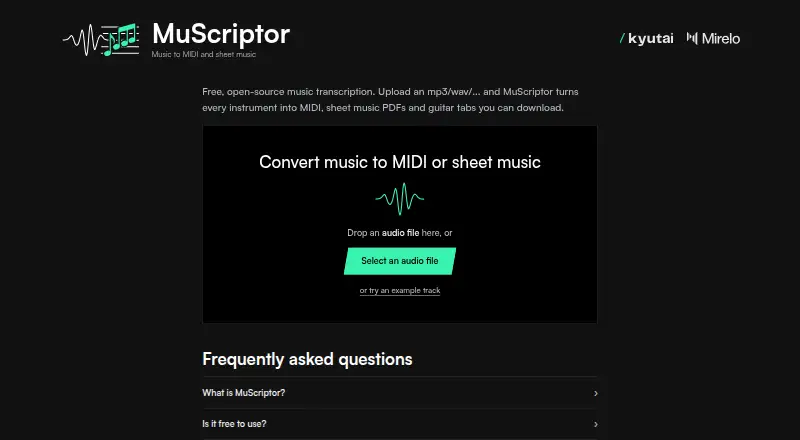
What MuScriptor is
MuScriptor transcribes recordings into MIDI and sheet music. Its hosted service offers downloadable MIDI files, sheet-music PDFs, and guitar-tab PDFs, and the web demo accepts MP3, WAV, FLAC, OGG, M4A, AIFF, and Opus audio. It can transcribe voice, piano, guitars, bass, strings, brass, woodwinds, drums, and other instruments; users can specify expected instruments to help improve transcription accuracy. Guitar and bass transcriptions include tablature alongside standard notation, but the system does not produce chord symbols. MusicXML output can be edited in MuseScore, Sibelius, or Guitar Pro. The web interface can be self-hosted, with transcription also available through a command-line interface and Python API. Local use requires Hugging Face authentication and acceptance of the model's CC BY-NC 4.0 license. Hosted audio is processed on the server and not retained afterwards, while local use keeps audio on the user's machine. The service says results are stronger on acoustic and guitar music than on electronic music, and that transcription is not perfect.
Good
- Hosted service offers MIDI and PDF downloads
- Accepts seven listed audio formats
- Users can specify expected instruments
- Local use keeps audio on the user's machine
- Available through a CLI and Python API
Watch out
- Does not write chord symbols
- Results are less effective on electronic music
- Local use requires Hugging Face authentication and license acceptance
Who it suits
MuScriptor suits musicians who want to turn recordings into MIDI, sheet music, or guitar and bass tablature. It may also suit users who prefer local processing, provided they meet the authentication and license requirements.
Verdict
MuScriptor offers several transcription outputs and can be used through a hosted demo or local setup. Its stated accuracy limitation and local-use requirements are worth considering before choosing it.
Plans and prices
From MuScriptor's own pricing page, checked 30 Sep 2026.
| Plan | Price | What it gives you |
|---|---|---|
| Free | Free | free hosted demo · MIT-licensed code · model weights CC BY-NC 4.0 non-commercial |
| Free open-source MuScriptor | Free | browser transcription · MP3/WAV upload · MIDI · sheet-music PDFs · guitar tabs |
The facts
Each one read from MuScriptor's own pages, with the date it was checked.
What it does
- Accuracy limitation
- The service says it works better on acoustic and guitar music than electronic music and is not perfect.checked 30 Sep 2026
- API detail
- The Python API supports instrument filtering, sampling, temperature, beam search, batching and prelude forcing.checked 14 Oct 2026
- Audio formats
- The web demo accepts MP3, WAV, FLAC, OGG, M4A, AIFF and Opus files.checked 30 Sep 2026
- CLI
- The package provides a command-line transcribe command that writes MIDI, JSON, JSONL or sheet outputs.checked 14 Oct 2026
- Code licence
- The inference and application code is released under the MIT licence.checked 14 Oct 2026
- Crunchbase facts
- Crunchbase lists Kyutai as an active Paris nonprofit with 11–50 employees and founders Laurent Mazare and Neil Zeghidour.checked 14 Oct 2026
- Documentation depth
- Documentation includes installation, model selection, CLI examples, Python usage, server operation, output formats and development setup.checked 14 Oct 2026
- Full-mix transcription
- The model is designed to transcribe complete mixes containing several simultaneous instruments.checked 14 Oct 2026
- Hardware guidance
- Small is recommended for CPU-only machines, medium is the default trade-off, and large is intended for GPU use; Apple Silicon uses Metal automatically.checked 14 Oct 2026
- Independent technical coverage
- A Japanese independent article reports that MuScriptor handles full mixes, explains its training approach and compares local, browser and Mirelo Studio use.checked 14 Oct 2026
- Independent usage report
- A Russian video review demonstrates local installation, memory use, MIDI export and opening results in MIDI editors.checked 14 Oct 2026
- Input formats
- The local package accepts WAV and other formats supported by libsndfile, including MP3, FLAC, OGG and M4A.checked 14 Oct 2026
- Instrument detection
- It detects and labels parts such as voice, drums, bass and synth lead.checked 14 Oct 2026
- Instruments
- It can transcribe voice, piano, guitars, bass, strings, brass, woodwinds, drums and other instruments.checked 30 Sep 2026
- Instrument targeting
- Users can specify expected instruments to improve transcription accuracy.checked 30 Sep 2026
- Integrations
- MusicXML output can be edited in MuseScore, Sibelius or Guitar Pro.checked 30 Sep 2026
- Kyutai funding
- Kyutai says it is funded by Iliad Group, CMA CGM Group and Schmidt Sciences.checked 14 Oct 2026
- Launch news
- Kyutai and Mirelo announced the open model and free audio-to-MIDI product on 9 July 2026.checked 14 Oct 2026
- Limit: local performance
- A reproducibility report found Large inference on an RTX 4090 Docker setup over six times slower than manual hosted-demo timings.checked 14 Oct 2026
- Limit: MusicXML
- A Windows user opened a bug stating that generated MusicXML differed substantially from the source score.checked 14 Oct 2026
- Limit: transcription errors
- A reported case had sustained blocks, overlapping instruments, wrong instrument labels and a slowdown toward the end of a song.checked 14 Oct 2026
Where it runs
- Browser interface
- The hosted site runs as a JavaScript web transcriber with no installation described on its home page.checked 14 Oct 2026
The company
- Headquarters
- Paris, Francechecked 28 Sep 2026
- Kyutai company
- LinkedIn lists Kyutai as a Paris nonprofit founded in 2023 with 11–50 employees.checked 14 Oct 2026
The full review of MuScriptor
MuScriptor is a music transcription tool for turning recordings into MIDI and notation, with tabs for guitar and bass. It is best for musicians working with acoustic or guitar-led material who want a hosted starting point or a local workflow. Its broad instrument coverage is useful, but the results are imperfect and it does not add chord symbols.
Overview
The hosted demo converts recordings into downloadable MIDI, sheet-music PDFs and guitar-tab PDFs. It accepts MP3, WAV, FLAC, OGG, M4A, AIFF and Opus files, and supports polyphonic transcription across voice, piano, guitars, bass, strings, brass, woodwinds, drums and other instruments. This breadth makes it a plausible first pass on a mixed recording, rather than a tool confined to a single instrument.
Users can specify which instruments they expect, giving the system a useful cue when approaching a recording. MuScriptor says it performs better on acoustic and guitar music than electronic music, and warns that transcription is not perfect. The model was trained on 170,000 songs ranging from classical music to heavy metal, but that range should not be mistaken for equal results across every style.
Key features
Guitar and bass transcriptions include tablature alongside standard notation, which makes the output more directly useful to players who prefer fret positions to staff reading. The system does not write chord symbols, however, so songwriters or performers who rely on chord labels will need to add them separately.
MusicXML output can be edited in MuseScore, Sibelius or Guitar Pro. That makes MuScriptor most useful as a route to editable material, not as a promise of a finished score: users should expect to correct the transcription where accuracy matters.
The hosted route is simple in scope: upload supported audio and download the available outputs. Uploaded audio is processed on the server and not retained afterwards. For users who prefer to keep recordings on their own machine, MuScriptor can be run locally through the same web UI using uvx muscriptor serve, as well as through a CLI or Python API.
Pricing
MuScriptor is free. The Free plan costs nothing and includes the hosted demo; there is no paid tier, quota, renewal term or trial period identified for this offering. That makes it easy to try without committing to a subscription, though the free hosted route is not the same as unrestricted local use.
The code is MIT-licensed, while the model weights use CC BY-NC 4.0, a non-commercial license. Local use requires Hugging Face authentication and acceptance of that model license. Users who need commercial local deployment should not assume the weights are cleared for that purpose.
Platforms
MuScriptor supports web, Windows, macOS and Linux, with API access and self-hosting also available. Local deployment requires Hugging Face authentication and acceptance of the model license, so it suits technically comfortable users more than someone seeking a fully managed desktop app. Local processing keeps audio on the user's machine; the hosted demo processes uploads on the server and discards them afterwards.
Who it's for
MuScriptor fits musicians who want to derive editable MIDI or notation from recordings, especially guitarists and bassists who can use the tab output. It is also a sensible option for developers or technically inclined musicians who want to work through a CLI, Python API or self-hosted interface. Those transcribing electronic-heavy material, or who need chord symbols in the score, should look elsewhere or budget time for substantial editing.
Pros and cons
- Pros: Multiple downloadable outputs, including MIDI, sheet-music PDFs and guitar-tab PDFs, give users more than one way to continue working.
- Pros: Instrument targeting and coverage across many instrument families make it adaptable to varied recordings.
- Pros: Free hosted access and local workflows provide a choice between convenience and keeping audio on-device.
- Cons: Accuracy is stated to be stronger on acoustic and guitar music than electronic material, limiting its appeal for synth-heavy recordings.
- Cons: It does not produce chord symbols, and transcriptions may need correction before they are dependable scores.
- Cons: Local use entails Hugging Face authentication and a non-commercial model license, which complicates deployment for commercial work.
Alternatives
AI Music Transcription Software, AI Audio-to-MIDI Software and Music Transcription Software are useful starting points for comparing tools in these categories.
- AnthemScore is worth considering if a 14-day full-song trial, followed by unlimited 30-second clips, better fits your evaluation needs.
- Klangio Transcription Studio suits mobile users who want unlimited free demo transcriptions capped at 20 seconds, with PDF downloads.
- Drum2Notes is the focused alternative for readers looking specifically at drum transcription; its free demo covers the first 20 seconds and can be repeated.
- Melody Scanner is a better fit for users who want YouTube import and AI composition alongside limited free recording and sheet export.
- Piano2Notes is a piano-focused alternative with repeatable 20-second demos and PDF, MIDI and MusicXML previews.
- ScoreCloud suits users who want to notate from singing and keep up to 10 songs online on its free plan, accepting watermarked print.
- Violin2Notes is the instrument-specific alternative for violin users, with repeatable 20-second demos and PDF previews.
- Wind2Notes is the instrument-specific alternative for wind users, offering repeatable demos of up to 20 seconds without signup.
Verdict
Choose MuScriptor if you want a free path from a recording to editable MIDI, notation or guitar and bass tabs, and value the option to process audio locally. Its broad instrument support and useful output formats make it a strong starting point for acoustic and guitar-led material. Look elsewhere if your work is predominantly electronic, requires chord symbols, or needs commercially licensed local model weights.
Alternatives to MuScriptor
- 1

Guitar2Tabs
Free planAndroidiOSWebAPI8.1Free plan - 2

Klangio Transcription Studio
Free planAndroidiOSWebAPI8.1Free plan - 3
Sing2Notes
Free planAndroidiOSWebAPI8.0From $14.99 a month - 4
AnthemScore
Free planWebLinuxmacOSWindows7.9From $8.33 a month - 5

Songscription
Free planiOSWebAPI7.8From $99.90 a year - 6
Muse
Free planOpen sourceLinuxmacOSSelf-hostedWindows7.4Free plan