Muse
Muse is a desktop app that converts recorded or uploaded audio into MIDI.
What Muse is
Muse is a desktop app that converts recorded or uploaded audio into MIDI. Its solo-piano workflow separates piano from a mix, transcribes notes, and divides them between left and right hands. Multi-instrument mode transcribes up to 13 tracks in one pass without source separation. You can record with a microphone or import MP3, WAV, OGG, or FLAC files. Built-in playback uses a grand piano synth and lets you mute or solo each track. Muse processes audio locally, and its maker says audio never leaves the user's machine. GPU acceleration supports CUDA and Apple Silicon MPS. Builds are listed for Windows, macOS on Apple Silicon and Intel, and Linux Debian/Ubuntu and AppImage. The project is open-source under the MIT license and costs nothing. Setup requires Python 3.10 or later, and first run downloads about 3 GB of machine-learning models. The maker estimates multi-instrument CPU inference at roughly two minutes per 30 seconds of audio, with a significant difference from GPU acceleration. Piano transcription can be less accurate on synth piano, electric piano, and sounds unlike a concert grand. MIDI output is available; MusicXML export is on the roadmap.
Good
- Transcribes up to 13 tracks in one pass.
- Accepts microphone recordings and four audio formats.
- Runs locally, with CUDA and Apple Silicon MPS support.
- Available for Windows, macOS, and Linux.
Watch out
- Requires Python 3.10 or later.
- First run downloads about 3 GB of models.
- CPU multi-instrument inference is estimated at two minutes per 30 seconds.
- MusicXML export is on the roadmap.
Who it suits
Muse suits musicians who want to convert piano or multi-instrument audio into MIDI on a desktop computer. It is also a fit for users who want local processing and can meet its setup requirements.
Verdict
Muse offers separate piano and multi-instrument transcription workflows with MIDI output and local processing. Account for the Python requirement, initial model download, and slower estimated CPU inference when deciding whether it fits your workflow.
Plans and prices
From Muse's own pricing page, checked 15 Oct 2026.
| Plan | Price | What it gives you |
|---|---|---|
| Free | Free | MIDI output · local desktop use · models download on first run |
| Muse | Free | Open-source · MIDI output |
The facts
Each one read from Muse's own pages, with the date it was checked.
What it does
- Audio input
- Users can record through a microphone or import MP3, WAV, OGG, and FLAC files.checked 15 Oct 2026
- Community signal
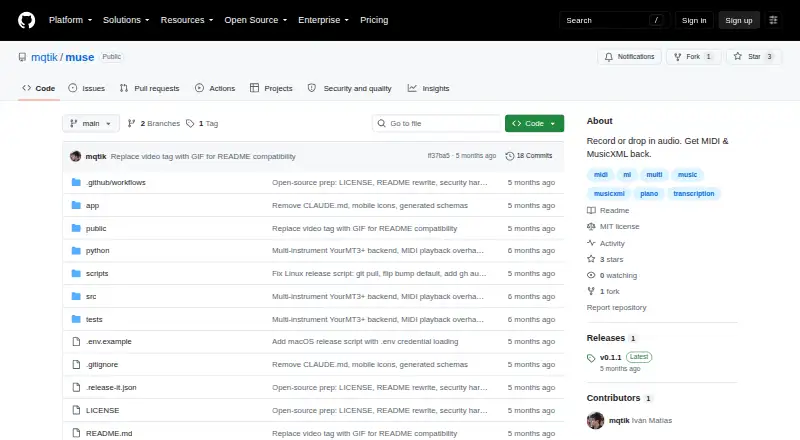
- The GitHub repository shows 6 stars, 2 forks, and 0 watchers.checked 15 Oct 2026
- Demucs model limitation
- An independent HTDemucs model card identifies six-stem htdemucs_6s separation as experimental for guitar and limited for piano quality.checked 15 Oct 2026
- Demucs research
- The Hybrid Transformer Demucs paper reports 9.20 dB SDR on MUSDB with extra training data.checked 15 Oct 2026
- Developer package
- The repository's Node package is named audio2sheets, exposes an audio2sheets CLI, and declares Node >=18.checked 15 Oct 2026
- Downloads
- Builds are listed for Apple-Silicon and Intel macOS, Windows x64, Debian/Ubuntu, and Linux AppImage.checked 15 Oct 2026
- Extensibility
- The source tree contains a Tauri desktop app, SolidJS frontend, Rust backend, Python pipeline, Node CLI/library, and automated tests.checked 15 Oct 2026
- GPU support
- CUDA and Apple Silicon MPS acceleration are supported.checked 15 Oct 2026
- Independent comparison context
- AlternativeTo lists NeuralNote and Basic Pitch as free open-source audio-to-MIDI alternatives and AnthemScore as a paid alternative.checked 15 Oct 2026
- Issue activity
- The repository's open-issues view currently shows zero open issues.checked 15 Oct 2026
- Licence
- Muse is released under the MIT License with copyright attributed to Muse Contributors in 2025.checked 15 Oct 2026
- License
- The repository identifies Muse as open-source and provides an MIT license.checked 4 Oct 2026
- Limit: CPU speed
- The README estimates about two minutes of CPU inference for each 30 seconds of multi-instrument audio.checked 15 Oct 2026
- Limit: instrument timbre
- The maker says piano results worsen for synths, electric pianos, and sounds unlike concert grands.checked 15 Oct 2026
- Limit: model size
- Muse downloads roughly 3 GB of machine-learning models on first launch.checked 15 Oct 2026
- Limit: MusicXML
- MusicXML export is listed as future work; MIDI is the currently available output.checked 15 Oct 2026
- Local processing
- The native Tauri desktop application is designed to keep audio on the user's machine.checked 15 Oct 2026
- MAPS accuracy
- Reported Transkun V2 onset F1 falls to 0.78–0.82 on MAPS real recordings.checked 15 Oct 2026
- MIDI outputs
- The pipeline writes a hand-split score MIDI and a performance MIDI that retains sustain-pedal information.checked 15 Oct 2026
- Multi-instrument
- Its multi-instrument mode transcribes up to 13 tracks in one pass without source separation.checked 4 Oct 2026
- Multi-instrument transcription
- YourMT3+ transcribes arrangements in one pass with up to 13 tracks.checked 15 Oct 2026
Money
- Free plan
- Yeschecked 20 Sep 2026
The company
- Maker identity
- A public GitHub gist profile identifies mqtik as Iván Matías and lists Argentina as the location.checked 15 Oct 2026
- Maker technical background
- A public Editor.js issue shows mqtik discussing native React Native editor work and cross-platform development.checked 15 Oct 2026
Alternatives to Muse
- 1
Sync Labs
Free planAndroidiOSWebAPI8.0From $5 a month - 2

Morph Studio
Free planiOSWeb7.8From $12 a month - 3
VEED
Free planAndroidiOSWebExtension7.5Free plan - 4

CHAMELAION LipSync API
Free planWebAPI7.3From €5 a month - 5

lipsyn.cc
Free planWebAPI7.3€11.99 one-time - 6
LatentSync
Free planOpen sourceAPILinuxSelf-hosted6.9Free plan