
CHAMELAION LipSync API
CHAMELAION LipSync API takes video and audio input and generates a video with mouth movements matched to the audio.
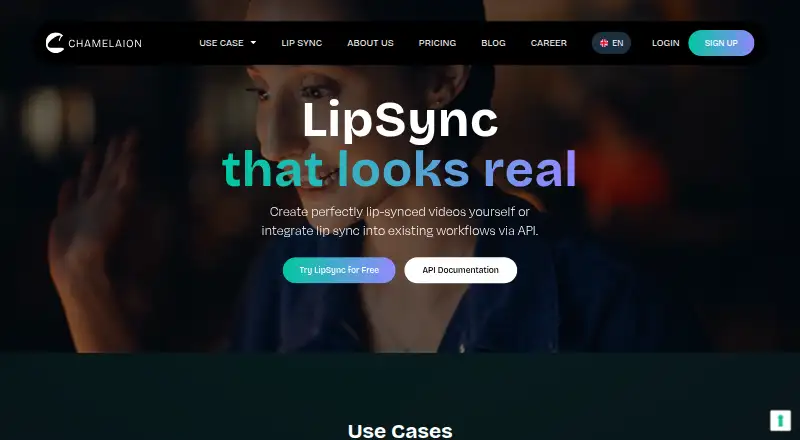
What CHAMELAION LipSync API is
CHAMELAION LipSync API takes video and audio input and generates a video with mouth movements matched to the audio. It accepts MP4 video and WAV or MP3 audio through public URLs or direct upload. Active-speaker detection is automatic and can be disabled for a request. The maker says its model retains speaker identity, speaking style, and expressions while matching mouth movements to new audio. Listed uses include dubbing and translation, AI avatars, creative ads, and dialogue replacement or personalization. SDKs are listed for Python 3.8+ and TypeScript/Node.js 18+. Requests need a Bearer token or x-api-key header, except at the health endpoint; generation endpoints have a 60-requests-per-minute limit, and maximum concurrent jobs depend on the plan. The free Starter plan includes 24,000 tokens and two minutes of translation and lip sync, with a watermark. Basic costs €4.00 per year. The maker says servers are hosted in Europe and users retain ownership of generated videos. Profile views may work when the mouth remains visible; extreme close-ups, side views above 90 degrees, and cropped mouths are difficult cases.
Good
- Accepts MP4 video and WAV or MP3 audio.
- Active-speaker detection can be disabled per request.
- SDKs are listed for Python and TypeScript/Node.js.
- Free Starter includes two minutes of video translation and lip sync.
- Users retain ownership of generated videos.
Watch out
- Starter output includes a watermark.
- Generation endpoints are limited to 60 requests per minute.
- Concurrent job limits depend on the plan.
- Cropped mouths and extreme angles are difficult cases.
Who it suits
It may suit creators, businesses, and organizations working on dubbing, translation, avatars, or dialogue replacement. Developers can connect through the API and its listed Python or TypeScript/Node.js SDKs.
Verdict
CHAMELAION LipSync API is designed for matching video mouth movements to supplied audio, with API access and multiple stated use cases. The free plan has a watermark and limited included minutes; the maker also identifies challenging framing conditions.
Plans and prices
From CHAMELAION LipSync API's own pricing page, checked 15 Oct 2026.
| Plan | Price | What it gives you |
|---|---|---|
| Starter | Free | 50,000 tokens · 2 minutes translation/lip sync · watermark · no credit card · Dubbing Studio · audio/video/SRT download · project management · AI voice library |
| Basic | €4 a year | 60,000 tokens · 5 minutes · 60-minute video length · no watermark · all Starter features · yearly |
| Basic | €5 a month | 60,000 tokens · 5 minutes · videos any size/length · no watermark · all Starter features · monthly |
| Bronze | €20 a year | 60,000 tokens · 5 minutes · 60-minute video length · no watermark · extra tokens · yearly |
| Bronze | €25 a month | 60,000 tokens · 5 minutes · videos any size/length · no watermark · extra tokens · monthly |
| Silver | €96 a year | 60,000 tokens · 5 minutes · 3 seats · glossary · priority support · SRT upload · extra tokens · yearly |
| Silver | €120 a month | 60,000 tokens · 5 minutes · 3 seats · glossary · priority support · SRT upload · extra tokens · monthly |
| Gold | €400 a year | 60,000 tokens · 5 minutes · 5 seats · glossary · priority support · SRT upload · extra tokens · yearly |
| Gold | €500 a month | 60,000 tokens · 5 minutes · 5 seats · glossary · priority support · SRT upload · extra tokens · monthly |
| Enterprise | Priced on request | Custom pricing and tokens · videos any size/length · no watermark · premium support · custom contract |
The facts
Each one read from CHAMELAION LipSync API's own pages, with the date it was checked.
What it does
- AI avatars
- The product is marketed for making AI avatars speak with realistic lip articulation.checked 15 Oct 2026
- API endpoints
- LipSync exposes URL and multipart upload generation endpoints plus request retrieval and listing endpoints.checked 15 Oct 2026
- API error limits
- Documented failures include inaccessible or unsupported media, stalled uploads over 30 seconds, exhausted token quota, videos over 2 GiB, concurrency/rate limits and server errors.checked 15 Oct 2026
- API limits
- Generation endpoints have a rate limit of 60 requests per minute, and maximum concurrent jobs depend on the plan.checked 30 Sep 2026
- API model
- The API is asynchronous: generation returns a request ID that is polled for completion, with webhooks available for video translation.checked 15 Oct 2026
- Audio sources
- Audio may be uploaded by the user or generated from text using cloned or synthetic voices.checked 15 Oct 2026
- Authentication
- API calls use a bearer token or x-api-key header; keys are created in Dashboard settings and shown once.checked 15 Oct 2026
- Camera robustness
- The maker says profile and non-frontal views, beards, head motion, partial occlusion, low light, cuts and strong shadows are generally supported when the mouth remains visible.checked 15 Oct 2026
- Developer support
- The API documentation lists SDKs for Python 3.8+ and TypeScript/Node.js 18+.checked 30 Sep 2026
- Dialogue replacement
- Finished videos can have words or complete lines replaced without a reshoot.checked 15 Oct 2026
- Documentation depth
- The docs include quickstart, authentication, generation, polling, error handling, API reference and runnable cURL, Python and TypeScript examples.checked 15 Oct 2026
- Founders and accelerator
- A hessian.AI announcement says Pascal Fischer, Julian Wustl and Dr. Yannik Rover founded the startup, which joined the Accelerator RISING 2025 program.checked 15 Oct 2026
- Founding registration
- The independent company register records CHAMELAION GmbH as registered on 7 November 2024 in Frankfurt.checked 15 Oct 2026
- Funding information
- Dealroom lists Frankfurt headquarters, a November 2024 launch, 2–10 employees and investor entries including Lauer Investment, BF Holding, PMA Capital Group and RL Ventures, without publishing round amounts.checked 15 Oct 2026
- Identity and style
- The maker says its lip-sync model preserves speaker identity, speaking style, and expressions while matching lip movements to new audio.checked 30 Sep 2026
- Input
- The API accepts MP4 video and WAV or MP3 audio via public URLs or direct upload.checked 30 Sep 2026
- Input constraints
- The product page says LipSync handles profile views when the mouth remains sufficiently visible; extreme close-ups, extreme side views above 90 degrees, and cropped mouths are listed as difficult scenarios.checked 30 Sep 2026
- Input formats
- The web workflow supports MP4 and MOV video, while the API accepts common video and audio formats including MP4, WAV and MP3.checked 15 Oct 2026
- Intended users
- The company describes its platform as serving creators, businesses, and organizations, and says it supports audio and video translation into 30 languages.checked 30 Sep 2026
- Legal entity
- The imprint identifies the maker as CHAMELAION GmbH, Berger Straße 342, 60385 Frankfurt am Main, registered under HRB 136581.checked 15 Oct 2026
- Licence and self-hosting
- The public documentation does not state an open-source licence or provide a self-hosting option.checked 15 Oct 2026
The company
- Company profile
- LinkedIn describes CHAMELAION as a German AI research and development company headquartered in Frankfurt with 2–10 employees and a 2024 founding year.checked 15 Oct 2026
- Content ownership
- CHAMELAION says users retain full ownership of generated videos and that the company processes content for translation and dubbing purposes.checked 30 Sep 2026
- Headquarters
- The imprint lists CHAMELAION GmbH at Berger Straße 342, 60385 Frankfurt am Main, Germany.checked 30 Sep 2026
The full review of CHAMELAION LipSync API
CHAMELAION LipSync API is best suited to developers building video dubbing, translation, avatar or advertising workflows that need lip-sync generation in an API pipeline. It pairs broad input options with developer SDKs, but small included translation quotas and demanding footage conditions make plan choice and source material important.
Overview
The API combines MP4 video with WAV or MP3 audio, supplied through a public URL or direct upload, to produce a new video with matched mouth movements. Automatic active-speaker detection can be disabled per request, which gives developers an option when they need to manage speaker selection themselves. CHAMELAION says its model preserves speaker identity, speaking style and expressions; those aims make it relevant to dubbing and dialogue replacement, but the source footage still has to show the mouth clearly enough.
The company names video dubbing and translation, AI avatars, UGC and creative ads, and dialogue replacement or personalization as use cases. It describes translation into 30 languages, while the supported-languages count is 28. Buyers should verify that their required languages are covered before building a workflow around it.
Key features
- API workflow: URL or direct-upload input supports both automated pipelines and submitted clips. Generation endpoints are limited to 60 requests per minute, and maximum concurrent jobs depend on the plan, so higher-volume workloads need to account for plan capacity.
- Developer support: Documentation lists SDKs for Python 3.8+ and TypeScript/Node.js 18+. Authentication uses a Bearer token or x-api-key header, except for the health endpoint. This is a clear fit for teams already working in those environments; no SDK support for other languages is established.
- Image quality and framing: Output resolution is 1080p, and the maker says the model retains identity, style and expression. Profile views can work when the mouth remains sufficiently visible, but extreme close-ups, side views beyond 90 degrees and cropped mouths are difficult cases. Teams with varied or poorly framed footage should expect those conditions to narrow the usable material.
- Ownership and handling: CHAMELAION says users retain full ownership of generated videos and that it processes content for translation and dubbing. Its servers are hosted in Europe, and it says subcontractors comply with GDPR or have signed Data Processing Agreements. Those terms may matter to organizations evaluating vendor and content handling.
Pricing
The free Starter plan costs nothing and includes 24,000 tokens, equivalent to 2 minutes of video translation and lip-sync. Output carries a watermark, but no credit card is required. It is a practical way to evaluate a short workflow, not a generous ongoing allowance.
Basic costs €4 a year (billed Yearly) for 60,000 tokens, equivalent to 5 minutes of video translation and lip-sync, with no watermark and videos of any size and length. The low annual price removes the watermark and stated video-length restriction, but five minutes remains a tight quota for regular work. Bronze costs €20 a year (billed Yearly) for 60,000 tokens and 5 minutes of video translation, with a 60-minute video-length limit and extra tokens available. It suits users who value the option to buy more tokens and can work within that length cap; it does not state lip-sync in its included-minutes description.
Silver costs €96 a year (billed Yearly) and includes 60,000 tokens, 5 minutes of video translation, 3 seats, a glossary, priority support and SRT upload. It is the more relevant annual tier for a small team needing those workflow features, though its stated translation allowance is still short. Gold costs €500 a month (billed Monthly) for 60,000 tokens, 5 minutes of video translation and lip-sync, 5 seats, a glossary, priority support and SRT upload. That monthly commitment is difficult to justify for occasional use; it is aimed at teams that need its collaboration and support provisions. Enterprise has custom pricing, individual pricing and tokens, premium support and a custom contract.
The pricing note gives paid plans from €4/mo (annual), while the Basic plan is shown as €4 a year; readers should distinguish that annual plan price from the monthly-equivalent pricing note.
Platforms
CHAMELAION offers API and web access. That combination serves developers integrating generation into software as well as users who prefer a web option. Output resolution is 1080p, and the API documentation names Python 3.8+ and TypeScript/Node.js 18+ SDKs.
Who it's for
This is a sensible option for creators, businesses and organizations with a defined dubbing or lip-sync workflow, particularly teams able to use the API and work within a small included-minute allowance. Its API inputs, speaker-detection control and language support suit automation and repeatable localization jobs. It is a weaker fit for high-volume use on the lower tiers, footage dominated by cropped or extreme-angle mouths, or teams whose required language is outside the 28 supported languages.
Pros and cons
- Pros: Public-URL and upload inputs make it adaptable to different pipelines; per-request control of speaker detection offers flexibility; 1080p output and Python and TypeScript/Node.js SDKs support a developer-led workflow; Europe-hosted servers, stated GDPR/DPA commitments and user ownership address important organizational concerns.
- Cons: Starter includes only 2 minutes and adds a watermark; most paid tiers describe just 5 minutes of translation, making quotas a central constraint; difficult framing conditions can rule out otherwise useful footage; maximum concurrency varies by plan, and the plans do not give a single fixed job limit.
Alternatives
For a broader comparison, browse AI Video Lip Sync Tools.
- VEED is worth considering for Android, iOS or browser-extension access; its free plan exports only at 720p and adds a watermark, unlike CHAMELAION's 1080p output.
- SadTalker is the alternative for users who want offline, open-source software across Linux, macOS and Windows rather than a hosted API and web service.
- LipDub offers API and web access with a free tier that includes one minute at 1080p, plus AI dubbing and voice cloning; compare its allowance and paid tiers against CHAMELAION's short quotas.
- lipsyn.cc may suit a one-off job: it offers a five-second preview without sign-up or a card, and a Quick Take priced at $6.99, paid once for five minutes.
- Muse is a free, open-source MIDI-output tool, not a like-for-like lip-sync service.
- Sync Labs offers a free tier with three generations per month, each capped at 20 seconds, plus separate text-to-speech generations; it may suit readers who can work within those small monthly limits.
- Rendley offers a free tier with no card requirement or time limit, and is operated by Onix Technologies SRL in Moldova.
- Morph Studio is a web-based option for users who also want text/image-to-video, text-to-image and video style-transfer tools alongside monthly credits.
Verdict
Choose CHAMELAION LipSync API if you need an API-led dubbing or lip-sync workflow, can confirm language coverage and have footage with visible mouths. Its broad input methods, SDK support and 1080p output are the strongest reasons to choose it. Look elsewhere if five included minutes will not cover your work, your footage often falls into the difficult framing cases, or you need a fixed high-concurrency allowance.
Getting started
- Open the CHAMELAION LipSync website
- Choose the web interface or API route
- Select a Starter or paid plan
- Prepare an MP4 video and WAV or MP3 audio
- Provide media through a public URL or direct upload
- Authenticate API requests with a Bearer token or x-api-key
- Use the Python or TypeScript/Node.js SDK documentation
Limits worth knowing
Starter includes 24,000 tokens and two minutes of video translation and lip sync, with a watermark. API generation is limited to 60 requests per minute, and concurrent jobs vary by plan.
Questions
Is there a free plan?
Yes. Starter costs nothing and includes 24,000 tokens plus two minutes of video translation and lip sync, with a watermark.
What does Basic cost?
Basic is listed at €5 a month, billed monthly.
Which media formats can I send?
The API accepts MP4 video and WAV or MP3 audio through public URLs or direct upload.
Which platforms and languages are supported?
It is available through web and API access, supports 28 languages, and documents SDKs for Python 3.8+ and TypeScript/Node.js 18+.
Does it support voice cloning and watermark-free output?
Voice cloning is supported. Watermark-free output is listed, while the free Starter plan includes a watermark.
Who owns generated videos?
CHAMELAION says users retain full ownership of generated videos.
Alternatives to CHAMELAION LipSync API
- 1
Sync Labs
Free planAndroidiOSWebAPI8.0From $5 a month - 2

Morph Studio
Free planiOSWeb7.8From $12 a month - 3
VEED
Free planAndroidiOSWebExtension7.5Free plan - 4
Muse
Free planOpen sourceLinuxmacOSSelf-hostedWindows7.4Free plan - 5
lipsyn.cc
Free planWebAPI7.3€11.99 one-time - 6
LatentSync
Free planOpen sourceAPILinuxSelf-hosted6.9Free plan