Moby
Moby is an open framework created by Docker for assembling specialized container systems from standard components.
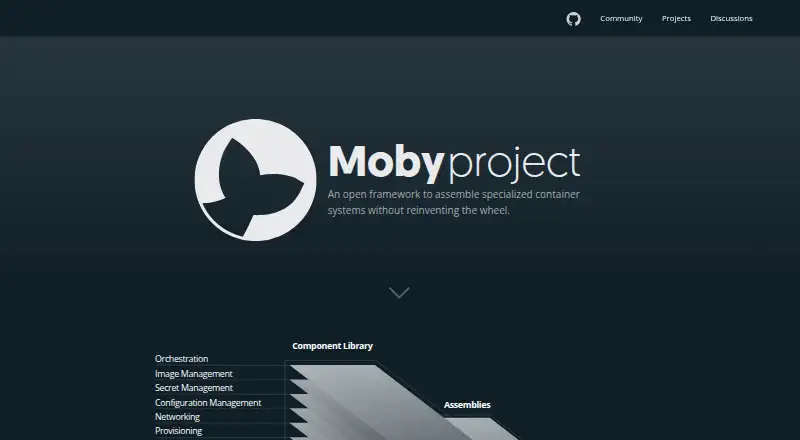
What Moby is
Moby is an open framework created by Docker for assembling specialized container systems from standard components. It supplies containerized parts for operating systems, runtimes, orchestration, infrastructure, networking, storage, security, builds, and image distribution. Its tools can produce runnable artifacts for bare-metal x86 and Arm, executables for Linux, Mac, and Windows, and VM images for cloud and virtualization providers. Reference assemblies can be used as provided, adapted, or treated as starting points; the components are OCI-compatible containers. Moby is modular: parts expose functions and APIs that work together and can usually be replaced with other implementations. Containerd is its default runtime, and the ecosystem connects with Kubernetes through related projects. Moby is free under the Apache License 2.0 and supports Linux, macOS, and Windows hosts, as well as API and self-hosted use. Releases receive best-effort community and maintainer support, not commercial support. The project is aimed at engineers, integrators, and enthusiasts who want to build or experiment with container-based systems.
Good
- Free and licensed under Apache License 2.0.
- Builds artifacts for bare-metal, desktop, and virtual environments.
- Modular components can usually be swapped.
- Supports Linux, macOS, and Windows hosts.
Watch out
- Commercial support is not provided.
- Not positioned as an easy application-running tool.
- Use and transfer may face government restrictions.
Who it suits
Moby suits engineers, integrators, and enthusiasts who want to modify or assemble container-based systems. Application developers seeking a simpler way to run containers are directed to Docker CE, while enterprise teams seeking commercial support are directed to Mirantis Container Runtime.
Verdict
Moby is a flexible foundation for people assembling or adapting container systems from modular components. Its best-effort support model and engineering focus may not suit users looking for a ready-to-run or commercially supported platform.
The facts
Each one read from Moby's own pages, with the date it was checked.
What it does
- Assemblies
- Reference assemblies can be used as-is, modified or used as inspiration, and components are OCI-compatible containers.checked 2 Oct 2026
- Audience
- The project is intended for engineers, integrators, and enthusiasts who want to modify, experiment with, or build container-based systems.checked 2 Oct 2026
- Build outputs
- Its tools create runnable artifacts for bare-metal x86 and Arm, Linux, Mac and Windows executables, and VM images for cloud and virtualization providers.checked 2 Oct 2026
- Commercial support
- Moby releases are supported by maintainers, the community and users on a best-efforts basis only.checked 2 Oct 2026
- Components
- It provides containerized components for operating systems, runtimes, orchestration, infrastructure, networking, storage, security, builds and image distribution.checked 2 Oct 2026
- Default runtime
- Moby uses containerd as its default container runtime.checked 2 Oct 2026
- Kubernetes integration
- The Moby ecosystem integrates with Kubernetes through projects including containerd, LinuxKit, InfraKit, libnetwork, Notary and libentitlement.checked 2 Oct 2026
- Legal restriction
- Use and transfer of Moby may be subject to restrictions imposed by the United States and other governments.checked 2 Oct 2026
- License
- Moby is licensed under the Apache License, Version 2.0.checked 2 Oct 2026
- Modularity
- The project is modular, with components exposing functions and APIs that work together and can usually be swapped for other implementations.checked 2 Oct 2026
- Purpose
- Moby is an open framework created by Docker for assembling specialized container systems from standard components.checked 2 Oct 2026
- Runtime
- Moby uses containerd as its default container runtime.checked 2 Oct 2026
- Security
- The project says it provides secure defaults without compromising usability.checked 2 Oct 2026
- Security reporting
- Security vulnerabilities should be reported privately to [email protected], and reporters can expect an acknowledgement within 72 hours.checked 2 Oct 2026
- Support
- Releases receive best-effort support from maintainers, the community, and users; Moby is not intended to provide commercial support.checked 2 Oct 2026
- Target users
- Moby is intended for engineers, integrators and enthusiasts who want to modify, experiment with and build container-based systems.checked 2 Oct 2026
- What it does
- Moby is an open framework created by Docker for assembling specialized container systems.checked 2 Oct 2026
Where it runs
- Not for application developers
- The project recommends Docker CE for application developers seeking an easy way to run applications in containers.checked 2 Oct 2026
- Security approach
- Moby says it provides secure defaults without compromising usability.checked 2 Oct 2026
The company
- Not for enterprise teams
- The project recommends Mirantis Container Runtime for enterprise IT and development teams seeking a ready-to-use, commercially supported container platform.checked 2 Oct 2026
Alternatives to Moby
- 1

LXD
Free planWebAPILinuxSelf-hosted7.0From $25 a year - 2
BuildKit
Free planAPILinuxmacOSSelf-hosted6.8Free plan - 3
Incus
Free planAPILinuxmacOSSelf-hosted6.8Free plan - 4
Apptainer
Free planAPILinuxmacOSSelf-hosted6.7Free plan - 5
crun
Free planLinuxSelf-hosted6.5Free plan - 6

Buildah
Free planAPILinuxSelf-hosted6.4Free plan