
Minikube
Minikube creates a local Kubernetes cluster for application developers and people learning Kubernetes.
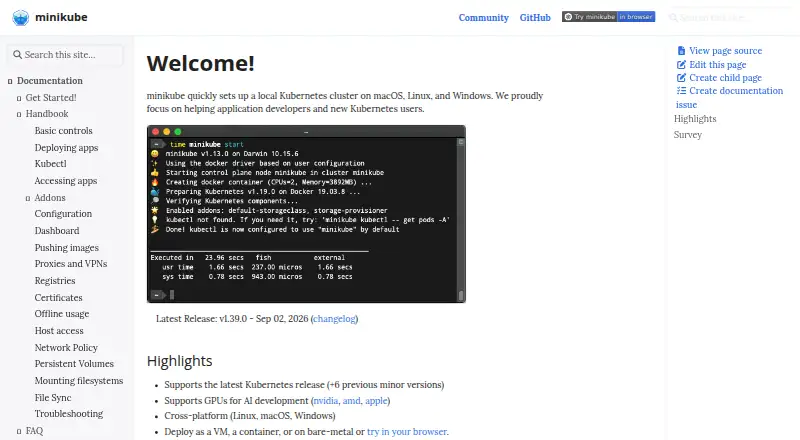
What Minikube is
Minikube creates a local Kubernetes cluster for application developers and people learning Kubernetes. A cluster can run as a virtual machine, a container, or on bare metal. The project supports the latest Kubernetes release and the six preceding minor versions, and lists CRI-O, containerd, and Docker as supported container runtimes.
Documented cluster capabilities include LoadBalancer, filesystem mounts, FeatureGates, and network policy; maintained addons can extend Kubernetes functionality. Minikube supports NVIDIA, AMD, and Apple GPUs for AI development. Supported drivers include Docker, KVM2, VirtualBox, QEMU, Podman, and SSH, though availability varies by operating system. The project also documents using Minikube in GitHub Actions for application testing.
Getting started requires at least 2 CPUs, 2 GB of free memory, 20 GB of free disk space, an internet connection, and a container or VM manager. The latest version can also be tried in a browser for free after signing into GitHub. Minikube is free on macOS, Linux, and Windows. Its documentation describes it as a learning and development tool, not a production cluster solution.
Good
- Runs clusters as VMs, containers, or on bare metal.
- Supports the latest Kubernetes release and six earlier minor versions.
- Supports NVIDIA, AMD, and Apple GPUs.
- Maintained addons extend Kubernetes functionality.
- Can be tried in a browser after signing into GitHub.
Watch out
- Requires at least 2 CPUs and 2 GB free memory.
- Requires 20 GB free disk space and internet access.
- A container or VM manager is required.
- Documentation positions it for learning and development, not production.
Who it suits
Minikube suits application developers and people learning Kubernetes who need a local cluster. Its documentation directs production users to Kubernetes production environment documentation.
Verdict
Minikube offers multiple local cluster modes and a range of documented Kubernetes features. Its stated requirements and learning-and-development focus make it important to check whether it fits the intended environment.
Plans and prices
From Minikube's own pricing page, checked 7 Oct 2026.
| Plan | Price | What it gives you |
|---|---|---|
| Minikube | Free | Local Kubernetes for learning and development |
The facts
Each one read from Minikube's own pages, with the date it was checked.
What it does
- Addons
- Maintained addons extend Minikube with additional Kubernetes functionality.checked 7 Oct 2026
- Cluster features
- The site lists LoadBalancer, filesystem mounts, FeatureGates, and network policy among its advanced features.checked 7 Oct 2026
- Container runtimes
- The project lists CRI-O, containerd, and Docker as supported container runtimes.checked 7 Oct 2026
- Deployment options
- A cluster can run as a VM, a container, or on bare metal.checked 7 Oct 2026
- Driver integrations
- Supported drivers include Docker, KVM2, VirtualBox, QEMU, Podman, and SSH, with availability varying by operating system.checked 7 Oct 2026
- GPU support
- Minikube supports GPUs for AI development, including NVIDIA, AMD, and Apple GPUs.checked 7 Oct 2026
- Integrations
- The project documents using Minikube in GitHub Actions for application testing.checked 7 Oct 2026
- Kubernetes versions
- Minikube supports the latest Kubernetes release and six previous minor versions.checked 7 Oct 2026
- Limits
- The documentation says Minikube is for learning and development and directs users to Kubernetes production environment documentation for production clusters.checked 7 Oct 2026
- Purpose
- Minikube sets up a local Kubernetes cluster for application developers and new Kubernetes users.checked 7 Oct 2026
- Requirements
- The getting started guide lists 2 or more CPUs, 2 GB of free memory, 20 GB of free disk space, an internet connection, and a container or VM manager as requirements.checked 7 Oct 2026
- Security
- The tutorials include examples for audit policy and OpenID Connect authentication.checked 7 Oct 2026
- Support
- The project README lists Kubernetes Slack, user and developer mailing lists, and community meetings as ways to engage with the community.checked 7 Oct 2026
Where it runs
- Browser use
- The getting started guide says the latest Minikube version can be tried in a browser for free after signing into GitHub.checked 7 Oct 2026
Alternatives to Minikube
- 1

Garden
Free planOpen sourceWebAPILinuxmacOS8.3From $50 a month - 2

DevPod
Free planOpen sourceLinuxmacOSSelf-hostedWindows7.4Free plan - 3
Docker Desktop
Free planWebLinuxmacOSWindows7.2From $9 a month - 4

OrbStack
Free planAPImacOS7.2From $8 a month - 5

Testcontainers Desktop
Free planWebAPILinuxmacOS7.2Free plan - 6
Kool
Free planWebLinuxmacOSWindows7.1From $49 a month