Metalware
Metalware is a binary analysis platform for locating crashes and vulnerabilities in embedded firmware.
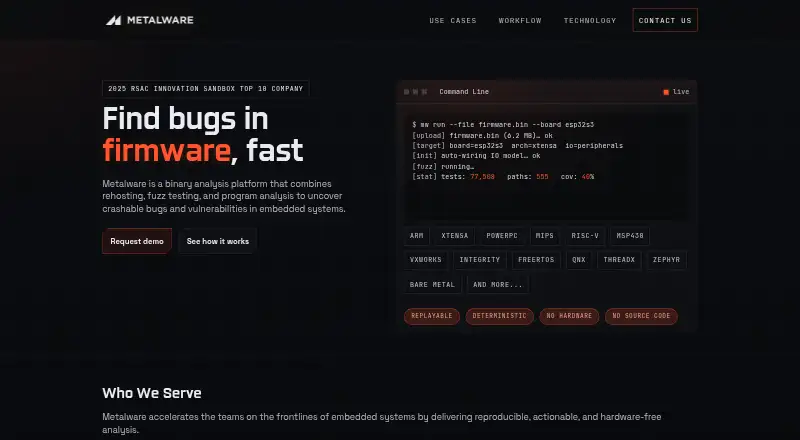
What Metalware is
Metalware is a binary analysis platform for locating crashes and vulnerabilities in embedded firmware. It accepts ELF and raw .bin files, including ROMs, binary images, update blobs, and extracted components, with a device or board profile; debug symbols are optional. The platform works without physical hardware, source code, or a test harness. It emulates an ARM Cortex-M processor, models memory-mapped peripheral input and output, detects DMA buffers, and uses coverage-guided fuzzing with generation, mutation, and symbolic input methods. Analysis runs through a web interface, CLI, or CI/CD API, as a cloud service or on-premise deployment. Results include stack traces, root-cause analysis, and reproducible proof-of-concept inputs, with time-travel debugging plus Ghidra, Binary Ninja, and remote GDB support. GitHub Actions and GitLab CI workflows can file issues automatically. PDF reports are available for audits. The default analysis lasts 24 hours and can be changed in the dashboard.
Good
- Works without hardware or source code
- Coverage-guided firmware fuzzing
- Stack traces and root-cause analysis
- CI/CD API and issue filing
- Cloud or on-premise deployment
Watch out
- Supports ARM Cortex-M firmware
- On-premise fuzzing is CPU intensive
- Pricing requires contacting sales
- On-premise use requires Linux and Docker
Who it suits
Metalware is intended for product security teams, DevSecOps practitioners, reverse engineers, vulnerability researchers, and firmware engineers analyzing ARM Cortex-M systems. It suits teams wanting cloud or on-premise workflows connected to CI/CD and debugging tools.
Verdict
Metalware brings emulation, fuzzing, and binary analysis into one workflow for embedded firmware. Its ARM Cortex-M focus, CPU demands for on-premise use, and sales-led pricing shape the fit.
The facts
Each one read from Metalware's own pages, with the date it was checked.
What it does
- Analysis duration
- The default analysis duration is 24 hours and can be configured from the dashboard.checked 7 Oct 2026
- Analysis output
- Defect details include root cause analysis, a stack trace, and a reproducible proof-of-concept input.checked 7 Oct 2026
- Analysis results
- Defects include a stack trace, root cause analysis, and proof-of-concept input, and can be reproduced with time-travel debugging.checked 7 Oct 2026
- CI/CD integrations
- The maker documents GitHub Actions and GitLab CI workflows, with options to file discovered defects as GitHub or GitLab issues.checked 7 Oct 2026
- Debugger integrations
- Metalware provides Ghidra and Binary Ninja plugins and remote GDB for investigating defects.checked 7 Oct 2026
- Debugging integrations
- Metalware provides debugging through Ghidra and Binary Ninja plugins and remote GDB.checked 7 Oct 2026
- Deployment
- Metalware is available as a cloud service or on-premise deployment; the on-premise instructions require a modern Linux computer with Docker.checked 7 Oct 2026
- Emulation
- It runs firmware on an emulated ARM Cortex-M processor and models peripheral I/O without physical hardware.checked 7 Oct 2026
- Emulation and fuzzing
- Metalware emulates an ARM Cortex-M processor, models memory-mapped peripheral I/O, automatically detects DMA buffers, and uses coverage-guided fuzzing.checked 7 Oct 2026
- Fuzzing
- Its coverage-guided fuzzer tracks basic blocks, keeps inputs that reach new code, and mutates them to explore further.checked 7 Oct 2026
- Input requirements
- Metalware supports ELF and raw .bin binaries for ARM Cortex-M firmware, and debug symbols are not required.checked 7 Oct 2026
- Inputs
- It accepts firmware ELF files, ROMs, binary images, update blobs, and extracted components, with a device or board profile and optional symbols or metadata.checked 7 Oct 2026
- Intended users
- The maker describes use by product security teams, DevSecOps, reverse engineers and vulnerability researchers, and firmware engineers.checked 7 Oct 2026
- Issue tracking
- The CLI can automatically file newly discovered defects as GitHub or GitLab issues and deduplicates previously filed issues.checked 7 Oct 2026
- No hardware or source
- The maker says analysis runs without physical hardware or source code, and requires no test harness.checked 7 Oct 2026
- Notable limits
- The docs specify support for ARM Cortex-M firmware and say on-premise fuzzing is CPU intensive, with performance scaling linearly with core count.checked 7 Oct 2026
- On-premise requirements
- The on-premise documentation says a modern Linux computer with Docker should work and that fuzzing is CPU intensive, with performance scaling linearly with core count.checked 7 Oct 2026
- Product
- Metalware is a binary analysis platform that combines rehosting, fuzz testing, and program analysis to find crashable bugs and vulnerabilities in embedded systems.checked 7 Oct 2026
- Purpose
- Metalware analyzes firmware binaries to find crashes and vulnerabilities using rehosting, fuzz testing, and program analysis.checked 7 Oct 2026
- Reports
- Metalware generates a downloadable PDF report for every defect, with summary, root cause analysis, stack trace, and proof-of-concept data.checked 7 Oct 2026
- Support
- The contact page lists [email protected] and says the team typically responds within 24 hours.checked 7 Oct 2026
- Supported firmware
- The documentation says Metalware supports ELF and raw .bin binaries for ARM Cortex-M firmware, and debug symbols are not required.checked 7 Oct 2026
- Workflow access
- Users can run analysis through a web interface, CLI, or CI/CD API.checked 7 Oct 2026
The company
- Company
- The company site identifies the maker as Metalware Inc.; LinkedIn lists its headquarters as San Francisco, California, and its founding year as 2023.checked 7 Oct 2026
Alternatives to Metalware
- 1
Jazzer
Free planOpen sourceAPILinuxmacOSSelf-hosted7.3Free plan - 2
AFL++
Free planAndroidLinuxmacOSSelf-hosted7.2From €20,000 a year - 3

Mayhem
Free planWebAPILinuxmacOS7.0From $236 a month - 4

ClusterFuzz
Free planWebLinuxmacOSSelf-hosted6.8Free plan - 5
cargo-fuzz
Free planLinuxmacOSWindows6.7Free plan - 6
boofuzz
Free planAPILinuxSelf-hostedWindows6.4Free plan