Meta Amiga Emulator
Meta Amiga Emulator is a free, open-source project intended to emulate Commodore Amiga systems for games, Workbench, and demoscene productions.
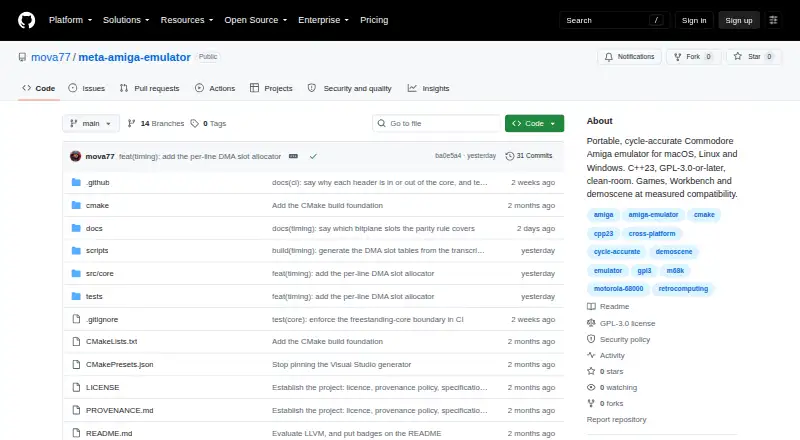
What Meta Amiga Emulator is
Meta Amiga Emulator is a free, open-source project intended to emulate Commodore Amiga systems for games, Workbench, and demoscene productions. Its planned machine coverage includes the A1000, A500, A500+, A600, A1200, A2000, A3000, A4000, CDTV, and CD32. The specification lists media formats such as ADF, ADZ, DMS, HDF, SCP, KryoFlux raw, and ISO/CUE/CHD, with IPF/CAPS support described as optional and dependent on a non-free library. Kickstart ROMs are not included; the project says it supports user-owned ROMs and bundles AROS as a fallback. The project targets macOS, Linux, and Windows and is written from scratch in C++23 under GPL-3.0-or-later. Its current state is pre-alpha: there is no emulator to run yet, and the repository contains design, build, and CI work. Building the current core requires CMake 3.28 or newer, Ninja, and a supported C++23 compiler, but does not produce a runnable emulator. GUI, configuration, save states, RTG, and releases are placed in a later roadmap phase.
Good
- Free and licensed under GPL-3.0-or-later.
- Targets macOS, Linux, and Windows.
- Planned scope covers ten Amiga systems.
- Designed for multiple disk and CD image formats.
- Project specifies user-owned ROM support and AROS fallback.
Watch out
- Pre-alpha project has no emulator to run yet.
- Current build does not produce a runnable emulator.
- Kickstart ROMs are not included.
- IPF/CAPS support requires a non-free library.
Who it suits
This project is for Amiga enthusiasts and developers interested in an open-source emulator in development. It is not yet suitable for someone who needs an emulator to run now.
Verdict
Meta Amiga Emulator has a defined Amiga scope and cross-platform implementation plan, but it remains pre-alpha with no runnable emulator. Consider it a project to follow rather than a usable emulator at this stage.
Plans and prices
From Meta Amiga Emulator's own pricing page, checked 9 Oct 2026.
| Plan | Price | What it gives you |
|---|---|---|
| Free / open source | Free | GPL-3.0-or-later · pre-alpha; no emulator to run yet |
The facts
Each one read from Meta Amiga Emulator's own pages, with the date it was checked.
What it does
- Amiga Forever support
- The specification says encrypted Amiga Forever ROMs can be decrypted at load time using the user's rom.key.checked 9 Oct 2026
- Architecture
- The specification describes a freestanding emulation core with explicit video, audio, input, storage, and clock interfaces.checked 8 Oct 2026
- Build requirements
- Building requires CMake 3.28 or later, Ninja and a C++23 compiler; the listed compiler minimums include Clang 17, AppleClang 15, GCC 13 or MSVC 19.38.checked 9 Oct 2026
- Compatibility goal
- It targets at least 99% compatibility across a published corpus of games, Workbench revisions and demoscene productions, verified automatically.checked 9 Oct 2026
- Compatibility testing
- Its planned verifier runs a deterministic corpus and compares framebuffer and audio hashes against stored references; regressions are intended to fail CI.checked 8 Oct 2026
- Current status
- The project is pre-alpha and says there is no emulator yet; the existing work is the specification, architecture, build and CI.checked 9 Oct 2026
- Determinism
- The specification requires identical inputs to produce bit-identical runs across platforms and build configurations.checked 9 Oct 2026
- Hardware coverage
- The stated scope includes Amiga models from A1000 through A4000, plus CDTV and CD32, with OCS, ECS and AGA chipsets.checked 9 Oct 2026
- Hardware scope
- The planned machine scope includes A1000, A500, A500+, A600, A1200, A2000, A3000, A4000, CDTV, and CD32 systems.checked 8 Oct 2026
- Implementation
- The project is written from scratch in C++23 and licensed under GPL-3.0-or-later.checked 8 Oct 2026
- Implementation provenance
- The project describes itself as a clean-room implementation containing no code from other emulators.checked 9 Oct 2026
- License
- The project is licensed under GNU GPL version 3 or later.checked 9 Oct 2026
- Media formats
- Planned media support includes ADF, ADZ, DMS, HDF, LHA/WHDLoad, SCP and raw KryoFlux images.checked 9 Oct 2026
- Media support
- The specification lists ADF, Extended ADF, ADZ, DMS, SCP flux, KryoFlux raw, HDF, directory-mapped volumes, and CD media formats.checked 8 Oct 2026
- Near-term limits
- The roadmap places the GUI, configuration, save states, RTG and releases in phase 8, with release 26.1.0 as its exit criterion.checked 9 Oct 2026
- Optional dependency
- IPF/CAPS support is optional, requires the non-free capsimage library, and is specified to be excluded from release binaries.checked 8 Oct 2026
- Project status
- The project is pre-alpha and says there is no emulator yet; the repository currently contains its design, build, and CI.checked 8 Oct 2026
- Purpose
- Meta Amiga is a portable, cycle-accurate Commodore Amiga emulator project for macOS, Linux and Windows.checked 9 Oct 2026
- Roadmap
- The roadmap places GUI, configuration, savestates, RTG, and releases in phase 8, with release 26.1.0 as its exit criterion.checked 8 Oct 2026
- ROM handling
- No copyrighted Kickstart ROMs are included; the project says it supports user-owned ROMs, including encrypted Amiga Forever files, and bundles AROS as a fallback.checked 8 Oct 2026
- ROMs
- No Kickstart ROM is included; the project says it loads ROMs the user owns and ships AROS as a redistributable fallback.checked 9 Oct 2026
- Security and provenance
- The project describes itself as a clean-room implementation and says it contains no code from UAE, WinUAE, FS-UAE, vAmiga, or other emulators.checked 8 Oct 2026
- Security and quality
- The repository says CI uses warnings-as-errors and runs ASan, UBSan and TSan builds across three platforms and two architectures.checked 9 Oct 2026
- Target systems
- The stated target platforms are macOS, Linux, and Windows, built from identical sources.checked 8 Oct 2026
The full review of Meta Amiga Emulator
Meta Amiga Emulator is a free, open-source project aiming to bring cycle-accurate Amiga emulation to macOS, Linux, and Windows. It is best suited to developers and Amiga enthusiasts following emulator development; its broad design is compelling, but it cannot run Amiga software yet.
Overview
The project is designed for games, Workbench, and demoscene productions across Amiga models from the A1000 through A4000, plus CDTV and CD32, with OCS, ECS, and AGA chipset support as a goal. That range gives the project a clear purpose, but it remains a target rather than usable compatibility: the current pre-alpha work covers the specification, architecture, build, and CI, and produces no runnable emulator.
Meta is a clean-room implementation written from scratch in C++23 and licensed under GPL-3.0-or-later. Its freestanding core is planned around explicit video, audio, input, storage, and clock interfaces, a structure that should help keep the emulation core portable. The identical-source builds and determinism goals are technically ambitious; for players, they matter only once there is an emulator to use.
Key features
- Broad planned media support: The specification spans ADF, Extended ADF, ADZ, DMS, SCP flux, KryoFlux raw, IPF/CAPS, HDF, directory-mapped volumes, LHA/WHDLoad, and ISO/CUE/CHD. This would suit collectors with varied disk and CD images if implemented. The breadth is useful as a roadmap, not a reason to switch from a working emulator today.
- User-owned ROM handling: Kickstart ROMs are not included. The project says it supports ROMs users own, including encrypted Amiga Forever files unlocked with the user's rom.key, and bundles AROS as a redistributable fallback. That gives the plan a route for users with their own ROMs while avoiding a bundled copyrighted Kickstart, but it does not remove the need for a runnable build.
- Accuracy and repeatability goals: The project targets at least 99% run-to-playable game compatibility, booting every shipped ROM revision to usable Workbench, and at least 99% frame-exact demoscene results. Its planned verifier compares framebuffer and audio hashes for a deterministic corpus, with regressions intended to fail CI. These are measurable quality goals, though they remain targets rather than demonstrated compatibility.
- Cross-platform engineering: The design requires identical inputs to produce bit-identical runs across platforms and build configurations. CI is described as using warnings-as-errors and ASan, UBSan, and TSan across three platforms and two architectures. This is a strong foundation for catching implementation defects, but the present build still does not produce software that users can run.
- Build and dependency constraints: Building the current core requires CMake 3.28 or newer, Ninja, and a supported C++23 compiler, so even developers need a modern toolchain. IPF/CAPS support is optional, requires the non-free capsimage library, and is specified to stay out of release binaries.
Pricing
Meta has one plan: Free / open source costs nothing, under GPL-3.0-or-later. There is no paid tier or trial to weigh against it. The meaningful limit is its status: the project is pre-alpha and has no emulator to run, so the free plan currently gives developers access to the project rather than players a usable Amiga environment.
Platforms
The stated host platforms are Linux, macOS, and Windows, built from identical sources. That is a useful cross-platform aim for people developing or tracking the project, but platform coverage does not yet translate into a working emulator on any of the three.
Who it's for
Meta is a reasonable project to follow if you care about clean-room emulator design, deterministic testing, or the challenge of supporting a wide range of Amiga hardware. Developers can inspect and build the current core with the required toolchain. Players who want to run games, Workbench, or demos should choose an existing emulator instead; Meta's roadmap puts the GUI, configuration, savestates, RTG, and releases in phase 8, whose exit criterion is release 26.1.0.
Pros and cons
- Pro: The planned machine range, media formats, and ROM approach cover varied Amiga setups, including user-owned encrypted Amiga Forever ROMs.
- Pro: A clean-room C++23 implementation, explicit core interfaces, deterministic-run requirement, and sanitizer-enabled CI give the project a concrete engineering direction.
- Con: There is no runnable emulator, so players cannot use it for Amiga software today.
- Con: The GUI, configuration, savestates, RTG, and releases are still placed in a later roadmap phase.
- Con: Building the current core requires a recent CMake version, Ninja, and a supported C++23 compiler, which adds setup work for developers without delivering a playable emulator.
Alternatives
FS-UAE is a free, open-source Amiga emulator for Linux, macOS, and Windows, making it the closer fit for someone who wants an existing desktop option. Amiberry is also free and open source under GPLv3, with Android support alongside Linux, macOS, and Windows, so consider it if Android matters. Damisoft Amiga Emulator is free and can start in a browser, but requires a Kickstart ROM and at least one disk. Amigo — Amiga Emulator is free on iOS and macOS, has no ads or accounts, and requires users to bring their own Kickstart ROM and disks. E-UAE is free, open-source software under the GPL. UAE4ALL2 Mod is a free option for Android and iOS. Jammy is free software under the MIT License for Linux and Windows. Buddi is budgeting software, not an Amiga emulator. For more options, see Amiga Emulators.
Verdict
Follow Meta if you want to track an open-source, cross-platform effort with unusually broad hardware, media, and accuracy goals. Its clean-room design is the strongest reason to watch it; the lack of a runnable emulator is the decisive reason to choose another option if you want to use Amiga software now.
Getting started
- Open the project on GitHub
- Install CMake 3.28 or newer
- Install Ninja
- Install a supported C++23 compiler
- Build the current core from the project sources
- Supply user-owned ROM files if needed
Limits worth knowing
The free open-source project is pre-alpha and currently has no emulator to run. GUI, configuration, save states, RTG, and releases are scheduled for a later roadmap phase, and the current build does not produce a runnable emulator.
Questions
Is Meta Amiga Emulator free?
Yes. It is free and open source under the GPL-3.0-or-later license.
Which host platforms are targeted?
The stated hosts are macOS, Linux, and Windows, built from identical sources.
Can I run the emulator now?
No. The project is pre-alpha and says there is no emulator yet; the repository currently contains design, build, and CI work.
Are Kickstart ROMs included?
No. The project says users provide ROMs they own and identifies AROS as a fallback.
Which Amiga systems are planned?
The scope names A1000, A500, A500+, A600, A1200, A2000, A3000, A4000, CDTV, and CD32.
What is required to build it?
The current core requires CMake 3.28 or newer, Ninja, and a supported C++23 compiler.
Alternatives to Meta Amiga Emulator
- 1

Damisoft Amiga Emulator
Free planWebLinuxmacOSWindows6.8Free plan - 2
Amiga Forever
AndroidiOSLinuxmacOS6.6$19.95 one-time - 3
UAE4ALL2 Mod
Free planAndroidiOS6.6Free plan - 4
Amiberry
Free planAndroidLinuxmacOSWindows6.4Free plan - 5
Jammy
Free planLinuxWindows6.4Free plan - 6

vAmigaWeb
AndroidiOSWeb6.4