
Mari
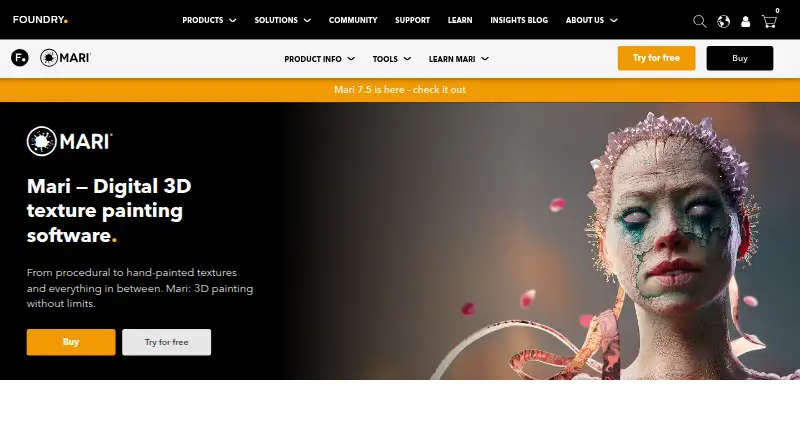
Mari is a 3D painting package for high-resolution texturing and look development in visual effects, animation, and games.
What Mari is
Mari is a 3D painting package for high-resolution texturing and look development in visual effects, animation, and games. Artists can preview projection-paint edits in context before applying them across texture maps. Its UDIM workflow supports thousands of textures per model, each up to 32K × 32K pixels, while the Multi-Channel Paint node handles up to eight streams at once. Mari’s Bakery bakes geometry maps such as curvature and occlusion across objects and UDIMs. Pipeline tools include OpenColorIO, OpenSubdiv, FBX, Alembic, APIs, and Python scripting, with shaders for 3Delight, VRay, Unreal, and Arnold. Supported systems listed are Windows 11 64-bit and Linux 64-bit Rocky/RHEL 9. Non-commercial use limits exports to 4K and 16-bit per channel, disables Python scripting, and allows at most five objects at once. Foundry offers a 30-day trial with unrestricted access. Individual subscriptions are $86 a month or $689 a year; the paid starting price is $86/mo.
Good
- UDIMs support thousands of textures per model
- Textures can reach 32K × 32K pixels
- Multi-Channel Paint handles up to eight streams
- Unrestricted 30-day trial
Watch out
- Non-commercial exports are limited to 4K
- Non-commercial use disables Python scripting
- Non-commercial use allows at most five objects
- Individual licensing requires periodic internet access
Who it suits
Mari suits texture artists working in VFX, animation, or games, especially freelancers and small companies where one person needs access. Studio subscriptions are also offered for teams.
Verdict
Mari combines high-resolution painting, baking, and pipeline tools for demanding texturing work. The non-commercial edition has significant limits, while individual subscriptions start at $86 a month.
Plans and prices
From Mari's own pricing page, checked 20 Sep 2026.
| Plan | Price | What it gives you |
|---|---|---|
| Studio Subscription | $1,289 a year | Node-locked or floating licenses · paid annually |
| Quarterly Rental | $949 a month | Node-locked or floating licenses · quarterly rental license |
| Individual Subscription | $689 a year | 1 named user · annual subscription |
| Individual Subscription | $86 a month | 1 named user · monthly subscription |
| Mari Non-commercial | Free | Non-commercial use · export limited to 4K and 16-bit per channel · Python scripting disabled · maximum five objects at once · Free for as long as you like |
| Mari Individual Subscription (monthly) | $86 a month | Single license for one named user · one license per user · $86/mth; price subject to applicable taxes |
| Mari Individual Subscription (annual) | $689 a year | Single license for one named user · one license per user · $689/yr; price subject to applicable taxes |
| Mari Rent | $949, paid once | Node-locked or floating licenses available · price subject to applicable taxes · $949/qtr; quarterly rental license |
| Mari Subscribe (teams) | $1,289 a year | Node-locked or floating licenses available · price subject to applicable taxes · $1,289 annually; annual license paid annually |
The facts
Each one read from Mari's own pages, with the date it was checked.
What it does
- Baking
- Mari’s Bakery can bake geometry maps, including curvature and occlusion, for multiple objects across multiple UDIMs.checked 29 Sep 2026
- Intended users
- Mari is described as suited to freelancers and small companies when only one person needs access, while studio subscriptions offer node-locked or floating licenses for teams.checked 29 Sep 2026
- License access
- Mari Individual Subscription uses login-based licensing and requires an internet connection at first login on a machine and at least once every 30 days afterward.checked 29 Sep 2026
- Multi-channel painting
- The Multi-Channel Paint node supports painting up to eight streams at once.checked 29 Sep 2026
- Non-commercial limits
- Mari Non-commercial limits texture exports to 4K and 16-bit per channel, disables Python scripting, and allows at most five objects at once.checked 29 Sep 2026
- Pipeline formats and APIs
- Mari supports OpenColorIO, OpenSubdiv, FBX and Alembic, and offers APIs and Python scripting for pipeline development.checked 29 Sep 2026
- Projection painting
- Artists can make and preview projection paint edits in context before committing them across texture maps.checked 29 Sep 2026
- Purpose
- Mari is a 3D painting package for high-resolution texturing and look development in VFX, animation and games.checked 29 Sep 2026
- Render shaders
- Mari provides shaders for 3Delight, VRay, Unreal and Arnold.checked 29 Sep 2026
- Support
- Mari users can get help through Foundry’s Support Portal or Community, and Individual Subscription customers receive support by email while their subscription is valid.checked 29 Sep 2026
- Supported operating systems
- The current tech-spec page lists Windows 11 64-bit and Linux 64-bit (Rocky/RHEL 9) as supported operating systems.checked 29 Sep 2026
- UDIM scale
- Mari supports thousands of textures per model via UDIMs, with each texture up to 32K × 32K pixels.checked 29 Sep 2026
The company
- Founded
- 1996checked 28 Sep 2026
- Headquarters
- London, United Kingdomchecked 28 Sep 2026
- Maker background
- Foundry says it was founded in 1996, is headquartered in London, and has over 275 people worldwide.checked 29 Sep 2026
Money
- Trial
- Foundry offers a free 30-day trial with unrestricted access to Mari.checked 29 Sep 2026
The full review of Mari
Mari is a specialist 3D painting application for high-resolution texturing and look development in VFX, animation and games. It is best suited to texture artists and production teams working with complex assets and established pipelines. Choose it for its scale and pipeline tools; look elsewhere if you need unrestricted free production use or cannot accommodate periodic online license checks.
Overview
Mari is built for texture work that spans many maps and channels, rather than serving as an all-purpose 3D creation suite. Its support for thousands of UDIM textures per model, at up to 32K × 32K pixels per texture, gives demanding assets room to carry fine detail. That capacity matters most when projects genuinely need it; for smaller or simpler jobs, Mari’s production focus may be more than necessary.
Projection painting lets artists preview edits in context before committing them across texture maps. That makes it easier to assess a change against the asset before applying it. The free Non-commercial edition is useful for personal exploration, but its 4K, 16-bit-per-channel export cap and five-object limit rule it out for unrestricted production work.
Key features
Painting and baking
Multi-Channel Paint can paint up to eight streams at once, a useful way to handle coordinated channel work. Mari’s Bakery bakes geometry maps such as curvature and occlusion across multiple objects and UDIMs, keeping those tasks within the texturing workflow. Procedural materials, node-based authoring and a PBR workflow add flexibility for building and managing material work.
Pipeline and rendering
OpenColorIO, OpenSubdiv, FBX and Alembic support, alongside APIs and Python scripting, make Mari a plausible fit for custom production pipelines. Render shaders are provided for 3Delight, VRay, Unreal and Arnold. The pipeline reach is a strength for studios already using compatible tools, though the Non-commercial edition disables Python scripting and therefore gives up an important route to pipeline development.
Pricing
Mari offers a free Non-commercial plan, a 30-day trial with unrestricted access, individual subscriptions, quarterly rentals and annual team subscriptions. The trial is a meaningful way to evaluate the full toolset before paying; the free plan is a more limited option for non-commercial use.
| Plan | Price | What it includes |
|---|---|---|
| Mari Non-commercial | free | Free for as long as you like for non-commercial use; exports limited to 4K and 16-bit per channel, Python scripting disabled, maximum five objects at once. |
| Mari Individual Subscription (monthly) | $86 a month | One named user and one license per user; applicable taxes may apply. |
| Mari Individual Subscription (annual) | $689 a year | One named user and one license per user; applicable taxes may apply. |
| Mari Rent | $949, paid once | Quarterly rental license; node-locked or floating licenses available; applicable taxes may apply. |
| Mari Subscribe (teams) | $1,289 a year | Annual license paid annually; node-locked or floating licenses available; applicable taxes may apply. |
The annual individual subscription costs less than paying the monthly rate for a full year, while keeping the same one-user licensing. Mari Rent offers a quarterly commitment and license types that can suit different team setups; the team subscription is annual and also offers node-locked or floating licenses. Foundry describes individual subscriptions as a fit for freelancers and small companies where one person needs access, and studio subscriptions as an option for teams. Individual subscription licensing requires an internet connection at first login on a machine and at least once every 30 days afterward. Subscribers can contact support by email while the subscription is valid; users can also seek help through Foundry’s Support Portal or Community.
Platforms
Mari supports Windows and Linux. The current supported systems are Windows 11 64-bit and Linux 64-bit (Rocky/RHEL 9), so teams should confirm their machines meet those requirements before committing.
Who it's for
Mari is a strong candidate for professional texture artists, freelancers, small companies and studios handling high-resolution assets across many UDIMs. Its painting scale, baking tools and pipeline support are most valuable when those needs are part of regular production. The free edition can serve non-commercial learning or experimentation, but the export, scripting and object limits make it a poor fit for paid work. Teams should weigh the annual or quarterly license options against their need for named-user access or node-locked and floating licenses.
Pros and cons
- Pros: Thousands of UDIM textures per model, with textures up to 32K × 32K, support high-detail asset work.
- Pros: Projection previews, painting across up to eight streams and multi-object, multi-UDIM baking cover key texture-production tasks.
- Pros: Pipeline formats, APIs and shaders for several renderers give studios useful integration options.
- Cons: Non-commercial exports stop at 4K and 16-bit per channel, Python scripting is disabled, and sessions are limited to five objects.
- Cons: Individual subscriptions require periodic online validation, which may not suit machines that stay offline.
- Cons: Individual licensing is limited to one named user per license, so teams need a studio-oriented option for shared or multiple-seat use.
Alternatives
For a broader comparison of options, browse Game Texture Software and 3D Texturing Software.
- InstaMAT is worth considering if you want a free tier or a lower-cost annual Pro option; its free Pioneer license has revenue or funding eligibility and requires attribution.
- Surface Labs is a free early-access alternative with support across desktop, mobile and API platforms.
- Material Maker is a free option across Windows, macOS and Linux, with a name-your-own-price Itch.io download and a paid Steam plan.
- ArmorPaint may suit buyers who prefer a one-time purchase; its listed ArmorPaint 1.0 price is $19, paid once, and its download page describes it as open source.
- PBRize is a web-based alternative with a free tier capped at 12 usage units per month, 1K maximum resolution and 1 GB storage.
- PBRgen offers a free Starter tier with 100 credits for personal use, making it an option for limited, personal-use generation.
- Blender is the choice to consider if you want a free, open-source 3D creation suite that can be downloaded without registration and used without an internet connection.
- Houdini is another option to compare for broader 3D work, with freemium licensing and workstation-perpetual and annual options.
Verdict
Choose Mari if high-resolution, multi-UDIM painting and pipeline integration are central to your texturing work; those are the reasons to accept its specialist focus and paid production licensing. Look elsewhere if the Non-commercial caps are too restrictive, if you need an offline individual license, or if your work does not call for Mari’s scale.
Getting started
- Open the Mari product website
- Choose Windows 11 64-bit or supported Linux 64-bit
- Start the unrestricted 30-day trial or select the free non-commercial plan
- Select an individual or team subscription
- Sign in for licence activation, with internet access required initially and at least every 30 days
Limits worth knowing
The free Mari Non-commercial plan restricts texture exports to 4K and 16-bit per channel, disables Python scripting and permits a maximum of five objects at once. Individual subscriptions are for one named user.
Questions
Is Mari free?
A Non-commercial plan is free for as long as you like. Foundry also provides a 30-day trial with unrestricted access.
What does Mari cost?
Individual Subscription pricing is $86 a month or $689 a year. Other listed options include $949 per quarter for Mari Rent and $1,289 annually for team subscriptions.
Which operating systems support Mari?
The current specifications list Windows 11 64-bit and Linux 64-bit Rocky/RHEL 9.
Does Mari support scripting and pipeline integration?
Mari offers APIs and Python scripting, and supports OpenColorIO, OpenSubdiv, FBX and Alembic. Python scripting is disabled in the non-commercial edition.
Can teams use floating licences?
Studio subscriptions offer node-locked or floating licences for teams.
Alternatives to Mari
- 1

Mixos Paint
Free planAndroidiOSWebAPI8.0From $5.99 a month - 2

Trumble
Free planWebLinuxmacOSWindows7.7From $3 a month - 3
Surface Labs
Free planAndroidiOSAPILinux7.5Free plan - 4

InstaMAT
Free planLinuxmacOSWindows6.9Free plan - 5

Adobe Substance 3D Modeler
ExtensionWindows6.7 - 6
Material Maker
Free planLinuxmacOSWindows6.7$14.99 one-time