Locus Fee Management
Locus Fee Management helps schools organize fee schedules, record collections, track dues, and keep receipts and payment history together.
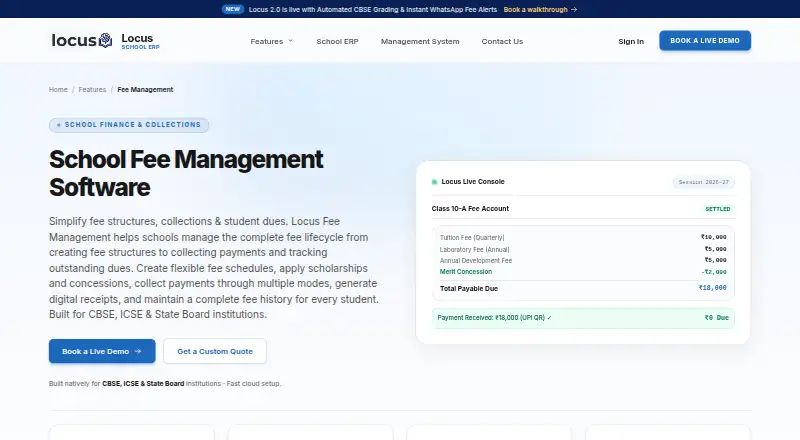
What Locus Fee Management is
Locus Fee Management helps schools organize fee schedules, record collections, track dues, and keep receipts and payment history together. It is built for CBSE, ICSE, and State Board institutions. Schools can set monthly, quarterly, bi-annual, or one-time schedules linked to the academic session, and apply fixed-amount or percentage-based concessions alongside adjustments for individual students. Payment options listed include UPI QR, cash, debit or credit card, net banking, and cheque or demand draft. Once a payment is recorded, the system creates a digital receipt and retains it in the student’s fee history. Staff can review outstanding and overdue amounts through student-wise and class-wise breakdowns. Fee transactions may be processed through aggregators such as Razorpay, Cashfree, and PayU. Parents can receive reminders and payment updates by SMS, WhatsApp, or email. The service offers web access and Android and iOS apps. Pricing is available by custom quote; the fee page also invites schools to book a demo.
Good
- Supports monthly, quarterly, bi-annual, and one-time schedules.
- Offers fixed and percentage-based concessions.
- Records digital receipts in student fee histories.
- Tracks overdue amounts with student- and class-wise breakdowns.
- Available on web, Android, and iOS.
Watch out
- Pricing is provided by custom quote, not publicly listed.
- The listed payment modes may require a payment aggregator.
Who it suits
It suits schools that need fee workflows for accountants, administrators, school management, and parents, particularly CBSE, ICSE, and State Board institutions. It may also fit schools seeking recurring fee schedules, concession handling, and student- or class-level dues tracking.
Verdict
Locus Fee Management covers fee scheduling, concessions, collections, receipts, and dues tracking in one school-focused system. Schools should request a quote to learn the price for their needs.
Plans and prices
From Locus Fee Management's own pricing page, checked 8 Oct 2026.
| Plan | Price | What it gives you |
|---|---|---|
| Custom quote | Priced on request | Personalized demo and custom quote offered; no public price stated |
The facts
Each one read from Locus Fee Management's own pages, with the date it was checked.
What it does
- Access
- The privacy policy describes a cloud ERP web application and staff and parent/student mobile apps for Android and iOS.checked 7 Oct 2026
- Concessions
- Schools can apply fixed-amount or percentage-based scholarships and concessions, with student-specific adjustments.checked 8 Oct 2026
- Data controls
- The privacy policy says partner institutions retain ownership of academic records, student profiles, and fee ledgers, with role-based access controls.checked 8 Oct 2026
- Dues tracking
- The product tracks outstanding balances, overdue amounts, student-wise dues, class-wise collections, and payment history.checked 8 Oct 2026
- Encryption
- The privacy policy states that AES-256 encryption at rest and TLS 1.3 in transit protect records, logs, and attachments.checked 8 Oct 2026
- Fee schedules
- Schools can set monthly, quarterly, bi-annual, or one-time fee schedules.checked 8 Oct 2026
- Intended schools
- The fee management product is built for CBSE, ICSE, and State Board institutions.checked 8 Oct 2026
- Notifications
- Locus says it sends fee reminders and payment updates to parents through supported channels, including SMS, WhatsApp, and email.checked 7 Oct 2026
- Payment integrations
- The privacy policy names Razorpay, Cashfree, and PayU as examples of payment aggregators used to process fee transactions.checked 7 Oct 2026
- Payment modes
- The page lists UPI QR code, cash counter, debit or credit card, bank netbanking, and cheque or DD as supported payment modes depending on setup.checked 8 Oct 2026
- Pricing
- The fee page invites schools to request a custom quote and book a demo; it does not state a price.checked 7 Oct 2026
- Privacy
- Locus's privacy policy says it does not sell, rent, or monetize student or institutional data for advertisers or third-party brokers.checked 8 Oct 2026
- Privacy and compliance
- The privacy policy describes a DPDP Act 2023 compliant architecture and says Locus does not sell student or institutional data or use it for advertising profiles.checked 7 Oct 2026
- Purpose
- Locus Fee Management helps schools create fee structures, collect payments, track dues, and maintain student fee histories.checked 8 Oct 2026
- Receipts
- Locus generates digital receipts after recording payments and retains them in the student's fee history.checked 8 Oct 2026
- Receipts and dues
- Locus generates digital receipts after recording payments and tracks outstanding and overdue fees with student-wise and class-wise breakdowns.checked 7 Oct 2026
- Security
- The privacy policy states that data is encrypted at rest with AES-256 and in transit with TLS 1.3, and that automated daily backups are maintained.checked 7 Oct 2026
- Support
- Locus lists a support desk phone number and email address on its site.checked 8 Oct 2026
- Users
- The fee workflows are described for accountants, administrators, school management, and parents.checked 8 Oct 2026
Where it runs
- Mobile apps
- The privacy policy describes staff apps for Android and iOS and a parent and student mobile app, alongside web portals.checked 8 Oct 2026
The full review of Locus Fee Management
Locus Fee Management is a fee-administration system for schools that need to coordinate charges, collections, concessions, and outstanding balances. It is particularly suited to CBSE, ICSE, and State Board institutions with varied fee schedules. Its strength is an end-to-end school fee workflow; its custom pricing means schools must establish the cost before judging fit.
Overview
The module brings recurring and one-time fees, payment records, receipts, and dues into a school-wide process. Accountants and administrators can follow student-level balances and class-level collections, while parents can receive fee reminders and payment updates. That scope is useful for schools managing fees across multiple groups, but is more than a school needs if it only wants a basic way to accept payments.
Key features
Schedules, concessions, and payments
Schools can generate monthly, quarterly, bi-annual, or one-time charges in line with the academic session. Fixed-amount and percentage-based concessions, scholarships, and student-specific adjustments add flexibility for differing fee arrangements. These controls suit institutions with varied student charges; schools with a uniform, uncomplicated fee structure may not need this breadth.
Payment modes include UPI QR, cash, debit or credit card, net banking, and cheque or demand draft. Razorpay, Cashfree, and PayU are named as examples of payment aggregators used to process fee transactions. The range accommodates different collection channels, though the custom quote leaves schools to confirm whether the full setup fits their budget.
Receipts, dues, and communication
After a payment is recorded, Locus generates a digital receipt and keeps it in the student's fee history. Staff can track outstanding and overdue amounts by student and class, making the system more useful for follow-up and reconciliation than a collection tool that ends at payment acceptance. Fee reminders and payment updates can reach parents through supported channels including SMS, WhatsApp, and email.
Access, security, and data control
The system combines a cloud ERP web application with staff and parent/student apps for Android and iOS, plus web portals. That gives school staff and families mobile and browser access, rather than limiting fee workflows to an office desktop. Locus states that records, logs, and attachments are encrypted with AES-256 at rest and TLS 1.3 in transit, with automated daily backups. It also describes a DPDP Act 2023-compliant architecture, role-based access controls, and institutional ownership of academic and fee records; it says it does not sell or monetize that data for advertising or brokers.
Pricing
Locus uses paid, custom pricing and invites schools to request a quote and book a personalized demo. No public price or tier comparison is available, so institutions cannot estimate the cost from a seat count or published quota before contacting the vendor. The custom approach may suit schools seeking a quote tailored to their needs, but makes straightforward budget comparisons harder.
Platforms
Locus Fee Management is available on Android, iOS, and the web. Staff apps, parent and student mobile apps, and web portals cover the main school and family user groups across those platforms.
Who it's for
This is a strong fit for CBSE, ICSE, and State Board schools whose accountants, administrators, and management need recurring fee schedules, student-specific concessions, digital receipts, and student- or class-level dues tracking in one workflow. Parents also benefit from payment updates and reminders. A school seeking transparent, published pricing or only a minimal collection function should compare simpler options before committing to a demo.
Pros and cons
- Broad fee coverage: recurring and one-time schedules, concessions, payment recording, receipts, and dues tracking work together for school-wide administration.
- Useful collection flexibility: multiple payment modes and named payment aggregators support different ways families may pay.
- Clear recordkeeping: digital receipts remain in fee history, while outstanding and overdue balances can be reviewed by student or class.
- Reassuring data controls: encryption, daily backups, role-based access, and stated limits on data monetization address important school-record concerns.
- Cost is hard to assess upfront: custom pricing requires a quote, limiting early comparison against a school's budget.
Alternatives
Tuition Management Software is a useful category to browse when comparing fee-management options beyond this product.
- Byntix School Fee Management is worth considering when a free starting point matters: its free Starter plan covers up to 50 students and includes core modules, attendance and fee collection, exams, marks and reports, plus parent and driver apps.
- Collexo Payment Cloud is another paid option available on Android, iOS, web, and API.
- Infinite Campus is another paid option available on Android, iOS, web, and API.
- SkoolBeep Fee Management is another paid option available on Android, iOS, and web.
- Blackbaud Financial Edge NXT is a paid web and API option with custom pricing; implementation, training, and ongoing support may be included.
- Intellio is a paid web-based alternative.
- Paymentus is a paid enterprise billing and payment platform available on Android, iOS, web, and API, with sales contact required for pricing.
- Transact Payment Plans is a paid, web-based alternative.
Verdict
Schools in the CBSE, ICSE, or State Board systems that need flexible fee schedules, concessions, receipts, and active dues tracking should put Locus Fee Management on their shortlist. Its main reason to choose it is the breadth of its school-focused fee workflow, backed by mobile and web access and stated data protections. Look elsewhere if a published price is essential to your decision or your school only needs a basic payment-collection tool.
Alternatives to Locus Fee Management
- 1
Byntix School Fee Management
Free planAndroidWeb7.5From ₹2 a month - 2
Edutris Fee Management
AndroidiOSWeb6.8From ₹2,999 a month - 3

Paymentus
AndroidiOSWebAPI6.8 - 4

Infinite Campus
AndroidiOSWebAPI6.7 - 5
Schoolites Fee Management
AndroidiOSWebAPI6.7From ₹10 a month - 6
Pearspark
AndroidiOSWeb6.6From $50 a month