locAGI
locAGI is a managed cloud computer-assisted translation platform that brings translation memory, terminology management, AI-assisted translation, and quality…
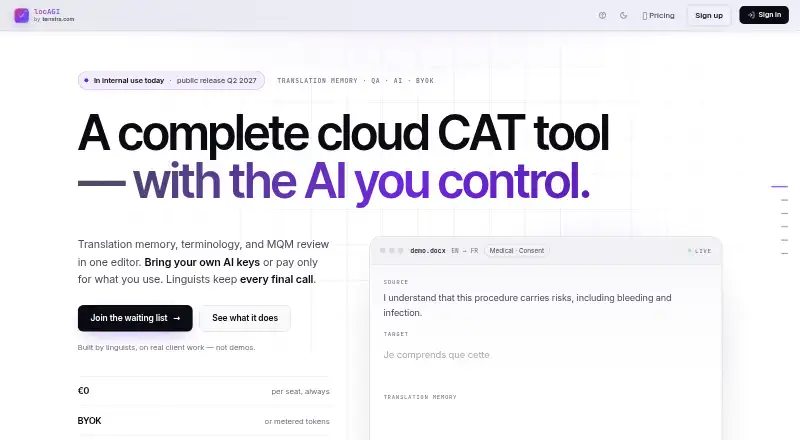
What locAGI is
locAGI is a managed cloud computer-assisted translation platform that brings translation memory, terminology management, AI-assisted translation, and quality review into one workflow. It is designed for enterprise localisation and linguistic teams, including internal staff and contracted freelancers. The platform supports MQM Core, LISA QA Model 3.1, or custom review categories, with findings exportable to Excel. It lists AI models from OpenAI, Anthropic, Google, Mistral, DeepSeek, xAI, and DeepL, as well as private models through Ollama or OpenAI-compatible endpoints. Workflows include memoQ, Trados, Phrase, and XLIFF formats; the platform also supports more than 40 source formats. A REST API, tokens, webhooks, and an OpenAPI specification support project, segment, QA, and export automation. The platform plan is free, with AI billed separately or used through BYOK. locAGI is currently in private beta, with public release scheduled for Q2 2027.
Good
- Includes translation memory and terminology management.
- Supports MQM and other configurable quality reviews.
- Lists more than 40 source formats.
- Offers a REST API, tokens, and webhooks.
- Free platform plan with no annual commitment.
Watch out
- Currently in private beta.
- Managed cloud service; self-hosting is unavailable.
- AI usage is billed separately or through BYOK.
- Desktop CAT tools are more battle-tested for very large XLIFF files.
Who it suits
It suits localisation teams and linguists who want translation, terminology, review, and automation in a managed cloud workflow. Teams needing a self-hosted platform or offline desktop use should note those options are not available.
Verdict
locAGI combines translation workflows, AI options, and quality review in a cloud platform with a free platform plan. Its private beta status and lack of self-hosting are important constraints to weigh.
Plans and prices
From locAGI's own pricing page, checked 2 Oct 2026.
| Plan | Price | What it gives you |
|---|---|---|
| Free forever — platform | Free | Unlimited seats · included storage (1 GB on homepage) · AI billed separately or BYOK · $0 for platform, seats, and setup; no annual commitment |
| Pay-as-you-go AI | Priced on request | AI tokens provisioned by locAGI · same integrated editor · can switch to BYOK · Tokens consumed; no monthly minimum; exact token rates not stated |
The facts
Each one read from locAGI's own pages, with the date it was checked.
What it does
- AI models
- The maker lists OpenAI, Anthropic, Google, Mistral, DeepSeek, xAI, and DeepL, plus private models through Ollama or OpenAI-compatible endpoints.checked 2 Oct 2026
- Automation
- A REST API is available for projects, segments, QA runs, and exports; the maker also lists API tokens, webhooks, and an OpenAPI spec.checked 2 Oct 2026
- Availability
- The product is currently in private beta, with public release scheduled for Q2 2027.checked 2 Oct 2026
- Compliance status
- SSO, SCIM provisioning, SOC 2 Type II readiness, and data-residency controls are listed as roadmap work; SOC 2 readiness is underway.checked 2 Oct 2026
- File support
- The maker says it supports more than 40 source formats, including DOCX, XLSX, PPTX, IDML, HTML, XML, DITA, JSON, PO, RESX, and SRT.checked 2 Oct 2026
- Integrations
- The platform supports memoQ MQXLIFF, Trados SDLXLIFF, Phrase MXLIFF, and XLIFF 1.2 and 2.0 workflows.checked 2 Oct 2026
- Intended users
- The maker describes locAGI as built for enterprise localisation teams and linguistic teams, including internal staff and contracted freelancers.checked 2 Oct 2026
- Notable limits
- The maker says it is a managed cloud service and cannot be self-hosted; desktop CAT tools are more battle-tested for XLIFF files with 50,000 or more segments.checked 2 Oct 2026
- Product
- locAGI is a managed cloud CAT platform combining translation memory, terminology, MQM review, and AI-assisted translation.checked 2 Oct 2026
- Quality review
- MQM review supports MQM Core, LISA QA Model 3.1, or custom free-text categories, with findings exportable to Excel.checked 2 Oct 2026
- Security controls
- The maker describes project audit logs, per-user rate limiting on AI surfaces, BYOK, and private-model routing as available controls.checked 2 Oct 2026
- Support and customization
- The maker says customer suggestions benefiting the platform are implemented free of charge, typically within a week.checked 2 Oct 2026
The company
- Company
- The platform is built and operated by Terratra OÜ in Tallinn, Estonia.checked 2 Oct 2026
- Headquarters
- Tallinn, Estoniachecked 28 Sep 2026
Where it runs
- Platforms
- locAGI is browser-native, Linux and macOS friendly, and requires no desktop installation.checked 2 Oct 2026
The full review of locAGI
locAGI suits enterprise localisation and linguistic teams that want translation memory, quality review and AI options in a managed cloud workflow. Its combination of CAT tools and configurable AI is compelling, but the private beta and cloud-only deployment make it a poor fit for teams that need a mature, self-hosted system today.
Overview
Translation memory, terminology management, QA checks, alignment and MQM review bring core localisation work into one platform. Support for established CAT file workflows can help teams exchange projects without committing to an immediate replacement of their existing tools.
locAGI is operated by Terratra OÜ in Tallinn, Estonia, and is currently in private beta, with public release scheduled for Q2 2027. It is a managed cloud service, not a self-hosted or offline desktop tool. That trade-off favors teams comfortable with a web-based workflow and rules out organisations that require local deployment.
For a broader category comparison, see Computer-Assisted Translation Software.
Key features
Translation and quality workflow
Translation memory and terminology management support repeat projects and consistent language choices; QA checks and an alignment tool cover preparation and review. MQM review can use MQM Core, LISA QA Model 3.1, or custom free-text categories, and findings can be exported to Excel. That flexibility suits teams with established review criteria, while the export option gives reviewers a way to carry findings into spreadsheet-based processes.
AI choices and controls
The platform lists models from OpenAI, Anthropic, Google, Mistral, DeepSeek, xAI and DeepL, as well as private models through Ollama or OpenAI-compatible endpoints. Teams can use locAGI-provisioned tokens or BYOK, giving them a choice between a managed AI spend and bringing their own credentials. AI token rates are not published, so the pay-as-you-go cost cannot be judged in advance.
Project audit logs, per-user rate limiting on AI surfaces, BYOK and private-model routing are available controls. SSO, SCIM provisioning, data-residency controls and SOC 2 Type II readiness are roadmap work, with SOC 2 readiness underway; organisations that require those controls now should look elsewhere.
File exchange and automation
Workflows cover memoQ MQXLIFF, Trados SDLXLIFF, Phrase MXLIFF, and XLIFF 1.2 and 2.0. More than 40 source formats are supported, including DOCX, XLSX, PPTX, IDML, HTML, XML, DITA, JSON, PO, RESX and SRT. A REST API covers projects, segments, QA runs and exports, alongside API tokens, webhooks and an OpenAPI specification. These are useful foundations for teams automating localisation work, though the platform cautions that desktop CAT tools are more battle-tested for XLIFF files with 50,000 or more segments.
Pricing
Free forever — platform: free. Platform, seats and setup are billed at $0, with no annual commitment and unlimited seats. Included storage is 1 GB on the homepage; AI is billed separately or can use BYOK. This makes the platform plan accessible for teams that can keep within the storage allowance and manage AI costs separately.
Pay-as-you-go AI: custom pricing, billed by tokens consumed with no monthly minimum. It keeps AI spending tied to usage rather than a monthly minimum, but teams should account for the unknown unit cost before relying on it at scale.
Platforms
locAGI is web-deployed, with API, Linux and macOS platforms also listed. It has no offline desktop use and cannot be self-hosted, so it does not suit teams whose requirements depend on a local installation or disconnected work.
Who it's for
The strongest fit is an enterprise localisation or linguistic team, including internal staff and contracted freelancers, seeking shared translation, QA and AI workflows without a per-seat platform charge. The unlimited-seat free platform plan may be especially useful for larger groups, provided 1 GB of included storage is sufficient and AI is budgeted separately.
It is a weaker fit for production-critical teams unwilling to work in a private beta, organisations that require self-hosting or roadmap compliance controls, and projects with very large XLIFF files that call for battle-tested desktop CAT tools. locAGI says customer suggestions that benefit the platform are implemented free of charge, typically within a week, which may appeal to teams looking to shape a developing product.
Pros and cons
- Pros: Translation memory, terminology, alignment and several QA approaches are brought together, including exportable MQM findings.
- Pros: A broad choice of hosted and private AI models, with BYOK as an alternative to locAGI-provisioned tokens.
- Pros: Unlimited seats and no platform charge lower the barrier to including staff and freelancers.
- Cons: Private beta status makes it a riskier choice for workflows that need a mature production service.
- Cons: Managed-cloud-only deployment excludes self-hosting and offline desktop work.
- Cons: Desktop CAT tools are more battle-tested for XLIFF files at 50,000 or more segments.
Alternatives
BasicCAT is the clearer choice for readers who want a free, open-source CAT tool with Linux, macOS and Windows support rather than a managed cloud platform.
Supervertaler Workbench is another free option for readers seeking a CAT tool on Linux, macOS or Windows.
TextUnited may fit a small team that wants a defined monthly allowance: its free plan includes 15,000 words, 15 PDF pages and one user each month, while its paid team plan costs €150 a month.
CafeTran Espresso suits readers who prefer a desktop CAT tool across Windows, macOS and Linux, with a free tier capped at 1,000 translation units and 500 glossary terms or an annual subscription at €80 a year.
XTM Cloud is an alternative for teams considering a paid cloud platform; its Team plan costs $16,500 a year and includes 2 million processed words per year and unlimited users.
Déjà Vu X3 offers a Windows free plan limited to one target language per project and one translation memory and termbase per target language, making it an option for readers who can work within those limits.
Fluency Now is a paid alternative for Linux, macOS and Windows users, with its Professional plan at $15 a month for up to two computers and a yearly payment option with two months free.
Swordfish is another paid desktop option for Linux, macOS and Windows; its annual subscription is $140 a year, and the subscription key cannot be shared or transferred between machines.
Verdict
Choose locAGI if your localisation team wants a shared cloud CAT workflow with flexible AI-model choices, configurable quality review and no platform charge per seat. Look elsewhere if you need a proven production platform now, self-hosting, offline desktop work or compliance controls beyond the current roadmap.
Getting started
- Visit locagi.com.
- Use the web platform; it is also listed for API, Linux, and macOS.
- Choose the free platform plan, which has no annual commitment.
- Set up AI usage with locAGI-provisioned tokens or BYOK; AI is billed separately on pay-as-you-go usage.
Limits worth knowing
The free platform plan includes 1 GB of storage on the homepage, while AI is billed separately or can use BYOK. The maker notes desktop CAT tools are more battle-tested for XLIFF files with 50,000 or more segments.
Questions
Is locAGI free?
Its platform plan is free forever at 0.00 USD, with no annual commitment. AI can be billed separately through pay-as-you-go tokens or used with BYOK.
What platforms does locAGI support?
The listed platforms are API, Linux, macOS, and web. The deployment model is web, and offline desktop use is not available.
What AI models can it use?
The maker lists OpenAI, Anthropic, Google, Mistral, DeepSeek, xAI, and DeepL. Private models can be used through Ollama or OpenAI-compatible endpoints.
What localization file workflows does it support?
It supports memoQ MQXLIFF, Trados SDLXLIFF, Phrase MXLIFF, and XLIFF 1.2 and 2.0 workflows, plus more than 40 source formats.
Who makes locAGI?
It is built and operated by Terratra OÜ, based in Tallinn, Estonia.
Is locAGI available publicly?
The product is currently in private beta, with public release scheduled for Q2 2027.
Alternatives to locAGI
- 1

XTM Cloud
AndroidiOSWebAPI7.9From $16,500 a year - 2

Trados
WebAPImacOSSelf-hosted7.5 - 3

TextUnited
Free planWebAPI7.2From €150 a month - 4

CafeTran Espresso
Free planLinuxmacOSWindows7.1From €80 a year - 5

Centus
WebAPI7.1From $145 a month - 6

Wordbee Translator
WebAPI6.8