
LINSTOR
LINSTOR is open-source software-defined storage management software for Linux clusters using DRBD-replicated storage.
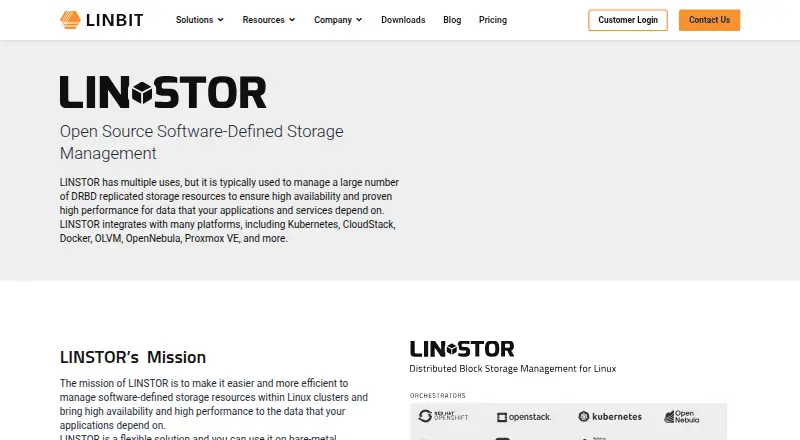
What LINSTOR is
LINSTOR is open-source software-defined storage management software for Linux clusters using DRBD-replicated storage. It manages persistent block resources for applications such as Kubernetes and other container platforms. A controller handles cluster configuration and storage resources, while satellite components manage resources on individual nodes. Deployment can use bare-metal, cloud or hybrid cloud, virtualized, or containerized environments. Administrators can use command-line and graphical clients or a REST API. Storage features include snapshots and clones, thin provisioning, and support for HDD, SSD, NVMe, and persistent memory. Volume types include LVM, thin-provisioned LVM, and ZFS; snapshots and encryption are supported, while multi-attach is not. DRBD supports synchronous, asynchronous, and semi-synchronous replication, with up to 32 replicated persistent volumes. LINBIT SDS can transfer encrypted snapshots remotely and ship backups to S3 and other targets. LINSTOR has a free plan; LINBIT Starter is $1,000 a year for two nodes.
Good
- Open-source storage management
- Supports bare-metal, cloud, and containers
- Snapshots, clones, and thin provisioning
- REST API plus CLI and GUI clients
- Encrypted snapshot transfer and S3 backup shipping
Watch out
- Multi-attach volumes are not supported
- LINBIT Starter costs $1,000 a year
- Starter support covers two nodes
- Linux-focused deployment
Who it suits
LINSTOR suits administrators managing Linux server clusters and persistent block storage for Kubernetes or other container platforms. It is intended for deployments spanning physical, cloud, virtualized, or container environments.
Verdict
LINSTOR provides DRBD-based storage management across varied infrastructure, with replication, snapshots, encryption, and backup options. Its free plan supports evaluation, while paid support begins with a two-node annual Starter plan.
Plans and prices
From LINSTOR's own pricing page, checked 4 Oct 2026.
| Plan | Price | What it gives you |
|---|---|---|
| LINBIT Starter | $1,000 a year | 2 nodes · includes access to official repositories and community non-SLA support · starting from $1,000 /2 nodes/year |
The facts
Each one read from LINSTOR's own pages, with the date it was checked.
What it does
- Architecture
- A LINSTOR controller manages cluster configuration and storage resources, while satellite components manage resources on individual nodes.checked 4 Oct 2026
- Availability
- LINSTOR uses DRBD for high availability, and its SDS features page says it can automatically recover from hardware failures such as failed drives, network interfaces, and switches.checked 4 Oct 2026
- Backup and recovery
- LINBIT SDS supports asynchronous transfer of encrypted snapshots to remote locations and backup shipping to S3 and other targets.checked 4 Oct 2026
- Data integrity
- LINBIT SDS supports variable-rate, fixed-rate, and checksum-based synchronization methods.checked 4 Oct 2026
- Deployment
- LINSTOR can run on bare-metal clusters, in cloud or hybrid cloud environments, and in virtualized or containerized environments.checked 4 Oct 2026
- Integrations
- LINBIT lists integrations including Kubernetes, CloudStack, Docker, OLVM, OpenNebula, Proxmox VE, and OpenShift compatibility through a Kubernetes CSI driver.checked 4 Oct 2026
- Intended users
- LINSTOR is presented for Linux server clusters and persistent block storage used by applications, including Kubernetes and other container platforms.checked 4 Oct 2026
- Management
- Administrators can manage storage through a command-line utility, and the features page also describes CLI and GUI clients and REST API support.checked 4 Oct 2026
- Notable limits
- The LINBIT HA Basic support tier lists device sizes up to 8TB, Plus up to 32TB, and Enterprise as unlimited.checked 4 Oct 2026
- Purpose
- LINSTOR is open-source software-defined storage management software for managing DRBD-replicated storage resources in Linux clusters.checked 4 Oct 2026
- Replication
- DRBD supports synchronous, asynchronous, and semi-synchronous replication, and the page states it can provide up to 32 replicated persistent volumes.checked 4 Oct 2026
- Storage capabilities
- LINBIT SDS features include snapshots and clones, thin provisioning, multi-attach volumes, and storage across HDD, SSD, NVMe, or persistent memory.checked 4 Oct 2026
- Support
- LINBIT's pricing page describes 24×7 support tiers, with Enterprise listing a maximum four-hour initial response and one-hour emergency initial response.checked 4 Oct 2026
The company
- Founded
- 2018checked 28 Sep 2026
- Headquarters
- Vienna, Austriachecked 28 Sep 2026
- Maker
- LINBIT says it was incorporated in 2001 and lists its headquarters in Vienna, Austria.checked 4 Oct 2026
Alternatives to LINSTOR
- 1
JuiceFS
Free planOpen sourceAPILinuxmacOSSelf-hosted7.9From $0.02 a month - 2

MinIO AIStor
Free planWebAPILinuxmacOS7.3Free plan - 3
StarWind Virtual SAN
Free planWebAPILinuxSelf-hosted7.2Free plan - 4

MooseFS
Free planWebAPILinuxmacOS7.1€9 one-time - 5

SeaweedFS
Free planAPILinuxmacOSSelf-hosted7.0From $20 a year - 6

Ceph
Free planAPILinuxSelf-hostedWindows6.6Free plan