LexNebulis
LexNebulis is a free, self-hosted legal practice management platform for small law firms.
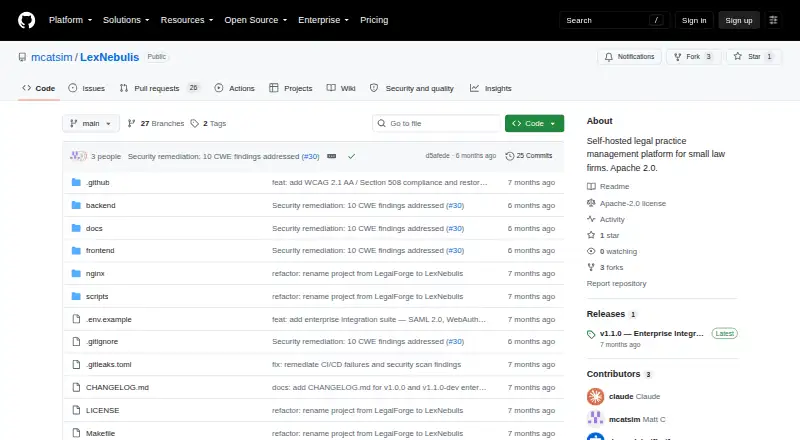
What LexNebulis is
LexNebulis is a free, self-hosted legal practice management platform for small law firms. It covers client and matter management, documents, calendars, time tracking, billing, and trust accounting, with workflows for conflict checking, document templates and generation, e-signature, client intake, and a client portal. Billing capabilities include LEDES 1998B and 2000 export, UTBMS codes, and electronic invoice submission. Listed integrations include Stripe and LawPay for payments, QuickBooks and CSV for accounting export, and Google Drive, Dropbox, Box, and OneDrive for storage. Security features include encryption at rest and in transit, password hashing, JWT authentication, and TOTP or WebAuthn/FIDO2 two-factor authentication. Its append-only audit log uses SHA-256 hash chaining so tampering or deletion can be detected. The software is free for commercial use under the Apache License 2.0. It requires Docker and Docker Compose v2, at least 2 GB RAM, and at least 10 GB disk space. The installation guide calls for a Linux server and recommends Ubuntu 22.04 or later; macOS is specified for development. The project wiki describes a target range of 1 to 50 users.
Good
- Includes client, matter, document, and calendar management.
- Supports trust accounting and legal billing workflows.
- Integrates with payment, accounting, and storage services.
- Free for commercial use under Apache License 2.0.
- Audit log makes tampering or deletion detectable.
Watch out
- Requires Docker and Docker Compose v2.
- Requires at least 2 GB RAM and 10 GB disk space.
- Installation calls for a Linux server.
- macOS is specified for development, not installation.
Who it suits
LexNebulis suits small law firms looking to host their own practice-management system, particularly those needing matter billing and trust accounting. Its project wiki describes firms with 1 to 50 users as the target.
Verdict
LexNebulis combines core law-firm management with trust accounting and legal billing workflows. It is free for commercial use, but requires self-hosting and the listed server resources.
Plans and prices
From LexNebulis's own pricing page, checked 20 Oct 2026.
| Plan | Price | What it gives you |
|---|---|---|
| Free, open-source | Free | Self-hosted · Apache License 2.0 · Free for commercial use |
The facts
Each one read from LexNebulis's own pages, with the date it was checked.
What it does
- Accounting integrations
- Financial data can be exported to QuickBooks using IIF or QBO formats and to CSV.checked 20 Oct 2026
- API
- A REST API is exposed under /api with Swagger UI at /api/docs when the backend runs.checked 20 Oct 2026
- API authentication
- API endpoints use JWT bearer authentication except login and health endpoints; access tokens last 15 minutes and refresh tokens seven days.checked 20 Oct 2026
- API scope
- Documented endpoints cover clients, contacts, matters, documents, calendar, billing, trust accounts and global search.checked 20 Oct 2026
- Architecture
- The stack uses React and TypeScript, FastAPI with Python 3.12, PostgreSQL 16, MinIO, Celery, Redis and Nginx in Docker containers.checked 20 Oct 2026
- Audit trail
- Audit records are append-only and linked with SHA-256 hashes to make tampering detectable.checked 20 Oct 2026
- Calendar
- The calendar handles court dates, limitation deadlines, appointments, reminders and iCal feeds.checked 20 Oct 2026
- Client intake
- Intake forms capture prospects, score leads and convert them into active clients.checked 20 Oct 2026
- Client management
- It tracks clients through their lifecycle with contact, matter, billing-preference and communication information.checked 20 Oct 2026
- Client portal
- A branded portal lets clients view matter status, upload documents and communicate securely.checked 20 Oct 2026
- Conflict checking
- Conflict searches use Soundex, Metaphone and Levenshtein matching for phonetic and fuzzy names.checked 20 Oct 2026
- Deployment requirements
- The repository lists Docker and Docker Compose v2, at least 2 GB RAM, and at least 10 GB disk space as requirements.checked 29 Sep 2026
- Document generation
- Users can upload DOCX templates with Jinja2 fields and generate documents from matter and client data.checked 20 Oct 2026
- Document management
- Documents are stored with MinIO, versioned, tagged and organized by matter.checked 20 Oct 2026
- Electronic signatures
- The platform can request and collect electronic signatures on documents.checked 20 Oct 2026
- Identity and security integrations
- The wiki lists OIDC and SAML 2.0 single sign-on, SCIM 2.0 provisioning, and SIEM export through webhooks and syslog.checked 29 Sep 2026
- Identity integrations
- Single sign-on supports OIDC and SAML 2.0, while SCIM 2.0 automates user provisioning.checked 20 Oct 2026
- Installation
- The setup script generates secrets, builds containers, starts services, runs migrations and creates the initial administrator.checked 20 Oct 2026
- Integrations
- Listed integrations include Stripe and LawPay payments, QuickBooks and CSV accounting export, and Google Drive, Dropbox, Box, and OneDrive storage.checked 29 Sep 2026
- Legal workflows
- The wiki lists conflict checking, document templates and generation, e-signature, client intake, and a client portal.checked 29 Sep 2026
- Licence
- The repository is distributed under Apache License 2.0 and states that commercial use is allowed.checked 20 Oct 2026
Money
- Billing
- The wiki says the platform supports LEDES 1998B and 2000 export, UTBMS codes, and electronic invoice submission.checked 29 Sep 2026
- E-billing
- Billing exports LEDES 1998B and 2000 formats, includes UTBMS codes and supports electronic invoice submission.checked 20 Oct 2026
- Free plan
- Yeschecked 20 Sep 2026
The full review of LexNebulis
Overview
LexNebulis is a self-hosted legal practice management system for small firms that want matter work and trust accounting in one platform. It is best suited to teams comfortable running their own server; the trade-off for its $0 price is responsibility for deployment and maintenance.
Its scope reaches beyond bookkeeping: the platform combines client and matter records, documents, calendars, time tracking, billing, and legal workflows. That makes it a broader choice than a dedicated trust-accounting tool, though firms seeking hosted software should look elsewhere. For category comparisons, see Legal Practice Management Software, Legal Accounting Software, Legal Trust Accounting Software, and Trust Accounting Software.
Key features
LexNebulis pairs client and matter management with conflict checks, client intake, document templates and generation, e-signatures, and a client portal. That range can keep routine legal work alongside billing rather than splitting it across a practice system and a separate accounting product.
Billing includes LEDES 1998B and 2000 export, UTBMS codes, and electronic invoice submission, useful for firms whose invoice workflows depend on those formats. Trust tools include matter-level billing, client ledgers, three-way reconciliation, and compliance reporting, giving the product a substantive accounting role as well as general practice management.
Payment connections include Stripe and LawPay; QuickBooks and CSV export support accounting workflows. For files, it integrates with Google Drive, Dropbox, Box, and OneDrive. The identity and security connections—OIDC and SAML 2.0 single sign-on, SCIM 2.0 provisioning, and SIEM export via webhooks and syslog—are particularly relevant to firms with established access-management or monitoring systems.
Security measures described for the project include encryption at rest and in transit, bcrypt password hashing, JWT authentication, and two-factor authentication using TOTP or WebAuthn/FIDO2. Its append-only audit log uses SHA-256 hash chaining to make changes or deletions detectable. These controls are meaningful for sensitive legal and financial records, but they do not remove the firm's obligation to operate and secure its own deployment.
The API documentation is available at /api/docs on a running instance, which gives technical teams a path to inspect the API. Deployment requires Docker and Docker Compose v2, at least 2 GB RAM, and 10 GB disk space. The installation guide calls for a Linux server, recommending Ubuntu 22.04 or later; macOS is supported for development, not given as the production server target.
Pricing
Free, open-source: free (self-hosted, Apache 2.0). The Apache License 2.0 permits commercial use, so firms can use it without a software subscription. There are no paid tiers described; the practical cost is providing and maintaining the required server environment. This suits technically capable small firms prioritizing control and avoiding per-seat software fees, but is a weaker fit for teams wanting a vendor-hosted service.
The project describes its intended scale as firms with 1 to 50 users. That is a target range, not a published seat cap or service-level promise.
Platforms
LexNebulis is a web application designed for self-hosting, with Linux as its server environment. It is not presented as a managed cloud service or as a native mobile app, so access depends on operating the web deployment.
Who it's for
Consider LexNebulis if a small firm wants practice management and trust accounting together, needs features such as three-way reconciliation and compliance reporting, and has the technical capacity to run Docker on Linux. Its commercial-use license and integrations also make it worth considering for firms that want to connect existing payment, accounting, storage, or identity systems.
Skip it if server administration is a burden, or if your firm needs a supported hosted service or native mobile apps. Its self-hosted model shifts operational responsibility to the firm, and the stated platform footprint is centered on the web.
Pros and cons
- Broad legal workflow coverage: Matter management, intake, conflict checking, documents, e-signatures, and a client portal make it more than an accounting ledger.
- Trust-accounting depth: Client ledgers, matter-level billing, three-way reconciliation, and compliance reporting address core legal accounting needs.
- No software subscription: The Apache 2.0 software is free for commercial use, avoiding a recurring license charge.
- Self-hosting demands technical ownership: Firms must supply Docker, Docker Compose v2, and a suitably provisioned Linux server, and manage the deployment themselves.
- Web-focused platform: Teams seeking native mobile clients or a managed service may prefer another product.
Alternatives
CosmoLex is a paid alternative with a free trial and Android, iOS, and web platforms. Its Launch plan costs $49 a month, billed monthly, per user per month, and includes time tracking, invoicing, online payments, trust accounting, and ledgers. Choose it if you prefer a paid product with those platforms and a trial rather than self-hosting.
Account Legal is another paid option with a free trial and Android, iOS, macOS, web, and Windows support. Its 1 Month plan costs $19.94 a month, billed monthly, and offers unlimited access, multiple trust accounts, unlimited clients, and downloadable client and account reports. It may fit firms chiefly seeking trust-accounting access across a wider range of platforms.
BarBooks has paid plans, a free trial, and Android, iOS, macOS, web, and Windows versions; consider it if those platforms matter to your choice.
LegalClaw is a free alternative with Linux and macOS platforms.
Actionstep is a paid alternative with a Practice Management plan priced per user plus implementation fees; consider it if you are evaluating a paid practice-management product.
PerfectLaw DMS offers paid web and on-premises plans and supports web, Windows, macOS, iOS, and Android; consider it if those deployment or platform options matter.
Affinity is a paid alternative for web, Windows, and API platforms.
PCLaw is a paid alternative for Windows, iOS, and Android.
Verdict
LexNebulis is a strong candidate for a technically capable small law firm that wants broad practice management and serious trust-accounting workflows without a software subscription. Its decisive advantage is the combination of commercial-use open-source licensing, matter work, and accounting controls. Look elsewhere if you need hosting and operational support handled for you, or want a native mobile platform.
Getting started
- Prepare a Linux server; Ubuntu 22.04 or later is recommended.
- Install Docker and Docker Compose v2.
- Provide at least 2 GB RAM and 10 GB disk space.
- Use the installation guide for setup.
- Use /api/docs on a running instance for API documentation.
Questions
Does LexNebulis have a free plan?
Yes. The Free, open-source plan costs nothing and is self-hosted under Apache 2.0.
Can a law firm use it commercially?
Yes. The repository identifies the license as Apache License 2.0 and says commercial use is free.
What platforms does LexNebulis support?
The listed platforms are API, Linux, self-hosted, and web. Installation specifies a Linux server; macOS is specified for development.
What integrations are listed?
Payment options include Stripe and LawPay; accounting export includes QuickBooks and CSV. Storage integrations include Google Drive, Dropbox, Box, and OneDrive.
Does it support trust accounting?
Yes. Trust accounting is included.
Who is LexNebulis for?
The project describes it as a platform for small law firms with 1 to 50 users.
Alternatives to LexNebulis
- 1
CaseFox
Free planAndroidiOSWebAPI8.7From $45 a month - 2
RunSensible
Free planAndroidiOSWebAPI8.7From $49 a month - 3

8am MyCase
Free planiOSmacOS8.6From $39 a month - 4
CaseDesk
Free planAndroidiOSAPILinux8.6From $290 a year - 5
Clio Manage
AndroidiOSWebAPI8.5 - 6

CosmoLex
AndroidiOSWeb8.5From $49 a month