LetterSchool
LetterSchool is a learning app that teaches handwriting, phonics, numbers and spelling through activities for young children.
What LetterSchool is
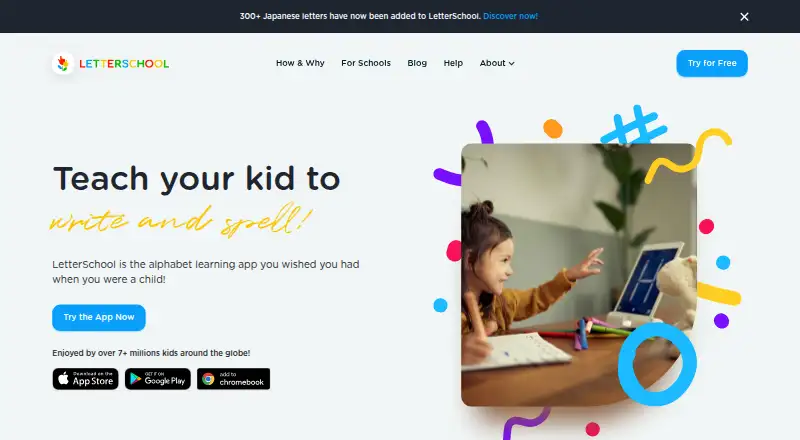
LetterSchool is a learning app that teaches handwriting, phonics, numbers and spelling through activities for young children. It is designed for ages three to eight, with a listed target age of two to six. Letter practice moves from tapping guided points to tracing and then writing independently. As children draw, the app provides visual and auditory feedback and corrects each line. The help page lists English, Spanish, Portuguese, French, German, Dutch, Japanese, Swedish, Norwegian, Finnish, Danish and Arabic. English users can choose Handwriting Without Tears, Zaner-Bloser or D’Nealian styles. The free app costs nothing and includes five uppercase and lowercase letters, five shapes and three CVC flashcards covering nine words. LetterSchool is available on Android, iOS, macOS and Windows, but the school version is currently iOS-only as LetterSchool – Block Letters.
Good
- Practice advances from guided tapping to independent writing.
- Visual and auditory feedback accompanies drawing.
- Help page lists 12 languages.
- Available on Android, iOS, macOS and Windows.
- Ad-free, with offline access and printable activities.
Watch out
- Free app covers only five letters and five shapes.
- School offering is currently iOS-only.
Who it suits
It suits families and educators looking for guided handwriting and early literacy activities for young children. The school version supports pre-K through grades one to three, but is available only on iOS.
Verdict
LetterSchool combines handwriting practice with phonics, numbers and spelling activities, and offers feedback as children work. Check the limited free content and iOS-only school version against your needs before choosing a plan.
Plans and prices
From LetterSchool's own pricing page, checked 29 Sep 2026.
| Plan | Price | What it gives you |
|---|---|---|
| Free app | Free | First five letters in uppercase and lowercase · five shapes · three CVC flashcards (nine words) |
| Monthly Plan | $9.99 a month | taxes included · after $1.99 first-week trial; auto-renews monthly |
| School student license | $9.99, paid once | 50% discount for orders over 20 · iOS only through Apple School Manager |
| Yearly Plan | $59.99 a year | 50% discount shown · taxes included · after $0.99 first-week trial; auto-renews yearly |
The facts
Each one read from LetterSchool's own pages, with the date it was checked.
What it does
- Ads
- The maker says the app has no advertisements or social-media features.checked 15 Oct 2026
- Age range
- The app is designed for children from three to eight years old.checked 29 Sep 2026
- Animations
- The product listing advertises more than 20 animations, graphics and sound effects.checked 15 Oct 2026
- API and extensibility
- The official site presents consumer apps and Apple School Manager distribution but no public API, SDK or self-hosting documentation.checked 15 Oct 2026
- Feedback
- The app gives visual and auditory feedback and corrects each line as a child draws it.checked 29 Sep 2026
- Fonts
- The app offers Handwriting Without Tears, D’Nealian and Zaner-Bloser font styles.checked 15 Oct 2026
- Funding
- Crunchbase identifies the business as a private, for-profit company and lists no funding information on its profile.checked 15 Oct 2026
- Languages
- Handwriting content is offered in 12 languages including English, Spanish, Portuguese, French, German, Dutch, Swedish, Norwegian, Finnish, Danish, Japanese and Arabic.checked 15 Oct 2026
- Learning method
- Children learn letters through three stages: tapping guided points, tracing, and writing independently.checked 29 Sep 2026
- Licence
- The terms provide a limited personal, non-transferable licence and prohibit copying, modification, reverse engineering, redistribution and commercial use.checked 15 Oct 2026
- Limit: sound accuracy
- Phonics.org reports that some letter sounds include an inaccurate schwa and recommends improving sound modeling.checked 15 Oct 2026
- Limit: spelling scope
- Phonics.org says spelling practice lacks beginning consonant-blend work and should be supplemented with pencil-and-paper activities.checked 15 Oct 2026
- Limit: subscription complaints
- App Store reviewers report that the free content is quickly exhausted and that a one-week trial unexpectedly renewed into an annual charge.checked 15 Oct 2026
- Limit: technical complaints
- Independent user reviews report tracing recognition failures, lost purchase restoration, freezes and requests for refunds after subscription charges.checked 15 Oct 2026
- Literacy content
- The app includes uppercase and lowercase letters, numbers 1–10, 24 shapes, phonics, syllables and spelling exercises.checked 15 Oct 2026
- Notable update
- The App Store version history records a December 2025 update adding downloadable switching among 12 languages and separate learning and menu-language settings.checked 15 Oct 2026
- Praise: engagement
- Common Sense Media says the guided interface, hints and animations make practice easy to navigate and engaging.checked 15 Oct 2026
Where it runs
- Android data safety
- Google Play says the app may share app-performance information and device identifiers, may collect personal information and activity, and does not encrypt data in transit according to its disclosure.checked 15 Oct 2026
- Platform limitation
- The school offering is currently available only on iOS as LetterSchool – Block Letters.checked 29 Sep 2026
The company
- Company facts
- LinkedIn lists the company as privately held, founded in 2016, headquartered in Amsterdam and employing 2–10 people.checked 15 Oct 2026
- Company history
- LinkedIn says the product was developed in 2011, while the company profile lists 2016 as its founding year.checked 15 Oct 2026
- Company identity
- The legal entity is Letterschool Enabling Learning B.V., with an Amsterdam, Netherlands address.checked 15 Oct 2026
- Headquarters
- Amsterdam, Netherlandschecked 28 Sep 2026
Money
- Free access
- The maker says children in Afghanistan can access LetterSchool for free and offers a free-subscription application for families unable to afford it.checked 29 Sep 2026
The full review of LetterSchool
LetterSchool is an early-learning app for children building handwriting, phonics, number and spelling skills. It suits preschool and early-primary learners who need guided, multisensory practice; children who already write fluently will find its core progression less useful. The central appeal is specific feedback during letter formation, while the free offering is deliberately limited.
Overview
LetterSchool teaches each letter in three stages: tapping marked points, tracing the form and writing it independently. Visual and auditory responses, with correction of each line as it is drawn, make the sequence instructional rather than a simple drawing exercise. This is a sensible structure for beginners who need repeated cues, but it is not aimed at older students seeking open-ended writing practice.
Beyond handwriting, activities cover phonics, numbers and spelling. The stated audience is children from three to eight, while the school edition covers pre-K through grade three. Handwriting levels generally target younger pupils and spelling levels older ones, so the school content can serve a wider early-years range than the core age label suggests. English school users can select Handwriting Without Tears, Zaner-Bloser or D’Nealian styles. The help materials list English, Spanish, Portuguese, French, German, Dutch, Japanese, Swedish, Norwegian, Finnish, Danish and Arabic.
Key features
The guided-to-independent progression is LetterSchool’s strongest teaching device. Line-by-line correction tells a child where a stroke has gone wrong instead of leaving accuracy to guesswork, and the combination of sound and visual cues supports learners who respond better to more than one type of prompt.
Offline access allows practice without an internet connection. Printable activities extend work away from the screen, although the app’s defining value remains its interactive stroke guidance. Three child profiles accommodate a small household or a limited classroom rotation. The maker describes an ad-free experience with no social media, restricted settings and privacy protection. Its policy says it does not seek to collect personally identifiable information directly from children under 13 and does not collect or store payment data. Support is available at [email protected].
Pricing
LetterSchool uses a freemium model. The Free app costs $0.00 USD and includes the first five uppercase and lowercase letters, five shapes and three CVC flashcards covering nine words. That is enough to judge whether the staged handwriting method suits a child, but the small letter and vocabulary allowance makes the free tier a sampler rather than a complete curriculum.
Paid access starts at $1.92/mo on an annual term. Monthly, quarterly and yearly subscriptions renew automatically, and cancellation is handled through App Store settings. A seven-day trial is referenced, so families should cancel before renewal if they do not intend to continue. The school student license costs 9.99 USD once, includes a 50% discount for orders above 20 licenses, is purchased through Apple School Manager and is iOS-only. It is the practical choice for schools standardising access, while a family wanting several platforms should use the consumer subscription instead.
The maker also offers free access for children in Afghanistan and a free-subscription application for families unable to afford the service. Those provisions broaden access, but they do not change the activity limits of the standard free app.
Platforms
Consumer versions run on Android, iOS, macOS and Windows. The school offering, LetterSchool – Block Letters, is currently only on iOS, an important restriction for schools using mixed hardware. Offline use is supported across the app’s stated capabilities.
Who it's for
Choose LetterSchool for children roughly three to eight who are learning letter formation and benefit from immediate visual and audio prompts. It is particularly suitable for families wanting a focused handwriting companion with phonics, numbers and spelling in the same child-oriented environment, or for early-years classrooms using compatible iPads and a preferred handwriting style.
Look elsewhere if you need broad access to the school edition beyond iOS, a large no-cost activity library, or lessons for learners past the early-primary stage. The three-profile limit is adequate for a small family but not a substitute for a larger classroom-management system.
Pros and cons
Pros
- Three-stage practice moves children from guided points to independent writing, with correction on every line.
- Phonics, numbers and spelling complement handwriting rather than limiting the app to letter tracing.
- Offline access, printable activities and three child profiles support flexible home practice.
- No ads or social media, restricted settings and stated limits on children’s personal-data collection reduce common child-safety concerns.
- English school editions offer Handwriting Without Tears, Zaner-Bloser and D’Nealian styles.
Cons
- The free app covers only five letters in each case, five shapes and three CVC flashcards, so sustained use requires payment.
- Subscriptions auto-renew and the seven-day trial requires timely cancellation through App Store settings.
- The 9.99 USD school license is iOS-only, excluding Android, Windows and Mac school deployments.
- Three profiles suit a household better than a sizeable class.
Alternatives
For a broader preschool catalogue, compare Preschool Learning Apps. For a handwriting-focused shortlist, see Handwriting Practice Apps.
ABCmouse is the better pick when web access and a larger general activity programme matter; its free Basic plan allows up to 10 activities per day for one child and remains ad-free. BabyBus suits families wanting free digital content including children’s apps, nursery rhymes, animations and stories.
Duolingo is an alternative for language learning across Android, iOS, macOS and the web, with a one-week free trial. Khan Academy is the stronger option for broader school instruction; its Enterprise Starter plan is $10 per student per year for U.S. schools and districts with 1,000 or fewer licenses.
GCompris is preferable when you want a completely free suite of more than 100 educational activities. Lingokids offers broader activity coverage, with a Basic tier capped at 10 games daily and Plus supporting up to four profiles and 4,000-plus activities. PBS KIDS Games provides free educational games for ages two to eight. Todo Math is the more focused choice for math practice on Android and iOS.
Verdict
LetterSchool is a strong fit for young beginners who need structured handwriting practice with immediate, multisensory correction and a few connected literacy activities. Choose it for that focused progression and child-safety stance; look elsewhere if the free allowance is too small, you need a larger classroom deployment, or your school cannot use the iOS-only license.
Alternatives to LetterSchool
- 1
Nazoru
Free planAndroidiOSmacOS7.8From $39.99 a year - 2
Writing Wizard
Free planAndroidiOSWindows7.8From $2.49 a month - 3
Letterpaths
Free planOpen sourceAndroidiOSWebAPI7.7Free plan - 4
Handwriting Repeater
Free planAndroidiOSWeb7.3Free plan - 5
Kitsunewa Writing Practice
Free planAndroidiOSWeb7.2From $4.08 a month - 6
Skritter
AndroidiOSWeb7.2From $99.99 a year