
BabyBus
BabyBus offers children’s digital content through interactive apps, nursery rhymes, animations, videos and stories.
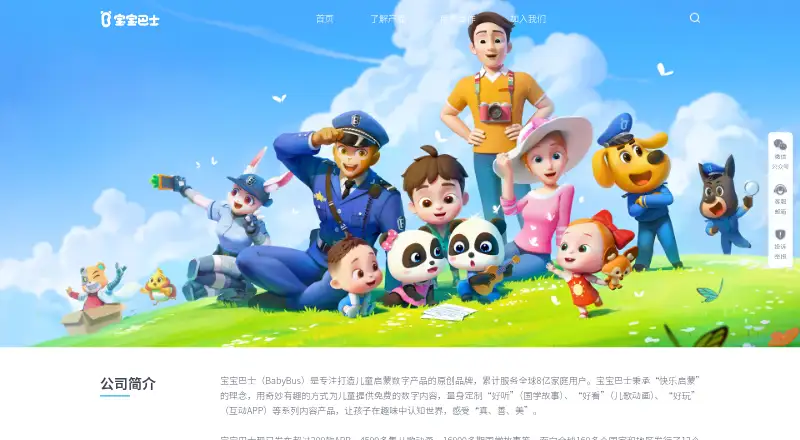
What BabyBus is
BabyBus offers children’s digital content through interactive apps, nursery rhymes, animations, videos and stories. Its main audience is children aged 0–8, and the listed target age range is 3–5 years. The catalog includes over 200 apps, with activities and learning topics spanning language, math, science, emotions, daily habits, school preparation and traditional culture. The site also lists over 2,500 videos and over 6,600 stories, including bedtime, fairy-tale and science stories. BabyBus describes its digital content as free; the listed plan is free. VIP benefits include removing ads, unlocking all games and sharing on three devices, while the ad-free experience is listed as unavailable. Offline access is available. Platforms listed are Android, iOS, macOS and Windows, though the app product page names Android and iOS as launch platforms. BabyBus was founded in 2009. Its child privacy information describes guardian consent, parental requests to access or delete children’s data, and no precise GPS collection.
Good
- Free digital content plan listed as free
- Over 200 apps across learning topics
- Offline access is available
- Parents can request access to or deletion of children’s data
Watch out
- Ad-free experience is listed as unavailable
- VIP benefits are needed to remove ads and unlock all games
Who it suits
BabyBus suits families seeking free digital content for young children, including apps, videos and stories. Its listed topics and activities cover early learning, daily habits and creative play.
Verdict
BabyBus brings learning apps, videos and stories together for young children, with offline access and a free plan. Families should note that removing ads and unlocking all games are listed as VIP benefits.
Plans and prices
From BabyBus's own pricing page, checked 8 Oct 2026.
| Plan | Price | What it gives you |
|---|---|---|
| BabyBus digital content | Free | Free digital content; children’s apps, nursery rhymes and animations, and stories |
The facts
Each one read from BabyBus's own pages, with the date it was checked.
What it does
- Age range
- The app directory includes products for children from ages 1–2 through 5–6 and older, as well as products marked for all ages.checked 8 Oct 2026
- Audience
- The site lists its main users as children aged 0–8.checked 7 Oct 2026
- Audience and reach
- BabyBus says its products serve children and have reached families in more than 160 countries and regions in 12 language versions.checked 8 Oct 2026
- Child privacy
- BabyBus says its privacy policy complies with COPPA, GDPR and other applicable laws.checked 7 Oct 2026
- Children’s data
- The policy says information collected from children is not disclosed to advertising partners and parents can request access to or deletion of children’s data.checked 7 Oct 2026
- Data collection
- The privacy policy says BabyBus does not collect precise GPS location and that payments are handled by the app download platform.checked 7 Oct 2026
- Data storage
- The children’s privacy guide says BabyBus currently does not transfer or store personal information across borders.checked 8 Oct 2026
- Educational content
- The app page describes content for language, emotions, daily habits, school preparation, self-protection, logic, science, math, English and traditional culture.checked 7 Oct 2026
- Interactive play
- BabyBus describes products with themed interactions, 3D activities across seven learning areas, creative drawing, and simulated vehicle driving.checked 8 Oct 2026
- Learning topics
- Its app directory groups products under language learning, math, science, healthy habits, emotional development, social culture, and arts.checked 8 Oct 2026
- Mobile availability
- The BabyBus app product page lists Android and iOS as launch platforms.checked 7 Oct 2026
- Privacy for children
- The children’s privacy guide says BabyBus collects and uses children’s personal information only with a guardian’s explicit consent and follows minimization principles.checked 8 Oct 2026
- Product
- BabyBus offers children’s digital content through interactive apps, videos and nursery rhymes, and audio stories.checked 7 Oct 2026
- Product catalog
- The company says it has released more than 200 apps, over 4,500 animated nursery rhyme episodes, and over 16,000 story installments.checked 8 Oct 2026
- Security measures
- The privacy guide says BabyBus has passed China’s Level 3 cybersecurity protection assessment and filing, and cites firewalls, encryption, de-identification or anonymization, and access controls.checked 8 Oct 2026
- Stories
- The site lists over 6,600 stories, including bedtime stories, fairy tales and science stories.checked 7 Oct 2026
- Support
- BabyBus lists [email protected] and customer service at 400-8877-589 as contact channels.checked 8 Oct 2026
- Video and stories
- Its site offers nursery rhyme and animation videos, traditional culture stories, safety stories, bedtime stories, and brain teasers.checked 8 Oct 2026
Where it runs
- Apps
- BabyBus says it has over 200 apps intended to foster creativity, learning, thinking, social skills and expression.checked 7 Oct 2026
- Example learning apps
- The directory describes apps for Chinese character learning, math logic, English, pinyin, science exploration, and reading.checked 8 Oct 2026
- Mobile platforms
- The app directory lists iOS and Android as download platforms.checked 8 Oct 2026
The company
- Company history
- BabyBus’s About page states that it was founded in 2009.checked 7 Oct 2026
- Founded
- 2009checked 28 Sep 2026
Money
- Free content
- BabyBus describes its digital content for children as free.checked 7 Oct 2026
The full review of BabyBus
Overview
BabyBus is a children’s media and learning library built around apps, videos, nursery rhymes and stories. It suits families seeking varied activities for preschoolers, especially those who want content to use offline. Its broad mix is more appealing than a single-subject learning path, but families looking for an ad-free free tier may prefer another option.
Key features
The catalog brings together more than 200 apps covering language, math, science, healthy habits, emotional development, social culture and arts. The app directory includes products for ages 1–2 through 5–6 and older, plus options marked for all ages; the stated target age range is 3–5. Examples include activities for Chinese characters, pinyin, English, reading, math logic and science exploration. This breadth gives families ways to switch topics, though it is less suited to someone seeking a structured course focused on one skill.
Play options include themed interactions, 3D activities across seven learning areas, creative drawing and simulated vehicle driving. Videos and stories cover nursery rhymes, animation, traditional culture, safety, bedtime and brain teasers. One BabyBus product page cites over 2,500 videos and over 6,600 stories, while its company catalog cites over 4,500 animated nursery rhyme episodes and over 16,000 story installments. These counts describe different catalog groupings, but both indicate a substantial range of material.
Offline access is a practical advantage for families who want children’s content away from a connection. BabyBus says its products are used by families in more than 160 countries and regions in 12 language versions, which supports a broad audience, though the listed learning topics and examples are the clearest guide to fit.
Pricing
BabyBus digital content costs nothing. The free offering includes children’s apps, nursery rhymes and animations, and stories, making it a low-commitment way to explore the library. The trade-off is that the free experience is not ad-free.
VIP benefits include removing ads, unlocking all games and sharing on three devices. No separate VIP price is given, so treat it as custom pricing rather than assuming the free plan includes those benefits. The three-device sharing limit makes VIP more relevant to households with multiple devices, while families content with the free selection can stay on the no-cost plan.
Platforms
The entry lists Android, iOS, macOS and Windows. BabyBus’s app directory and app product page identify Android and iOS as mobile download platforms, so families should expect the broadest app-specific fit on phones and tablets.
Who it's for
BabyBus is best for families with young children who value variety across early learning, stories and entertainment over a narrow curriculum. The stated main audience is ages 0–8, with the target age range set at 3–5 and app options spanning younger and older age bands. It is less appropriate for parents who require an ad-free experience without paying for VIP benefits or who want one clearly focused course.
Pros and cons
- Pro: More than 200 apps and extensive video and story collections give families many topics and formats to choose from.
- Pro: Offline access can make the content usable when a connection is unavailable.
- Pro: BabyBus says children’s data is collected only with guardian consent, is not disclosed to advertising partners, and can be accessed or deleted at a parent’s request.
- Con: The free experience is not ad-free; removing ads and unlocking all games are VIP benefits.
- Con: The catalog’s breadth may be a poor fit for families seeking a single, structured subject course.
BabyBus says its privacy policy complies with COPPA, GDPR and other applicable laws, does not collect precise GPS location, and leaves payments to the app download platform. Its children’s privacy guide also cites security controls including encryption and access controls, and says personal information is not transferred or stored across borders.
Alternatives
Preschool Learning Apps is a useful next stop for comparing preschool-focused options. Choose ABCmouse instead if its free tier’s ad-free access and up to 10 activities per day for one child profile better match your needs. Duolingo is the alternative to consider for a free, focused language-learning app with a one-week free trial.
Khan Academy may suit U.S. schools and districts seeking student licenses, with an Enterprise Starter plan at $10 a year billed at $10 per student per year for up to 1,000 licenses. LetterSchool is worth considering for early letter practice, with its free app covering the first five letters in uppercase and lowercase. GCompris is a free educational software suite with more than 100 activities for families wanting a broad alternative.
Lingokids is another freemium children’s learning option. PBS KIDS Games is a free alternative with 280+ educational games for ages 2–8. Todo Math is a freemium alternative for families considering a math-focused app.
Verdict
Choose BabyBus if your preschooler will benefit from a large mix of learning apps, videos and stories, and offline access matters. The main reason to look elsewhere is the lack of an ad-free free experience; families wanting a more focused course or an ad-free basic tier should compare alternatives first.
Getting started
- Visit https://www.babybus.com/.
- Choose Android or iOS for the app launch platforms.
- Use the free digital content plan.
- Consider VIP for ad removal, access to all games and sharing on three devices.
Limits worth knowing
The free plan is described as free digital content. Removing ads, unlocking all games and sharing on three devices are listed as VIP benefits.
Questions
Does BabyBus have a free plan?
Yes. Its digital content plan is listed as free.
What platforms does BabyBus support?
The listed platforms are Android, iOS, macOS and Windows. The app product page identifies Android and iOS as launch platforms.
What does VIP add?
VIP benefits are described as removing ads, unlocking all games and sharing on three devices.
Can children use BabyBus content offline?
Yes, offline access is listed as available.
How does BabyBus describe its handling of children’s data?
Its privacy information says children’s information is not disclosed to advertising partners and parents can request access to or deletion of children’s data. It says collection and use of children’s personal information requires a guardian’s explicit consent.
Who is BabyBus for?
The site names children aged 0–8 as its main users and gives a target age range of 3–5 years.
Alternatives to BabyBus
- 1

ABCmouse
Free planAndroidiOSWebmacOS8.2From $45 a year - 2

LetterSchool
Free planAndroidiOSmacOSWindows8.1From $59.99 a year - 3
GCompris
Free planOpen sourceAndroidiOSLinuxmacOS7.9Free plan - 4

Reading Eggs
AndroidiOSWebmacOS7.9From $99.99 a year - 5

Duolingo
Free planAndroidiOSWebmacOS7.7Free plan - 6
Khan Academy
Free planAndroidiOSWeb7.7From $10 a year