KubeLedger
KubeLedger tracks Kubernetes CPU, memory, and GPU use by namespace to support usage accounting and cost allocation.
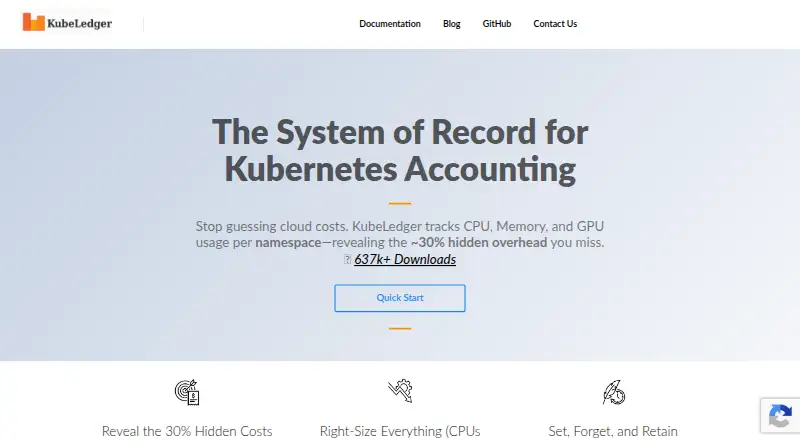
What KubeLedger is
KubeLedger tracks Kubernetes CPU, memory, and GPU use by namespace to support usage accounting and cost allocation. It includes non-allocatable resources and node overhead in its accounting, and compares resource use with requests over time to help teams spot over-provisioning and plan capacity. Built-in dashboards show hourly CPU and memory trends for seven days, daily accounting for 14 days, and monthly accounting for 12 months. Charts and datasets can be exported as PNG, CSV, or JSON, and integrations include a Prometheus exporter and an official Grafana dashboard. The site says the tool retains a year of usage analytics with a fixed footprint under 100 MB. Installation guidance covers Kubernetes and OpenShift through Kustomize or Helm. KubeLedger requires read-only access to Kubernetes API endpoints, including the Metrics API. An optional MCP server provides ten read-only tools for compatible assistants, but it is disabled by default, has no tool-layer authentication, and is exposed as a ClusterIP service in v1. Internal use is free; source code is available, but it cannot be sold as a managed service.
Good
- Tracks CPU, memory, and GPU usage by namespace
- Accounts for node overhead and non-allocatable resources
- Exports charts and datasets as PNG, CSV, or JSON
- Includes Prometheus exporter and official Grafana dashboard
- Free for internal use; source code available
Watch out
- Requires read-only access to Kubernetes API endpoints
- MCP server has no tool-layer authentication
- MCP server is disabled by default
- Cannot be sold as a managed service
Who it suits
KubeLedger suits teams that need namespace-level Kubernetes usage accounting, cost allocation, or capacity planning. It may also fit operators seeking Prometheus or Grafana integration and a self-hosted deployment.
Verdict
KubeLedger combines namespace-level accounting, resource comparison, and a range of export and monitoring options. Review its API access requirement and MCP server limits before using those components.
Plans and prices
From KubeLedger's own pricing page, checked 4 Oct 2001.
| Plan | Price | What it gives you |
|---|---|---|
| KubeLedger (self-hosted) | Free | Internal use is free · Source code available · Cannot be sold as a managed service |
The facts
Each one read from KubeLedger's own pages, with the date it was checked.
What it does
- Access requirements
- KubeLedger requires read-only access to Kubernetes API endpoints including the Metrics API.checked 4 Oct 2001
- AI integration
- An optional MCP server exposes ten read-only tools for MCP-aware assistants including Claude, Gemini CLI, Cursor, Windsurf, and Cline.checked 4 Oct 2001
- Dashboards
- Built-in dashboards show hourly CPU and memory trends for seven days, daily accounting for 14 days, and monthly accounting for 12 months.checked 4 Oct 2001
- Deployment
- The maker documents installation on Kubernetes and OpenShift using Kustomize or Helm.checked 4 Oct 2001
- Exports
- Charts and datasets can be exported as PNG, CSV, or JSON.checked 4 Oct 2001
- Integrations
- KubeLedger has a Prometheus exporter and an official Grafana dashboard.checked 4 Oct 2001
- MCP access limits
- The MCP server is disabled by default, has no authentication at the tool layer, and is exposed as a ClusterIP service in v1.checked 4 Oct 2001
- Purpose
- KubeLedger tracks Kubernetes CPU, memory, and GPU usage by namespace for usage accounting and cost allocation.checked 4 Oct 2001
- Retention
- The site says KubeLedger retains a full year of usage analytics and has a fixed footprint under 100 MB.checked 4 Oct 2001
- Right-sizing
- It compares resource usage with requests over time to help identify over-provisioning and plan capacity.checked 4 Oct 2001
Money
- Cost accounting
- It accounts for non-allocatable resources and node overhead to support chargeback and showback.checked 4 Oct 2001
The company
- Headquarters
- Francechecked 28 Sep 2001
- Maker and origin
- RealOps Labs maintains KubeLedger; the project was originally created and architected by Rodrigue Chakode.checked 4 Oct 2001
The full review of KubeLedger
KubeLedger is a self-hosted Kubernetes accounting tool that measures CPU, memory, and GPU consumption by namespace. It suits platform teams that need internal chargeback, showback, and capacity planning without a software bill. The trade-off is that your team operates the deployment and must govern cluster permissions, while its optional AI interface has limited first-version safeguards.
Overview
RealOps Labs maintains KubeLedger, a project originally created and architected by Rodrigue Chakode. It requires read-only access to Kubernetes API endpoints, including the Metrics API, and supports installation on Kubernetes and OpenShift through Kustomize or Helm. That keeps accounting inside your environment and avoids dependence on a hosted service, but cluster operations, upgrades, and permission management remain your responsibility.
The accounting model includes non-allocatable resources and node overhead instead of counting only workload consumption. This gives chargeback and showback figures a more realistic basis. Allocation is at namespace level, which works for teams assigning costs to applications or departments by namespace; organizations that need ownership split below that boundary will need another model.
Key features
Accounting and right-sizing
KubeLedger tracks CPU, memory, and GPU usage over time and compares consumption with resource requests. That combination helps expose over-provisioned workloads and supports capacity decisions rather than merely reporting historical usage. Rightsizing recommendations are included, although the accounting granularity remains namespace-based.
Retention and dashboards
The service retains a full year of usage analytics while maintaining a fixed footprint under 100 MB. Built-in views cover hourly CPU and memory trends for seven days, daily accounting for 14 days, and monthly accounting for 12 months. The different windows make short-term troubleshooting and longer planning possible, though the dashboard horizons are fixed rather than user-defined.
Exports and monitoring
Charts and datasets can be exported as PNG, CSV, or JSON. A Prometheus exporter and official Grafana dashboard provide familiar routes for teams that already centralize Kubernetes telemetry. These options make KubeLedger more useful in an existing observability stack than a dashboard-only accounting tool.
AI access
An optional MCP server exposes ten read-only tools to MCP-aware assistants such as Claude, Gemini CLI, Cursor, Windsurf, and Cline. It is disabled by default, but version one has no authentication at the tool layer and exposes the service as a ClusterIP. Teams should treat that as an integration for controlled internal environments, not as a ready-made secure assistant gateway.
Pricing
KubeLedger has one published plan: KubeLedger (self-hosted) costs free. Internal use is free and source code is available, but the software cannot be sold as a managed service. There are no paid seats or usage quotas stated for this plan, so it is a straightforward fit for teams willing to run it themselves. The restriction matters to consultancies and vendors that want to package KubeLedger as a hosted offering.
Platforms
KubeLedger is delivered through an API, a self-hosted deployment, and a web interface. Kubernetes and OpenShift installation via Kustomize or Helm suits infrastructure teams already managing those platforms; it is not positioned as a standalone desktop application or managed cloud service.
Who it's for
Choose KubeLedger when namespace-level accounting, internal chargeback or showback, and rightsizing are the priority, especially if a year of retention and Prometheus/Grafana integration matter. It is also a sensible option for organizations that require source-available, internal deployment at no software cost. Look elsewhere if you need a vendor-operated service, allocation below namespaces, or stronger built-in controls for AI-tool access.
Pros and cons
Pros
- Complete cost basis: non-allocatable resources and node overhead are included, producing more credible internal accounting.
- Useful planning history: one year of analytics, plus hourly, daily, and monthly dashboard windows, supports both investigation and capacity planning.
- Operationally light footprint: the fixed footprint is under 100 MB.
- Open integration paths: PNG, CSV, and JSON exports, a Prometheus exporter, and an official Grafana dashboard fit existing workflows.
- No internal-use software charge: the self-hosted plan is free and provides source code.
Cons
- Namespace-only allocation: teams requiring team, project, or workload splits below namespaces will find the model limiting.
- Self-hosting burden: installation, upgrades, API permissions, and ongoing operation sit with your organization.
- MCP security limits: the optional server lacks tool-layer authentication and is exposed as a ClusterIP in version one.
- Managed-service resale is prohibited: the free plan cannot be sold as a managed service.
Alternatives
Kubernetes Cost Management Software is the broader category to browse when you want to compare several accounting and optimization approaches.
Pick KubeAdapt instead if a freemium product with a free allowance covering the first 100 vCPU, all features, and email support is preferable. Atmosly Kubernetes Cost Optimization is a better fit for a small, bounded setup: its free Personal plan covers one cluster, one cloud account, one seat, one project, two environments, and ten applications. Choose PerfectScale when a free tier of up to 200 vCPU per month with unlimited clusters, nodes, and pods matches your scale.
Krossboard is another free, self-hosted API and web option. OpenCost is the clearer choice for an Apache 2.0 open-source project that requires Kubernetes and Prometheus. Podledger suits users wanting a forever-free community plan with single-cloud deployment and pod-level cost visibility. CloudBolt is aimed at broader cloud-management needs, with a free core CMP allowance for up to 100 resources. Klustercost is an alternative open-source project under GPL-3.0.
Verdict
KubeLedger is a strong choice for Kubernetes or OpenShift platform teams that want free, self-hosted namespace accounting with realistic overhead treatment, year-long retention, and established Prometheus/Grafana routes. Its main reasons to look elsewhere are the operational work of running it, the namespace-only allocation boundary, and the MCP server's limited access controls.
Alternatives to KubeLedger
- 1

KubeAdapt
Free planWebAPILinuxmacOS7.7From $0.60 a month - 2
Krossboard
Free planOpen sourceWebAPILinuxSelf-hosted7.2Free plan - 3

Atmosly Kubernetes Cost Optimization
Free planWebLinuxSelf-hosted6.8From $399 a month - 4

Varcio Kubernetes Cost Management
WebAPISelf-hosted6.3From $49 a month - 5
CloudBolt
Free planWebAPISelf-hosted6.2Free plan - 6

OpenCost
Free planWebAPILinuxSelf-hosted6.2Free plan