
Atmosly Kubernetes Cost Optimization
Atmosly Kubernetes Cost Optimization helps teams allocate and reduce Kubernetes cloud spending across Amazon EKS, Google GKE, and Azure AKS.
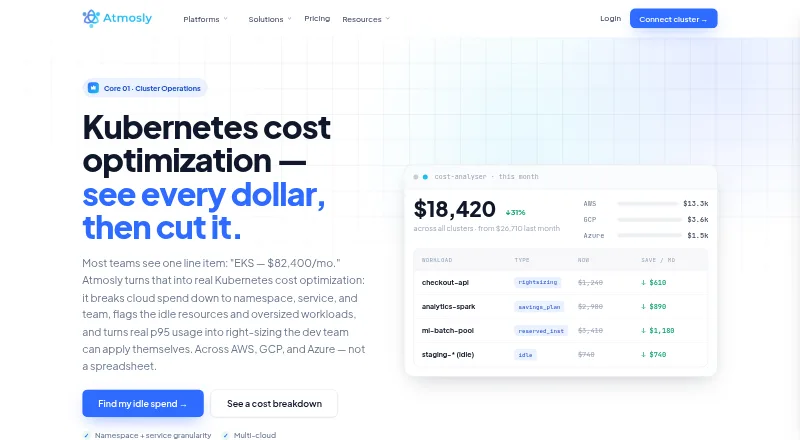
What Atmosly Kubernetes Cost Optimization is
Atmosly Kubernetes Cost Optimization helps teams allocate and reduce Kubernetes cloud spending across Amazon EKS, Google GKE, and Azure AKS. Its dashboard breaks costs down by account, cluster, namespace, and service, with showback views for teams. It identifies idle workloads and orphaned volumes, provides daily budget alerts and monthly forecasts, and ranks reserved-instance and savings-plan opportunities by monthly savings. Right-sizing suggestions use workload p95 usage over time, estimate dollar impact, and can be submitted as reviewable pull requests. Assessments can begin with read-only cluster access; changes require explicit approval. Cost telemetry needs an existing in-cluster Prometheus instance, and the page says kube-prometheus-stack works out of the box. The Personal plan is free forever for one engineer and one cluster, with recommendations in view-only mode and seven-day history. Team signups receive 30 days of Growth features without a credit card for self-serve signup. Paid plans start at $399/mo, and a self-hosted control plane is available on the Platform tier.
Good
- Allocates spend by account, cluster, namespace, and service.
- Forecasts costs and sends daily budget alerts.
- Estimates right-sizing savings and supports reviewable pull requests.
- Personal plan is free for one engineer and cluster.
Watch out
- Requires an existing in-cluster Prometheus instance for cost telemetry.
- Personal plan recommendations are view-only.
- Personal plan history is limited to seven days.
- Paid plans start at $399/mo.
Who it suits
It suits Kubernetes teams that need cost allocation, forecasting, and right-sizing guidance across supported cloud services. The free Personal plan is aimed at one engineer managing one cluster.
Verdict
Atmosly combines Kubernetes cost visibility with forecasts, budget alerts, and approval-based optimization suggestions. Check the Prometheus prerequisite and the Personal plan's view-only recommendations before choosing it.
Plans and prices
From Atmosly Kubernetes Cost Optimization's own pricing page, checked 28 Sep 2001.
| Plan | Price | What it gives you |
|---|---|---|
| Personal | Free | 1 cluster · 1 cloud account · 1 seat · 1 project · 2 environments · 10 applications · cost recommendations view only · 7-day history · $0 forever |
| Starter | $399 a month | 2 clusters · 2 cloud accounts · 25 seats · 100 AI actions/mo · cost recommendations + manual apply · 30-day retention · billed annually ($3,990/yr) · 2 months free; launch price $199/mo for your first year |
| Growth | $1,299 a month | 20 clusters · 10 cloud accounts · 75 seats · 750 AI actions/mo · automated right-sizing + full cloud FinOps · 180-day retention · billed annually ($12,990/yr) · 2 months free; launch price $799/mo for your first year |
| Enterprise | Priced on request | Unlimited clusters, accounts, seats & AI actions · dedicated CSM + SLA · optional managed services · Negotiated pricing & terms |
The facts
Each one read from Atmosly Kubernetes Cost Optimization's own pages, with the date it was checked.
What it does
- Budgets and idle resources
- It offers daily budget alerts, monthly cost forecasts, and detection of idle workloads and orphaned volumes.checked 28 Sep 2001
- Integrations
- The product page supports a Helm-installed read-only agent or direct cloud integration and identifies Prometheus as the telemetry prerequisite.checked 28 Sep 2001
- Purpose
- Atmosly breaks cloud spend down by namespace, service, and team, flags idle or oversized workloads, and provides right-sizing recommendations.checked 28 Sep 2001
- Read-only setup
- Atmosly says a connected cluster can be assessed with read-only access and that changes require explicit approval through pull requests.checked 28 Sep 2001
- Right-sizing
- Recommendations use workload p95 usage over time and include estimated dollar impact, and can be applied through reviewable pull requests.checked 28 Sep 2001
- Security
- The homepage says customer data never leaves the cluster, identifies Atmosly as ISO 27001 certified, and says SOC 2 Type II is in progress.checked 28 Sep 2001
- Self-hosting
- The homepage states that a self-hosted control plane is available on the Platform tier.checked 28 Sep 2001
- Setup prerequisite
- Cost telemetry uses an existing in-cluster Prometheus instance, and the page says kube-prometheus-stack works out of the box.checked 28 Sep 2001
- Supported clouds
- The cost optimization product covers Amazon EKS, Google GKE, and Azure AKS in one normalized dashboard.checked 28 Sep 2001
Money
- Commitment planning
- The product surfaces reserved-instance and savings-plan opportunities ranked by monthly savings.checked 28 Sep 2001
- Cost allocation
- Automatic allocation breaks spend down by account, cluster, namespace, and service, with showback dashboards per team.checked 28 Sep 2001
- Free access
- The Personal plan is free forever for one engineer and one cluster, with cost recommendations in view-only mode.checked 28 Sep 2001
- Trial
- Team signups receive 30 days of Growth features, and self-serve signup does not require a credit card.checked 28 Sep 2001
The company
- Company and support
- The company About page identifies Gurugram as its engineering hub, while pricing lists email support for Starter and priority plus Slack support for Growth.checked 28 Sep 2001
- Headquarters
- Gurugram, Haryana, Indiachecked 28 Sep 2001
The full review of Atmosly Kubernetes Cost Optimization
Atmosly Kubernetes Cost Optimization is a cloud-spend management tool for Kubernetes teams running Amazon EKS, Google GKE, or Azure AKS. It is best suited to organizations that already have Prometheus and want cost recommendations to pass through human review. Its free tier is useful for a narrow assessment, but meaningful ongoing optimization requires a paid plan.
Overview
Atmosly puts account, cluster, namespace, and service costs into one normalized dashboard, with team showback views to help assign shared spend. It also identifies idle workloads and orphaned volumes, forecasts monthly costs, and surfaces reserved-instance and savings-plan opportunities ranked by monthly savings. That combination makes it more than a reporting dashboard: it connects allocation and planning with specific savings opportunities.
Right-sizing recommendations use workload p95 usage over time and include estimated dollar impact. Changes can be proposed through reviewable pull requests, while a connected cluster can be assessed with read-only access. This approval path is a meaningful safeguard for teams that do not want automated changes made without review. The trade-off is a setup dependency: cost telemetry requires an existing in-cluster Prometheus instance, with kube-prometheus-stack supported out of the box.
Teams can connect with a Helm-installed read-only agent or direct cloud integration. Atmosly says customer data never leaves the cluster and identifies itself as ISO 27001 certified; SOC 2 Type II is in progress. Its engineering hub is in Gurugram, Haryana, India.
Key features
- Cost allocation and showback: Automatic allocation down to namespace and service, alongside account and cluster views, gives teams a practical basis for assigning shared costs.
- Usage-based recommendations: p95-based right-sizing suggestions with estimated dollar impact help teams prioritize changes, while pull requests preserve an approval step.
- Budget and commitment planning: Daily budget alerts, monthly forecasts, and ranked reserved-instance and savings-plan opportunities provide forward-looking controls as well as cost visibility.
- Idle-resource detection: Finding idle workloads and orphaned volumes can expose waste beyond oversized active workloads.
Pricing
The Personal plan is free forever at $0. It covers one cluster, one cloud account, one seat, one project, two environments, and 10 applications, with cost recommendations in view-only mode and seven-day history. That is enough for one engineer to inspect a small setup, but the view-only recommendations prevent applying savings changes through the plan.
Starter is $399 a month, billed annually at $3,990/yr with two months free; the launch price is $199/mo for your first year. It allows two clusters, two cloud accounts, 25 seats, 100 AI actions per month, manual application of recommendations, and 30-day retention. This is the practical entry point for a team that wants to act on recommendations, though it has little cluster headroom and optimization remains manual.
Growth is $1,299 a month, billed annually at $12,990/yr with two months free; the launch price is $799/mo for your first year. It expands the allowance to 20 clusters, 10 cloud accounts, 75 seats, 750 AI actions per month, automated right-sizing, full cloud FinOps, and 180-day retention. It fits larger environments that need automation and longer history, but the price is a substantial step up from Starter. Team signups receive 30 days of Growth features, and self-serve signup does not require a credit card.
Enterprise has custom pricing with negotiated terms, unlimited clusters, accounts, seats, and AI actions, plus a dedicated CSM, SLA, and optional managed services. It is the fit for organizations that need those capacity and support terms. Starter includes email support; Growth adds priority and Slack support. The pricing model is freemium, with paid plans starting at $399/mo.
Platforms
Atmosly supports Linux, self-hosted, and web environments. Its cost optimization product covers EKS, GKE, and AKS. A self-hosted control plane is available on the Platform tier, so self-hosting is not a stated capability of every plan.
Who it's for
Atmosly is a strong fit for Kubernetes teams managing spend across the three supported clouds, especially where showback, budget alerts, and approval-based recommendations matter. The Personal plan suits a single engineer checking one cluster; Starter is more suitable for teams ready to apply suggestions manually; Growth makes more sense when cluster scale, automated right-sizing, and extended retention justify the higher commitment. Teams without an existing Prometheus instance should account for that prerequisite before choosing it.
Pros and cons
- Pros: Allocation spans account to service, with namespace-level granularity and team showback, making shared costs easier to assign.
- Pros: Recommendations pair p95 usage with estimated dollar impact and an approval-based pull-request path, connecting analysis to controlled action.
- Pros: Daily alerts, forecasts, idle-resource detection, and ranked commitment opportunities cover several distinct ways to manage spend.
- Cons: Prometheus is required for cost telemetry, which adds a prerequisite for teams that do not already run it.
- Cons: The free plan is view-only and limited to one engineer and one cluster, so it is an assessment tier rather than an operating plan for a team.
- Cons: Starter caps teams at two clusters and 100 AI actions monthly, while automated right-sizing starts with the much pricier Growth plan.
Alternatives
Kubernetes Cost Management Software is the broader category page for comparing tools. Consider KubeAdapt if its free allowance of the first 100 vCPU across an account is a better fit for an initial cost-management setup. PerfectScale offers a free allowance up to 200 vCPU per month with unlimited clusters, nodes, and pods, making it worth considering when those free capacity limits matter more than Atmosly's view-only one-cluster tier.
Krossboard is another freemium Kubernetes cost-management option. KubeLedger is free, self-hosted, and provides source code for internal use, but cannot be sold as a managed service. Podledger offers a forever-free, self-hosted community plan for a single cloud with basic dashboards and pod-level cost visibility. Klustercost is a free, open-source option under GPL-3.0.
Flexera One IT Asset Management is a paid alternative with a free plan. IBM Kubecost offers OpenCost with unlimited clusters and cores, as well as a free Kubecost plan with stated core and spend limits.
Verdict
Choose Atmosly if your team needs cross-cloud Kubernetes cost allocation, forecasts, and usage-based recommendations that remain subject to approval. The combination of showback and controlled right-sizing is its clearest advantage. Look elsewhere if Prometheus is not part of your setup, or if you need automated optimization without moving to Growth.
Getting started
- Visit https://atmosly.com/platform/kubernetes-cost-optimization.
- Connect a cluster using a Helm-installed read-only agent or direct cloud integration.
- Ensure an in-cluster Prometheus instance provides cost telemetry.
- Use self-serve team signup for a 30-day Growth trial; no credit card is required.
- Choose a plan based on cluster, account, seat, and recommendation needs.
Limits worth knowing
The free Personal plan covers one cluster, one cloud account, one seat, one project, two environments, and ten applications, with view-only cost recommendations and seven-day history. Starter begins at $399 a month and includes two clusters, two cloud accounts, 25 seats, 100 AI actions per month, manual apply, and 30-day retention.
Questions
Is there a free plan?
Yes. Personal is free forever for one engineer and one cluster. Recommendations are view-only, and history is seven days.
How much does Starter cost?
Starter is listed at $399 a month, billed annually at $3,990 per year. Its listed launch price is $199 per month for the first year.
Is there a free trial?
Yes. Team signups receive 30 days of Growth features, and self-serve signup does not require a credit card.
Which Kubernetes clouds does it cover?
The product covers Amazon EKS, Google GKE, and Azure AKS.
What does setup require?
Cost telemetry requires an existing in-cluster Prometheus instance. The product supports a Helm-installed read-only agent or direct cloud integration.
Is a self-hosted option available?
Yes. A self-hosted control plane is available on the Platform tier.
Alternatives to Atmosly Kubernetes Cost Optimization
- 1

KubeAdapt
Free planWebAPILinuxmacOS7.7From $0.60 a month - 2
Krossboard
Free planOpen sourceWebAPILinuxSelf-hosted7.2Free plan - 3

Flexera One IT Asset Management
WebSelf-hosted6.3 - 4

Varcio Kubernetes Cost Management
WebAPISelf-hosted6.3From $49 a month - 5
CloudBolt
Free planWebAPISelf-hosted6.2Free plan - 6

OpenCost
Free planWebAPILinuxSelf-hosted6.2Free plan