Krossboard
Krossboard tracks Kubernetes cluster usage over time to support cost allocation and capacity planning.
What Krossboard is
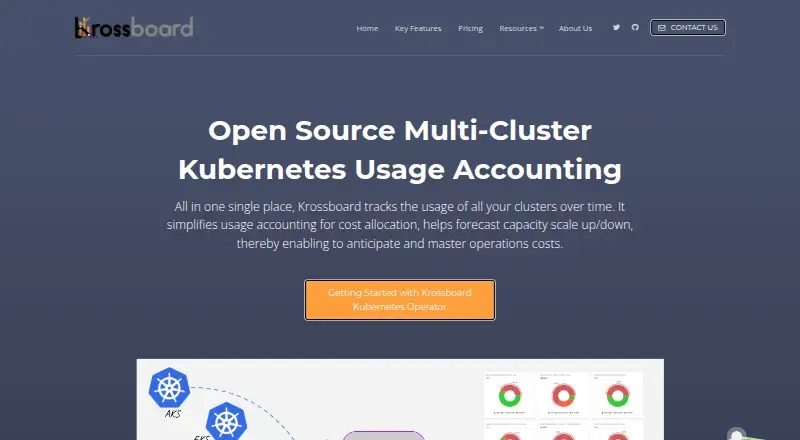
Krossboard tracks Kubernetes cluster usage over time to support cost allocation and capacity planning. It can analyze multiple clusters configured through one or more KUBECONFIG files, with views for namespaces, nodes and clusters across minutes, hours, days and months. Users can export analytics data as CSV. Each deployed instance provides a user interface and REST API, while the Kubernetes Operator deploys and manages instances as pods. The free plan includes unlimited clusters, core analytics and CSV export. It does not include managed-cluster discovery or support. Enterprise plans add discovery of managed AKS, EKS and GKE clusters; maintained-version bug and security fixes are available for one year on Enterprise and up to three years on Enterprise Advanced. Normal operation needs read-only access to Kubernetes metrics and core APIs. Managed-cluster discovery requires read-only cloud IAM permissions, and deployment requires cloud administration permissions to configure access. Krossboard is made by 2Alchemists SAS in Toulouse, France, and is available as web, API and self-hosted software.
Good
- Tracks multiple clusters from KUBECONFIG files.
- Provides namespace, node and cluster analytics.
- Exports analytics data as CSV.
- Free plan supports unlimited clusters.
- Available as web, API and self-hosted software.
Watch out
- Free plan excludes managed-cluster discovery.
- Free plan includes no support.
- Managed-cluster discovery requires cloud IAM permissions.
- Deployment requires cloud administration permissions.
Who it suits
Krossboard suits teams that need usage analytics across Kubernetes clusters for allocation or capacity planning. The free plan may fit users who do not need managed-cluster discovery or support.
Verdict
Krossboard offers multi-cluster usage reporting and CSV export, including on its free plan. Managed-cluster discovery and maintained-version support require paid Enterprise options.
Plans and prices
From Krossboard's own pricing page, checked 15 Oct 2001.
| Plan | Price | What it gives you |
|---|---|---|
| ALWAYS FREE | Free | core analytics · namespace, node and cluster analytics · unlimited clusters · multiple KUBECONFIG files · CSV export · no managed-cluster discovery · no support |
| ENTERPRISE | Priced on request | core analytics · up to 12 months namespace and cluster history · unlimited node history · unlimited clusters · managed AKS, EKS and GKE discovery · one year maintained-version support · On-demand |
| ENTERPRISE ADVANCED | Priced on request | core analytics · up to 12 months namespace and cluster history · unlimited node history · unlimited clusters · managed AKS, EKS and GKE discovery · up to three years maintained-version support · specific onboarding support · On-demand |
The facts
Each one read from Krossboard's own pages, with the date it was checked.
What it does
- API
- A deployed instance exposes a REST API service alongside its web UI service.checked 15 Oct 2001
- Cloud permissions
- Managed-cluster autodiscovery requires read-only cloud IAM permissions, while deployment requires cloud administration permissions to configure access.checked 3 Oct 2001
- Cluster analytics
- Cluster dashboards compare consolidated resource utilization across one or more clusters over selected dates.checked 15 Oct 2001
- Cross-distribution support
- The product is tested with Amazon EKS, Google GKE, Microsoft AKS, Red Hat OpenShift, Rancher RKE and vanilla Kubernetes.checked 15 Oct 2001
- CSV export
- Generated analytics data can be exported as CSV for processing in external analytics tools.checked 15 Oct 2001
- Deployment
- The Kubernetes Operator deploys and manages Krossboard instances as Kubernetes pods.checked 3 Oct 2001
- Documentation
- The documentation hub includes concepts, analytics, operator setup, cross-cloud setup, troubleshooting, releases and FAQs.checked 15 Oct 2001
- Independent ecosystem listing
- GitHub's cost-allocation topic lists a deprecated Krossboard VM repository updated on December 4, 2022 and tagged for Kubernetes, dashboards, analytics and cloud platforms.checked 15 Oct 2001
- Integrations
- The documentation names Google BigQuery, AWS Athena, Azure Synapse, Tableau and Microsoft Excel as external tools suitable for exported data.checked 15 Oct 2001
- KUBECONFIG support
- Krossboard can use several KUBECONFIG files without extra configuration.checked 15 Oct 2001
- Licence
- The public GitHub repository identifies Krossboard as AGPL-3.0 licensed.checked 15 Oct 2001
- Limit: data latency
- The troubleshooting guide says initial charts may take at least five minutes and hourly-consolidated charts about an hour to populate.checked 15 Oct 2001
- Limit: legacy deployment baseline
- The cross-cloud installation guide depends on Ubuntu Server 18.04 LTS and Docker-based virtual-machine or package deployment.checked 15 Oct 2001
- Managed-cluster discovery
- Automatic discovery is available for managed EKS, GKE and AKS clusters on paid plans and requires read-only cloud IAM permissions.checked 15 Oct 2001
- Managed Kubernetes
- Enterprise plans include discovery of managed AKS, EKS, and GKE clusters; the free plan does not.checked 3 Oct 2001
- Metrics dependency
- Krossboard requires Kubernetes Metrics Server on each target cluster for basic metrics collection.checked 15 Oct 2001
- Multi-cluster
- It provides usage analytics across multiple Kubernetes clusters configured through one or more KUBECONFIG files.checked 3 Oct 2001
The company
- Company founded
- A French company-record listing gives 2Alchemists an immatriculation date of May 25, 2020.checked 15 Oct 2001
- Company legal status
- The maker identifies itself as 2Alchemists SAS, registered in Toulouse, France, with headquarters at 25 Rue Jacqueline Auriol.checked 15 Oct 2001
- Headquarters
- 25 Rue Jacqueline Auriol, 31400 Toulouse, Francechecked 28 Sep 2001
- Independent company history
- The Org reports that Christophe Camel co-founded 2Alchemists in June 2020 and is based in Toulouse, France.checked 15 Oct 2001
- Maker
- Krossboard is made by 2Alchemists SAS, a French company registered in Toulouse, with headquarters at 25 Rue Jacqueline Auriol, 31400 Toulouse.checked 3 Oct 2001
Money
- Limit: free-tier discovery
- The free plan excludes automatic discovery of managed AKS, EKS and GKE clusters.checked 15 Oct 2001
- Limit: free-tier support
- The pricing table lists no support for the free plan, while paid plans provide time-limited maintained-version access.checked 15 Oct 2001
The full review of Krossboard
Overview
Krossboard is Kubernetes software for tracking cluster usage over time to support cost allocation and capacity planning. It is best suited to teams that want reporting across multiple clusters and can manage a Kubernetes-based deployment. Its broad free plan covers core analytics and CSV export, while managed-cluster discovery and maintained-version access are paid options.
Key features
Configure one or more KUBECONFIG files to bring multiple clusters into consolidated views of namespace, node, and cluster usage. Reporting spans minutes through months, so teams can examine both short-term changes and longer-term patterns. Namespace-level allocation and cost forecasting make the reporting relevant to internal charge allocation and capacity planning, though teams looking for a more expansive cost-optimization feature set should compare alternatives.
CSV export lets teams take analytics into their own workflows. Each deployed instance also provides a REST API alongside its UI, and the Kubernetes Operator deploys and manages instances as pods. Normal operation needs read-only access to Kubernetes metrics and core APIs. Enterprise discovery for AKS, EKS, and GKE requires read-only cloud IAM permissions; configuring deployment access requires cloud administration permissions, a meaningful setup consideration for teams with strict access controls.
Pricing
ALWAYS FREE costs nothing and includes unlimited clusters, core analytics, and CSV export. That is a substantial starting point for teams that can configure clusters themselves, but it excludes managed-cluster discovery and support.
ENTERPRISE has custom pricing, billed On-demand. It adds managed-cluster discovery and one year of access to maintained versions for bug and security fixes. It fits teams that want AKS, EKS, or GKE discovery and a defined period of maintenance access.
ENTERPRISE ADVANCED also has custom pricing, billed On-demand. It includes unlimited clusters, managed-cluster discovery, up to three years of support, and specific onboarding support. That is the more suitable option when longer support access and onboarding matter; teams that do not need those services can stay on the free plan.
Platforms
Krossboard is available as API, self-hosted, and web software. The Operator-based deployment runs instances as Kubernetes pods, making it a natural fit for teams already operating Kubernetes, rather than those seeking only a hosted service.
Who it's for
Krossboard suits platform and infrastructure teams that need multi-cluster usage reporting, namespace-level allocation, cost forecasting, or CSV data for further analysis. Its free plan keeps the core reporting useful without a cluster cap. Teams that want automatic discovery of managed clusters, maintenance access, or onboarding help need to consider the Enterprise tiers and their cloud permission requirements.
Pros and cons
- Pros: Unlimited clusters, core analytics, and CSV export are included in the free plan, making it practical to consolidate reporting without a cluster-count charge.
- Pros: Namespace, node, and cluster views across minute-to-month intervals support different levels of usage analysis.
- Pros: A REST API and CSV export provide both programmatic and file-based ways to work with analytics.
- Cons: Managed AKS, EKS, and GKE discovery is reserved for Enterprise plans and requires read-only cloud IAM permissions.
- Cons: The free plan has no support; access to maintained versions and onboarding support are paid-tier benefits.
- Cons: Configuring deployment access requires cloud administration permissions, which may complicate rollout in tightly controlled environments.
Alternatives
For a separate category-wide comparison, see Kubernetes Cost Management Software.
- KubeAdapt is worth considering if its free allowance of the first 100 vCPU across an account, all features, and email support better matches a capped, supported free tier; it also offers a free trial.
- Atmosly Kubernetes Cost Optimization may fit a small setup that can work within its free Personal plan's one cluster, one cloud account, one seat, one project, two environments, and 10 applications.
- PerfectScale is an option for teams whose usage fits its free allowance of up to 200 vCPU per month, with unlimited clusters, nodes, and pods; its Expert plan is priced by quote per vCPU.
- OpenCost may suit teams seeking open-source software under Apache 2.0 that requires Kubernetes and Prometheus.
- KubeLedger is another free, self-hosted choice, with source code available for internal use but not for sale as a managed service.
- Podledger may appeal to a team that wants a forever-free self-hosted Community plan for one cloud, with basic cost dashboards, pod-level visibility, and GitHub community support.
- CloudBolt offers a free CMP plan with core capabilities for up to 100 resources, which may better fit teams focused on that scope.
- Klustercost is a free open-source option under GPL-3.0.
Verdict
Krossboard is a strong fit for Kubernetes teams that want unlimited-cluster usage reporting, namespace-level allocation, forecasting, and export without paying for core analytics. Choose it when self-managed configuration and read-only cluster access are acceptable; look elsewhere if you need free support or want managed-cluster discovery without an Enterprise plan.
Alternatives to Krossboard
- 1

KubeAdapt
Free planWebAPILinuxmacOS7.7From $0.60 a month - 2

Atmosly Kubernetes Cost Optimization
Free planWebLinuxSelf-hosted6.8From $399 a month - 3

Varcio Kubernetes Cost Management
WebAPISelf-hosted6.3From $49 a month - 4
CloudBolt
Free planWebAPISelf-hosted6.2Free plan - 5

OpenCost
Free planWebAPILinuxSelf-hosted6.2Free plan - 6
Skuber+
Web6.2