
KubeAdapt
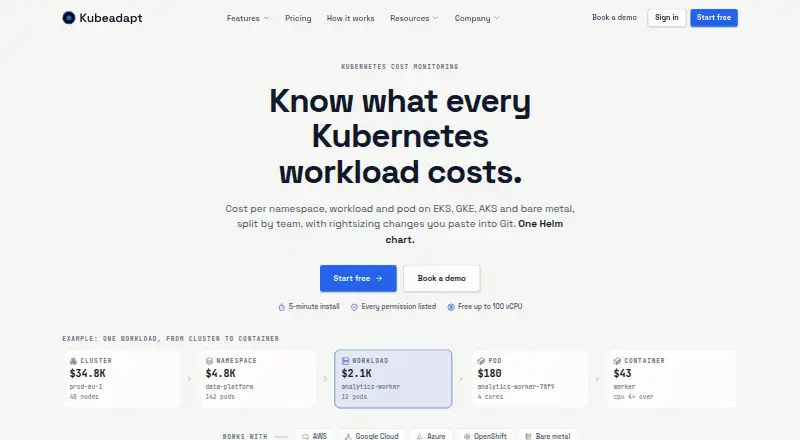
KubeAdapt monitors Kubernetes costs and provides views by cluster, namespace, workload, pod, and team.
What KubeAdapt is
KubeAdapt monitors Kubernetes costs and provides views by cluster, namespace, workload, pod, and team. It supports AWS, Google Cloud, Azure, OpenShift, and bare-metal Kubernetes. Installation uses a Helm chart, and the site says setup takes about five minutes. Rightsizing guidance gives per-container CPU and memory recommendations as YAML for GitOps workflows. Recommendations include OOM-aware, bursty-CPU, and replica-aware guardrails, but KubeAdapt does not apply changes to the cluster. Its agent uses read-only Kubernetes permissions limited to list and watch, and the company says it does not collect Secrets, ConfigMaps, environment variables, container logs, or network traffic. Aggregated payloads are signed in the cluster and sent with TLS 1.3 and mutual TLS. Smart Alerting can send budget, cost-spike, and new-workload notices through Slack, email, or webhooks. A read-only REST API provides cost, capacity, and resource data using Bearer API keys. The free allowance covers the first 100 vCPU across an account. Paid monthly rates vary by tier, from $0.60 to $1.99 per billable vCPU; startup pricing is $0.60 per billable vCPU per month for qualifying companies.
Good
- Cost views span clusters, workloads, and teams.
- Per-container CPU and memory guidance is provided as YAML.
- Agent uses read-only list and watch permissions.
- Free allowance covers the first 100 vCPU.
Watch out
- KubeAdapt does not apply cluster changes.
- GCP commitment and sustained-use discounts are not reflected.
- Network agent requires Linux kernel 5.10 or newer.
- Network agent currently priced for AWS only.
Who it suits
KubeAdapt suits teams managing Kubernetes on the listed cloud, OpenShift, or bare-metal environments that want cost views, alerts, and rightsizing guidance. It is also relevant to teams using GitOps workflows and read-only cost data.
Verdict
KubeAdapt provides cost visibility and recommendations while leaving cluster changes to the user. Check its GCP discount and optional network-agent limits against your environment before selecting a plan.
Plans and prices
From KubeAdapt's own pricing page, checked 15 Oct 2001.
| Plan | Price | What it gives you |
|---|---|---|
| Free allowance | Free | all features · no credit card · email support · first 100 vCPU across the account |
| Free allowance | Free | No credit card · All features · Email support · First 100 vCPU across account |
| Startup pricing | $0.60 a month | company under 3 years old · fewer than 30 employees · under $6M raised · flat per billable vCPU/month after first 100 vCPU |
| Startup pricing | $0.60 a month | Company under 3 years old · Fewer than 30 employees · Under $6M raised · Flat per billable vCPU / month |
| Standard tier 4 | $0.60 a month | 5,000+ billable vCPU · First 100 vCPU free · Per billable vCPU / month |
| Standard tier 4 | $0.60 a month | 5,000+ billable vCPU · per billable vCPU/month after first 100 vCPU |
| Standard tier 3 | $0.99 a month | 2,000–5,000 billable vCPU · First 100 vCPU free · Per billable vCPU / month |
| Standard tier 3 | $0.99 a month | 2,000–5,000 billable vCPU · per billable vCPU/month after first 100 vCPU |
| Standard tier 2 | $1.49 a month | 500–2,000 billable vCPU · per billable vCPU/month after first 100 vCPU |
| Standard tier 2 | $1.49 a month | 500–2,000 billable vCPU · First 100 vCPU free · Per billable vCPU / month |
| Standard tier 1 | $1.99 a month | 0–500 billable vCPU · per billable vCPU/month after first 100 vCPU |
| Standard tier 1 | $1.99 a month | 0–500 billable vCPU · First 100 vCPU free · Per billable vCPU / month |
The facts
Each one read from KubeAdapt's own pages, with the date it was checked.
What it does
- Agent architecture update
- A March 2026 vendor release says the rebuilt agent removed Prometheus, OpenCost, node-exporter and kube-state-metrics dependencies, requiring metrics-server instead.checked 15 Oct 2001
- Alert integrations
- Smart Alerting sends budget, cost-spike and new-workload alerts to Slack, email or webhooks.checked 30 Sep 2001
- Alerts
- Smart Alerting supports budget and cost-spike alerts delivered through Slack, email or webhooks.checked 15 Oct 2001
- API
- The REST API provides read-only cost, capacity and resource data and authenticates with Bearer API keys.checked 30 Sep 2001
- API rate limit
- The documented default API quota is 100 requests per minute per API key, with HTTP 429 responses when exceeded.checked 15 Oct 2001
- Best-practice checks
- Best Practices evaluates Kubernetes configuration and assigns a score for each cluster.checked 15 Oct 2001
- Changelog activity
- The changelog lists a public API release on February 25, 2026 and a CLI release on March 14, 2026.checked 15 Oct 2001
- CLI
- Kubeadapt CLI can be installed with Homebrew, go install or release archives for macOS, Linux and Windows.checked 15 Oct 2001
- Data collection
- Kubeadapt says it does not collect Secrets, ConfigMaps, environment variables, container logs or network traffic.checked 30 Sep 2001
- Data exclusions
- Kubeadapt says it does not collect Secrets, ConfigMaps, environment variables, container logs or network traffic.checked 15 Oct 2001
- Data transport
- Aggregated payloads are signed in the cluster and sent to Kubeadapt over TLS 1.3 with mutual TLS.checked 15 Oct 2001
- Documentation depth
- The documentation site reports 71 pages across nine sections covering installation, integrations, configuration, CLI, API reference and troubleshooting.checked 15 Oct 2001
- GCP integration limit
- GCP on-demand and Spot or Preemptible pricing work without setup, while Committed Use and Sustained Use Discounts are planned and not yet reflected.checked 30 Sep 2001
- GCP pricing limitation
- GCP committed-use and sustained-use discounts are not reflected; the documentation says those capabilities are planned.checked 15 Oct 2001
- GreenOps
- GreenOps estimates kilograms of carbon dioxide equivalent per workload.checked 15 Oct 2001
- Helm chart licence
- The public Kubeadapt Helm chart repository is licensed under Apache License 2.0.checked 15 Oct 2001
- Helm repository status
- The GitHub Helm repository is public, shows 2 stars, 0 forks and 58 commits on the opened page.checked 15 Oct 2001
- Installation
- The agent is installed with a Kubeadapt Helm repository and cluster token; the vendor says initial cost data appears within minutes.checked 15 Oct 2001
- Kubernetes requirements
- The Helm chart supports Kubernetes 1.24 or newer, Helm 3, and an installed metrics-server.checked 15 Oct 2001
The company
- Company founding
- Kubeadapt says it was founded in 2025 by engineers and cloud architects with enterprise Kubernetes experience.checked 30 Sep 2001
- Company size
- LinkedIn lists Kubeadapt as having 2–10 employees.checked 15 Oct 2001
- Founded
- LinkedIn lists Kubeadapt as founded in 2025.checked 15 Oct 2001
- Independent company post reach
- Kubeadapt’s LinkedIn page displayed 56 followers when opened.checked 15 Oct 2001
Money
- Cost views
- Dashboards can show cost by cluster, namespace, workload, pod, node, node group and container, with filtering, grouping, saved dashboards and exports.checked 15 Oct 2001
The full review of KubeAdapt
Overview
KubeAdapt is Kubernetes cost monitoring and optimization software for teams that need cost visibility across clusters, namespaces, workloads, pods and teams. It suits organizations managing Kubernetes across cloud and on-premises environments, especially those that want recommendations without automatic changes to production workloads. Its strongest case is the combination of granular cost views, guarded rightsizing guidance and a free first 100 vCPU; check the GCP discount and network-agent limits before committing.
Key features
Cost views extend from cluster down to pod and team, while container-level allocation and cost forecasting help teams examine where spend is accumulating. The breadth of supported environments—AWS, Google Cloud, Azure, OpenShift and bare-metal Kubernetes—makes it relevant to mixed estates, although GCP pricing has an important gap: on-demand and Spot or Preemptible rates work without setup, but Committed Use and Sustained Use Discounts are not yet reflected.
Workload rightsizing produces per-container CPU and memory recommendations as YAML, a useful fit for teams that review changes through GitOps rather than applying them directly. OOM-aware, bursty-CPU and replica-aware guardrails add operational context, but KubeAdapt leaves all cluster changes to the user. Smart Alerting can send budget, cost-spike and new-workload alerts to Slack, email or webhooks. The REST API is read-only and uses Bearer API keys, so it suits reporting and integrations that need cost, capacity or resource data without write access.
The Kubernetes agent is installed with a Helm chart; the site estimates installation at about five minutes. It uses read-only RBAC with list and watch permissions, and KubeAdapt says it does not collect Secrets, ConfigMaps, environment variables, container logs or network traffic. Aggregated payloads are signed in the cluster and sent over TLS 1.3 with mutual TLS. The optional network agent is narrower: it requires Linux kernel 5.10 or newer and is currently priced for AWS, with GCP and Azure unsupported.
Pricing
The Free plan costs nothing and covers the first 100 vCPU across the account, with no credit card required. It includes all features and email support, making it a substantial starting point for small deployments; the 100-vCPU cap is the key boundary. Email support is offered on all accounts, including free ones.
Startup pricing is $0.60 a month, billed flat per billable vCPU per month, for companies under three years old, with fewer than 30 employees and under $6M raised. Standard pricing also begins with the first 100 vCPU free, then charges per billable vCPU per month: Standard tier 1 is 1.99 USD for 0–500 billable vCPU; tier 2 is 1.49 USD for 500–2,000; tier 3 is 0.99 USD for 2,000–5,000; and tier 4 is 0.60 USD for 5,000+ billable vCPU. The lower per-vCPU rates at larger scale favor bigger estates, while the startup rate is restricted by company age, headcount and funding.
Platforms
KubeAdapt supports API, Linux, self-hosted and web. The optional network agent's Linux kernel requirement and AWS-only pricing matter specifically to teams considering network intelligence; core cost monitoring spans the supported Kubernetes environments.
Who it's for
KubeAdapt is best suited to platform and FinOps teams that need container-level cost allocation, budget alerts and actionable rightsizing suggestions, but want engineers to approve and implement changes. Its free allowance lowers the barrier to evaluating a small cluster footprint, while the tiered per-vCPU rates accommodate larger accounts. It is less suitable when teams expect automatic remediation, need commitment discounts represented in GCP cost views, or require the network agent across GCP or Azure.
Pros and cons
- Pros: The first 100 vCPU are free, with all features and email support, enabling meaningful evaluation without a card.
- Pros: Per-container YAML recommendations and GitOps-oriented, replica-aware guardrails make optimization guidance usable in controlled deployment workflows.
- Pros: Read-only Kubernetes permissions and read-only API access reduce the scope of changes the product itself can make.
- Cons: Recommendations are not applied automatically, so teams must own review and rollout.
- Cons: GCP committed-use and sustained-use discounts are not reflected yet, which can limit cost accuracy for discount-heavy accounts.
- Cons: Network intelligence has a Linux 5.10+ requirement and is priced only for AWS at present.
Alternatives
For another freemium Kubernetes cost tool, compare Kubernetes Cost Management Software. Atmosly Kubernetes Cost Optimization is worth considering if a free account capped at one cluster, one cloud account, one seat and one project, with two environments and ten applications, matches your footprint. Flexera One IT Asset Management is a paid, web and self-hosted option with demo-based pricing.
PerfectScale may suit teams wanting a free allowance of up to 200 vCPU per month with unlimited clusters, nodes and pods; its Expert plan is quote-priced per vCPU. Krossboard is another freemium API, self-hosted and web option. IBM Kubecost is a web-based alternative with a free tier covering 250 cores and $100K spend over 30 days, alongside OpenCost. KubeLedger is a free self-hosted option for internal use, with source code available but no permission to sell it as a managed service. Podledger is a freemium web option. Varcio Kubernetes Cost Management may appeal to teams seeking a paid monthly entry point: its $49 a month Explorer plan includes one workspace, one user and one account on one cloud provider, but lacks Kubernetes detectors.
Verdict
Choose KubeAdapt if your team wants broad Kubernetes cost visibility and guarded, GitOps-friendly rightsizing guidance without granting a tool permission to alter workloads. The free first 100 vCPU and read-only access make it an appealing starting point; look elsewhere if automated changes, GCP commitment-discount coverage or cross-cloud network intelligence are essential.
Getting started
- Visit the KubeAdapt website.
- Install the Kubernetes agent with its Helm chart.
- Use the free allowance for the first 100 vCPU across the account; no credit card is required.
- For paid use, select the applicable startup or standard per-billable-vCPU rate.
- For API access, authenticate with a Bearer API key.
Limits worth knowing
The free allowance covers the first 100 vCPU across an account. The optional network agent requires Linux kernel 5.10 or newer and is currently priced for AWS; GCP and Azure are not yet supported for that agent. GCP on-demand and Spot or Preemptible pricing work without setup, but Committed Use and Sustained Use Discounts are not yet reflected.
Questions
Is KubeAdapt free?
Yes. The free allowance covers the first 100 vCPU across an account, includes all features and email support, and requires no credit card.
How is KubeAdapt priced beyond the free allowance?
Rates are per billable vCPU per month. Standard tier rates range from 1.99 USD for 0–500 billable vCPU to 0.60 USD for 5,000 or more; the startup rate is 0.60 USD for qualifying companies.
Which Kubernetes environments does KubeAdapt support?
It works with AWS, Google Cloud, Azure, OpenShift, and bare-metal Kubernetes.
Does KubeAdapt change cluster resources automatically?
No. It provides CPU and memory recommendations as YAML, but does not apply changes to the cluster.
What data does the agent collect?
KubeAdapt says it does not collect Secrets, ConfigMaps, environment variables, container logs, or network traffic. Its agent has read-only Kubernetes permissions limited to list and watch.
Who founded KubeAdapt?
KubeAdapt says it was founded in 2025 by engineers and cloud architects with enterprise Kubernetes experience.
Alternatives to KubeAdapt
- 1
Krossboard
Free planOpen sourceWebAPILinuxSelf-hosted7.2Free plan - 2

Atmosly Kubernetes Cost Optimization
Free planWebLinuxSelf-hosted6.8From $399 a month - 3

Flexera One IT Asset Management
WebSelf-hosted6.3 - 4

Varcio Kubernetes Cost Management
WebAPISelf-hosted6.3From $49 a month - 5
CloudBolt
Free planWebAPISelf-hosted6.2Free plan - 6

OpenCost
Free planWebAPILinuxSelf-hosted6.2Free plan