KubeFleet
KubeFleet is an open-source, self-hosted control plane for managing Kubernetes resources across multiple clusters.
What KubeFleet is
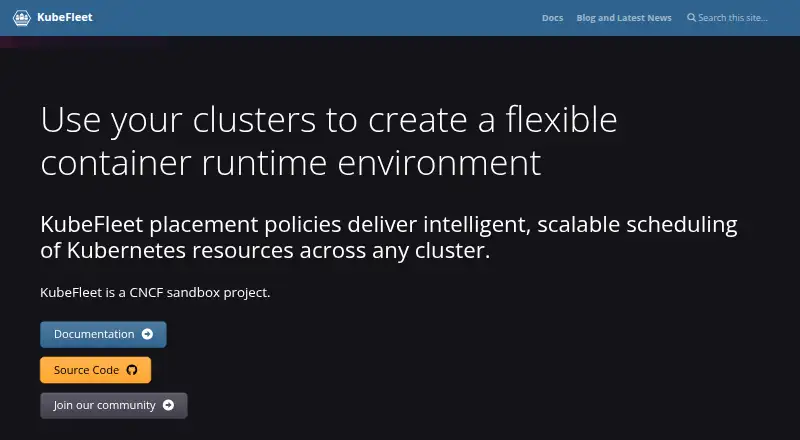
KubeFleet is an open-source, self-hosted control plane for managing Kubernetes resources across multiple clusters. A hub cluster coordinates member clusters, whose agents pull manifests from the hub; this allows members with outbound network access to participate without inbound access. Placement policies direct resources using rules such as region and release stage, and staged rollouts let changes progress across member clusters. Administration features include policy enforcement, status observation, configuration drift detection, and moving resources between clusters. KubeFleet works with supported Kubernetes versions on public clouds, on-premises, and local kind clusters. Its documentation describes fleet groups from smaller setups to hundreds of clusters and thousands of nodes. On joining, a member cluster’s service account permissions are restricted to a namespace reserved for that cluster. KubeFleet placement APIs can also be combined with Kueue for scheduling AI and machine learning workloads across a fleet. The project is a Cloud Native Computing Foundation sandbox project, and it directs users to GitHub discussions and issues for support and bug reports.
Good
- Supports staged rollouts across member clusters
- Works with cloud, on-premises, and local kind clusters
- Member agents can operate with outbound access only
- Restricts member service-account permissions to a reserved namespace
Watch out
- Self-hosted deployment
- The kind quickstart requires Docker, kind, and Helm
- Support and bug reports are directed to GitHub discussions and issues
Who it suits
KubeFleet suits teams managing Kubernetes resources across multiple clusters, including clusters that cannot accept inbound connections. It is also relevant to teams scheduling AI or machine learning workloads across a fleet with Kueue.
Verdict
KubeFleet offers placement, rollout, and administration tools for multi-cluster Kubernetes setups. Teams should account for self-hosting and the listed local tools required by its kind quickstart.
The facts
Each one read from KubeFleet's own pages, with the date it was checked.
What it does
- Access controls
- When a member cluster joins, its service account permissions are restricted to a namespace reserved for that member cluster.checked 4 Oct 2026
- Administration
- KubeFleet can enforce policies, observe status, detect configuration drift, and move resources between clusters.checked 8 Oct 2026
- AI workloads
- A guide explains scheduling AI/ML workloads across a fleet using Kueue together with KubeFleet placement APIs.checked 8 Oct 2026
- Architecture
- KubeFleet uses hub and member agents, with member agents pulling resource manifests from the hub.checked 8 Oct 2026
- Cluster compatibility
- KubeFleet can work with supported Kubernetes clusters on public clouds, on premises, or locally with kind.checked 8 Oct 2026
- Compatibility
- KubeFleet can work with supported Kubernetes versions on public clouds, on-premises, or local kind clusters.checked 4 Oct 2026
- Deployment requirement
- The kind quickstart lists Docker, kind, and Helm as required local tools.checked 4 Oct 2026
- Integration
- A tutorial describes integrating KubeFleet with Argo CD for multi-cluster application management, cluster-specific configuration, and controlled rollouts.checked 8 Oct 2026
- Management
- It provides a multi-cluster control plane for deploying and managing resources across member clusters.checked 8 Oct 2026
- Network access
- Member clusters can operate with outbound network access only, without inbound access from the hub.checked 8 Oct 2026
- Network model
- The member agent uses pull mode, so member clusters can be supported when they have outbound network access but no inbound access.checked 4 Oct 2026
- Progressive rollout
- The documentation describes progressively rolling out changes across clusters.checked 8 Oct 2026
- Progressive rollouts
- KubeFleet supports staged, progressive rollouts of resource changes across member clusters.checked 4 Oct 2026
- Project status
- KubeFleet is a Cloud Native Computing Foundation sandbox project.checked 8 Oct 2026
- Purpose
- KubeFleet manages Kubernetes resources across multiple clusters using placement policies and scheduling.checked 8 Oct 2026
- Scale
- The documentation says KubeFleet is designed to work with cluster groups from smaller setups up to hundreds of clusters and thousands of nodes.checked 8 Oct 2026
- Scheduling
- Its scheduling capabilities help select clusters for workloads based on placement policies.checked 8 Oct 2026
- Security
- The documentation says KubeFleet reserves a namespace on the hub to isolate permissions and resources across member clusters.checked 8 Oct 2026
- Support
- The site directs users to GitHub discussions and issues for questions, feedback, and bug reports.checked 8 Oct 2026
Money
- Control plane
- KubeFleet acts as a multi-cluster control plane for deploying and managing resources across clusters.checked 4 Oct 2026
Alternatives to KubeFleet
- 1

Portainer
Free planOpen sourceAndroidiOSWebAPI8.6Free plan - 2

KubeSphere
Free planOpen sourceWebAPILinuxSelf-hosted8.1From $65 a month - 3

vCluster Platform
Free planOpen sourceWebAPILinuxmacOS7.7Free plan - 4
Headlamp
Free planOpen sourceWebAPIExtensionLinux7.5Free plan - 5
Lens K8S IDE
Free planAPIExtensionLinuxmacOS7.5From $25 a month - 6
Docker Desktop
Free planWebLinuxmacOSWindows7.2From $9 a month