Krkn-AI
Krkn-AI is a free, open-source tool for automatically running chaos scenarios and finding experiments to assess application resilience.
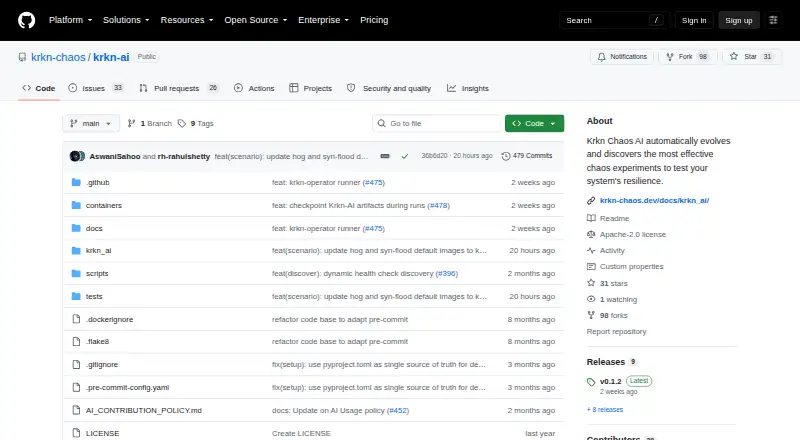
What Krkn-AI is
Krkn-AI is a free, open-source tool for automatically running chaos scenarios and finding experiments to assess application resilience. It uses evolutionary algorithms to generate experiments from Krkn scenarios, guided by objectives such as service-level objectives (SLOs) and application health checks. Its discover command creates a YAML configuration populated with cluster component details and basic setup. Results describe the effect of scenarios on application liveness and provide fitness scores; Prometheus metrics can be used to measure system response. An interactive dashboard can monitor experiment results. The project describes testing Kubernetes and OpenShift applications and requires a cluster kubeconfig. Krkn-AI can run as a Python CLI or from a pre-built container image. Listed prerequisites include Python 3.11 or later, krknctl, oc or kubectl, Podman, Helm 3.x, and a Kubernetes or OpenShift cluster kubeconfig. The repository lists an Apache-2.0 license. Its README says the tool is under active development and advises users to use it at their own risk.
Good
- Generates experiments from Krkn scenarios
- Objectives can include SLOs and health checks
- Reports application liveness impact and fitness scores
- Prometheus metrics can measure system response
- Available as a Python CLI or container
Watch out
- Requires a Kubernetes or OpenShift cluster kubeconfig
- Requires several command-line and container tools
- The project is under active development
Who it suits
Krkn-AI suits teams evaluating the resilience of Kubernetes or OpenShift applications. It requires a cluster kubeconfig and the listed command-line and container tooling.
Verdict
Krkn-AI is aimed at resilience testing for Kubernetes and OpenShift applications, with experiment generation and result monitoring. Review the prerequisites and active-development warning before adopting it.
Plans and prices
From Krkn-AI's own pricing page, checked 10 Oct 2001.
| Plan | Price | What it gives you |
|---|---|---|
| Apache License 2.0 | Free | Open-source software · No commercial pricing or plan limits stated |
The facts
Each one read from Krkn-AI's own pages, with the date it was checked.
What it does
- Algorithm
- It uses evolutionary algorithms to generate experiments from Krkn scenarios and guide testing with user-defined objectives such as SLOs and application health checks.checked 10 Oct 2001
- Audience
- The project is intended for testing the resilience of Kubernetes and OpenShift applications.checked 10 Oct 2001
- Cluster discovery
- The discover command can populate configuration with cluster components, runnable scenarios, health check URLs, and Prometheus-validated fitness queries.checked 10 Oct 2001
- Container
- A pre-built container image is available on Quay.io, and the container guide documents discovery and run modes.checked 9 Oct 2001
- Container permissions
- The documented standard run example uses host networking and privileged mode; the guide also describes a FUSE-based option without the privileged flag.checked 9 Oct 2001
- Deployment
- Krkn-AI can be installed as a Python CLI or run from a pre-built container image, including on Kubernetes.checked 10 Oct 2001
- Development status
- The repository cautions that the tool is under active development and should be used at the user's own risk.checked 10 Oct 2001
- Evaluation
- User-defined objectives such as SLOs and application health checks guide the algorithm.checked 9 Oct 2001
- Installation
- The README provides installation from source or directly from the GitHub repository using uv and Python 3.11 or later.checked 9 Oct 2001
- Integrations
- The documented setup uses Krkn scenarios, krknctl, Kubernetes or OpenShift, and Prometheus metrics.checked 10 Oct 2001
- License
- The public repository is licensed under Apache-2.0.checked 10 Oct 2001
- Metrics
- Fitness evaluation can measure system response using Prometheus metrics.checked 10 Oct 2001
- Monitoring
- An interactive dashboard can monitor Krkn-AI experiment results.checked 9 Oct 2001
- Project affiliation
- The Krkn documentation identifies Krkn as a Cloud Native Computing Foundation Sandbox project.checked 9 Oct 2001
- Purpose
- Krkn-AI automatically runs chaos scenarios and discovers experiments to evaluate system resilience.checked 10 Oct 2001
- Requirements
- The project lists Python 3.11+, krknctl, oc or kubectl, Podman, Helm 3.x, and a Kubernetes or OpenShift cluster kubeconfig as prerequisites.checked 10 Oct 2001
- Results
- Users can analyze scenario impact on application liveness and fitness scores, with an interactive dashboard for monitoring experiment results.checked 10 Oct 2001
- Security
- The project documentation links to a security self-assessment; the repository page does not state a compliance certification.checked 10 Oct 2001
- Support
- The project documentation links to a community Slack, GitHub issues, and contribution guidelines.checked 9 Oct 2001
- Supported environments
- The project describes testing Kubernetes and OpenShift applications and requires a cluster kubeconfig.checked 9 Oct 2001
Alternatives to Krkn-AI
- 1

FaultMesh
Free planWebAPISelf-hosted7.2From $49 a month - 2

Gremlin
WebAPILinuxSelf-hosted7.2From $3,750 a month - 3

Reliably
Free planWebLinuxmacOSSelf-hosted7.1From £40 a month - 4
Krkn
Free planWebAPILinuxSelf-hosted6.7Free plan - 5

Chaos Mesh
Free planWebAPISelf-hosted6.5Free plan - 6
Toxiproxy
Free planAPILinuxmacOSSelf-hosted6.5Free plan