
FaultMesh
FaultMesh is a Kubernetes-native platform for introducing controlled failures and checking how systems respond.
What FaultMesh is
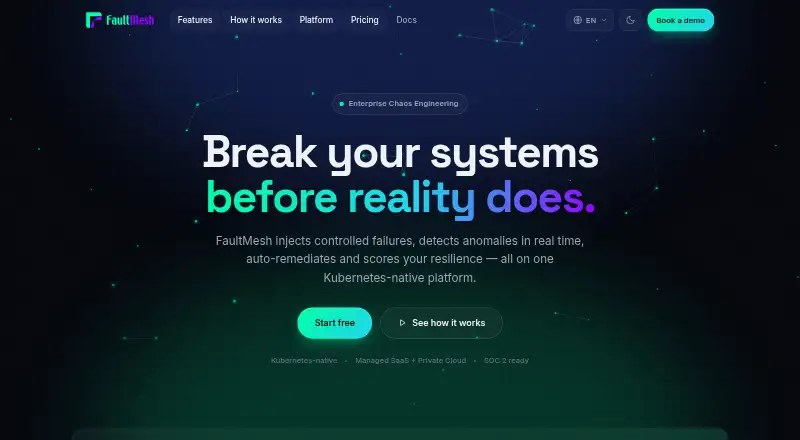
FaultMesh is a Kubernetes-native platform for introducing controlled failures and checking how systems respond. It can inject latency, packet loss, pod kills, CPU stress, and memory stress using Chaos Mesh CRDs. Real-time metric analysis surfaces regressions, while configurable rules and actions can remediate issues automatically. The platform scores services across six dimensions and assigns L1–L5 resilience maturity levels. Teams can track SLO error budgets and build multi-step chaos game days with validation between steps. Safety measures include dry runs, blast-radius limits, an error-budget gate, a background monitor, and an instant kill switch. FaultMesh is available as managed SaaS or a Kubernetes Operator in a customer's cluster, where data stays within that perimeter. A free Starter plan covers up to three services; Growth costs $49 a month, billed per host. A 14-day trial is listed.
Good
- Injects five listed types of faults.
- Can remediate issues automatically through rules and actions.
- Tracks SLO error budgets and multi-step game days.
- Offers a Kubernetes Operator deployment option.
- Includes blast-radius limits and an instant kill switch.
Watch out
- Starter is limited to three services.
- Growth is billed per host.
- Formal SOC 2 certification is on the roadmap.
Who it suits
Starter is described for small teams beginning chaos engineering, while Growth suits teams making it routine. Enterprise is aimed at organizations that want to run FaultMesh inside their own perimeter.
Verdict
FaultMesh combines fault injection with monitoring, remediation, and resilience scoring for Kubernetes environments. The free plan offers a way to start, while Growth adds unlimited services and experiments for $49 a month, billed per host.
Plans and prices
From FaultMesh's own pricing page, checked 15 Oct 2001.
| Plan | Price | What it gives you |
|---|---|---|
| Starter | Free | up to 3 services · core fault types · basic resilience scoring · community support |
| Growth | $49 a month | unlimited services and experiments · automated remediation and game days · SLO and error-budget tracking · priority support · per host per month |
| Enterprise | Priced on request | Private Cloud Kubernetes Operator · SSO, RBAC and audit logs · dedicated support and SLA · onboarding and training |
The facts
Each one read from FaultMesh's own pages, with the date it was checked.
What it does
- Access control
- Security controls include JWT and API-key authentication, Admin/Operator/Viewer RBAC and license-based feature gating.checked 15 Oct 2001
- Access controls
- Security features include JWT and API-key authentication, Admin/Operator/Viewer role-based access control and license-driven feature gating.checked 8 Oct 2001
- Anomaly detection
- Real-time metric analysis is used to surface regressions as they occur.checked 15 Oct 2001
- API
- A single REST gateway exposes endpoints for authentication, experiments, game days, incidents, remediation, scoring, topology and licensing.checked 15 Oct 2001
- API authentication
- Interactive clients use JWT bearer tokens while agents and CI can use long-lived API keys.checked 15 Oct 2001
- API error format
- Errors use standard HTTP status codes with machine-readable codes and localized human-readable messages.checked 15 Oct 2001
- API pagination
- Collection endpoints return paginated results and log streams use a monotonic cursor.checked 15 Oct 2001
- API rate limits
- The gateway allows 100 requests per minute by default and 20 requests per minute on authentication routes.checked 15 Oct 2001
- Audience
- Starter is described for small teams beginning chaos engineering, Growth for teams making it routine, and Enterprise for organizations running FaultMesh inside their own perimeter.checked 8 Oct 2001
- Auditability
- OpenTelemetry tracing, structured logs and an immutable audit trail cover approvals, aborts and kill-switch events.checked 15 Oct 2001
- Automated remediation
- Rules can run ordered healing actions such as restart, scale, failover or a custom executor, with cooldowns to reduce flapping.checked 15 Oct 2001
- Compliance
- FaultMesh describes its controls and processes as SOC 2-aligned, with formal certification on the roadmap, and its data handling as GDPR-aligned.checked 8 Oct 2001
- Compliance status
- FaultMesh describes its controls as SOC 2 aligned with formal certification planned, and its data handling as GDPR aligned.checked 15 Oct 2001
- Data protection and audit
- The security page states that data is encrypted in transit and that governance decisions are recorded in an immutable audit trail.checked 8 Oct 2001
- Deployment
- FaultMesh is available as managed SaaS or as a Kubernetes Operator deployed in the customer's cluster, where data stays inside the perimeter.checked 8 Oct 2001
- Deployment options
- FaultMesh is offered as managed SaaS or as a Kubernetes Operator deployed inside a customer cluster.checked 15 Oct 2001
- Detection and remediation
- Real-time metric analysis surfaces regressions, and rules and actions can heal systems automatically.checked 8 Oct 2001
- Documentation depth
- FaultMesh documentation covers concepts, quickstart, experiments, Game Days, remediation, SLO scoring, deployment and safety.checked 15 Oct 2001
- Encryption and secrets
- The security page states that traffic is encrypted and secret material is kept in the customer's secret store.checked 15 Oct 2001
- Error budgets
- The product reports total, consumed and remaining error budget with one-hour, six-hour and 24-hour burn rates.checked 15 Oct 2001
- Fault injection
- The platform injects latency, packet loss, pod kills, CPU stress, memory stress and other faults through Chaos Mesh custom resources.checked 15 Oct 2001
- Game days
- Game Days chain multiple experiments and can validate steady state between steps while retaining timestamped logs.checked 15 Oct 2001
- Incident conversion
- The API can turn a recorded incident into a reproducible experiment template.checked 15 Oct 2001
Where it runs
- Integration context: Chaos Mesh
- The Chaos Mesh project used by FaultMesh is an open-source Kubernetes platform that defines experiments with Kubernetes custom resources.checked 15 Oct 2001
Alternatives to FaultMesh
- 1

Gremlin
WebAPILinuxSelf-hosted7.2From $3,750 a month - 2

Reliably
Free planWebLinuxmacOSSelf-hosted7.1From £40 a month - 3
Krkn
Free planWebAPILinuxSelf-hosted6.7Free plan - 4
Chaos Mesh
Free planWebAPISelf-hosted6.5Free plan - 5
Toxiproxy
Free planAPILinuxmacOSSelf-hosted6.5Free plan - 6

Chaos Toolkit
Free planWebAPILinuxmacOS6.4Free plan