
Chaos Toolkit
Chaos Toolkit is an open-source chaos engineering toolkit for developers exploring systems to find weaknesses.
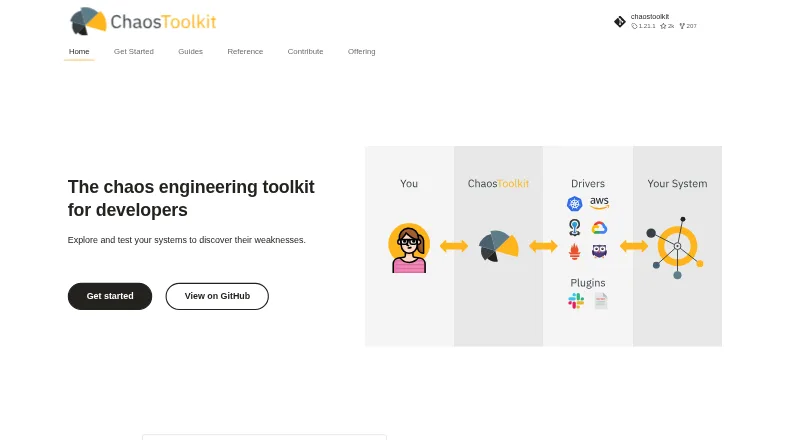
What Chaos Toolkit is
Chaos Toolkit is an open-source chaos engineering toolkit for developers exploring systems to find weaknesses. An experiment defines a steady-state hypothesis and probes to check it, alongside a method made of actions and probes. If the system does not meet the steady state, the method is not applied and the experiment must bail out. Experiments can be declared and saved as JSON or YAML, making them suitable for collaboration and orchestration alongside code. The toolkit extends to systems through its Open API and can be embedded in a CI/CD chain. Listed integrations include AWS, Azure, Google Cloud Platform, Kubernetes, Kafka, Slack, Datadog, Grafana, OpenTelemetry and Prometheus. The standalone CLI is free under Apache License 2.0. It is implemented in Python 3, officially supports Python 3.8 and later, and has only been tested against CPython. Installation instructions cover macOS, Debian or Ubuntu, and Windows; users can add extensions after installing the CLI and core library. Reliably is described separately, with SaaS, private SaaS and on-premises options.
Good
- Free standalone CLI under Apache License 2.0.
- Experiments can be stored as JSON or YAML.
- Can be embedded in a CI/CD chain.
- A failed steady-state check prevents the method.
Watch out
- Officially supports Python 3.8 and later.
- Only tested against CPython.
- Extensions must be installed separately.
Who it suits
Chaos Toolkit suits developers who want to define and run system experiments in code or CI/CD workflows. Its Python CLI and installable extensions are relevant for teams working with supported systems and integrations.
Verdict
Chaos Toolkit offers a free CLI for defining experiments and connecting them to development workflows. Check its Python runtime requirements and available extensions against your environment.
Plans and prices
From Chaos Toolkit's own pricing page, checked 28 Sep 2001.
| Plan | Price | What it gives you |
|---|---|---|
| Chaos Toolkit | Free | Open source CLI · free forever · Apache License 2.0 |
The facts
Each one read from Chaos Toolkit's own pages, with the date it was checked.
What it does
- Automation
- The toolkit can be embedded in a CI/CD chain.checked 28 Sep 2001
- Community
- The project invites contributions through issue reports, issue voting, project stars, community Slack, pull requests and extension proposals.checked 28 Sep 2001
- Deployment options
- The offering page describes a standalone open source CLI; it distinguishes Reliably as a separate platform with SaaS, private SaaS and on-premises options.checked 28 Sep 2001
- Experiment format
- Experiments can be declared and stored as JSON or YAML files for collaboration and orchestration like other code.checked 28 Sep 2001
- Experiments
- An experiment declares a steady-state hypothesis and probes to validate it, plus a method made up of actions and probes.checked 28 Sep 2001
- Extensions
- After installing the CLI and core library, users can install extensions for different facets of chaos engineering.checked 28 Sep 2001
- Installation
- The installation guide provides Python setup instructions for macOS, Debian or Ubuntu, and Windows, and installs the CLI using pip.checked 28 Sep 2001
- Integrations
- The extension directory lists integrations including AWS, Azure, Google Cloud Platform, Kubernetes, Kafka, Slack, Datadog, Grafana, OpenTelemetry and Prometheus.checked 28 Sep 2001
- License
- The toolkit is open source under the Apache 2 license.checked 28 Sep 2001
- Open API
- The toolkit is extensible for systems through its Open API.checked 28 Sep 2001
- Purpose
- Chaos Toolkit is a chaos engineering toolkit for developers to explore and test systems to discover weaknesses.checked 28 Sep 2001
- Safety gate
- If the steady state is not met, the method is not applied and the experiment must bail out.checked 28 Sep 2001
- Security practice
- The contribution guide suggests contributor accounts enable 2FA to reduce security risks if an account is breached.checked 28 Sep 2001
- Supported runtime
- The CLI is implemented in Python 3, officially supports Python 3.8+, and has only been tested against CPython.checked 28 Sep 2001
The full review of Chaos Toolkit
Chaos Toolkit is an open-source toolkit for developers who want to probe systems for weaknesses through structured experiments. It is best suited to teams comfortable with a Python CLI and self-managed deployment. Its code-based experiments and steady-state safety gate are useful strengths, but it is not a managed chaos engineering service.
Overview
Experiments are saved as JSON or YAML, allowing teams to keep them alongside other code and use familiar collaboration and orchestration practices. Each combines a steady-state hypothesis and validating probes with a method of actions and probes. If the steady state is not met, the method is withheld and the experiment must bail out. That precondition is a meaningful guardrail for teams injecting faults, though it does not replace careful experiment design.
The project is open source under Apache License 2.0, and its community welcomes issue reports, voting, stars, Slack participation, pull requests and extension proposals. Its contribution guide recommends that contributors enable two-factor authentication to reduce account-compromise risk.
Key features
Automation and integrations
Chaos Toolkit can be embedded in a CI/CD chain, making it a fit for teams that want experiments to be part of their development workflow. Its Open API supports extensions for different systems; users install those after the CLI and core library. Integrations include AWS, Azure, Google Cloud Platform, Kubernetes, Kafka, Slack, Datadog, Grafana, OpenTelemetry and Prometheus. That breadth can connect experiments to varied environments, but teams should expect to select and install the extensions they need.
Experiment controls
It supports Kubernetes, cloud and network fault injection, experiment scheduling and blast-radius controls. Those capabilities cover both experiment execution and containment, which is useful for teams seeking a configurable toolkit rather than a narrow fault simulator. The CLI is self-hosted, so teams remain responsible for their own environment and workflow.
Pricing
The Chaos Toolkit plan costs free and is free forever under Apache License 2.0. It provides the open-source CLI without a paid-plan upgrade requirement stated. There are no published seat or usage caps in this plan description, but the free offering is the standalone CLI rather than the separate Reliably platform, which has SaaS, private SaaS and on-premises options.
Platforms
The toolkit is available for API, Linux, macOS, self-hosted, web and Windows environments. Its CLI is implemented in Python 3 and officially supports Python 3.8 and later; it has only been tested against CPython. The installation guide covers Python setup on macOS, Debian or Ubuntu, and Windows, and installs the CLI with pip. Teams using other Python implementations should account for the narrower tested runtime support.
Who it's for
Chaos Toolkit suits development and reliability teams that want experiments stored as code, integrated into CI/CD, and extended to cover their systems. It is especially compelling for teams able to manage Python and self-hosted tooling. Readers looking for a turnkey managed platform should consider a different product.
Pros and cons
- Pro: JSON or YAML experiment definitions can live with other code, supporting collaboration and orchestration practices familiar to development teams.
- Pro: A failed steady-state check prevents the experiment method from running, providing a clear safety condition.
- Pro: The free, Apache-licensed CLI supports scheduling, blast-radius controls, Kubernetes, and cloud and network fault injection.
- Con: The CLI depends on Python 3.8+ and is tested only against CPython, constraining runtime choices.
- Con: The standalone CLI is self-hosted; teams seeking SaaS or managed operations need another option.
Alternatives
For a broader comparison, browse Chaos Engineering Platforms.
- Reliably is worth considering for teams seeking a freemium alternative that describes itself as open source and emphasizes avoiding lock-in.
- ChaosBlade is another free, open-source chaos engineering tool, with stated support for three system platforms, four programming-language applications and more than 200 experiment scenarios.
- Chaos Mesh is a free, open-source cloud-native chaos engineering platform that runs on Kubernetes.
- PowerfulSeal offers self-hosted Kubernetes chaos testing with pip or Docker installation.
- AWS Fault Injection Service is a paid option billed at $0.10 per action-minute, with an additional $0.10 per action-minute for each additional account; AWS GovCloud (US-East and US-West) is $0.12 per action-minute.
- Gremlin may suit teams considering a paid platform: its trial is free for 30 days, requires no credit card and does not auto-convert.
- Steadybit is a paid alternative with Professional and Enterprise plans; Enterprise includes on-prem installation, SAML, audit log and enterprise support.
- Toxiproxy is a free alternative available for Windows, macOS and Linux.
Verdict
Choose Chaos Toolkit if your team wants a free, extensible way to define experiments as code and bring them into development workflows, while retaining control over a self-hosted Python CLI. Look elsewhere if you need a managed service or cannot accommodate its Python runtime requirements.
Getting started
- Open the Chaos Toolkit website
- Install Python 3.8 or newer on macOS, Debian or Ubuntu, or Windows
- Install the CLI and core library with pip
- Add extensions for the systems or services you want to test
- Store experiments as JSON or YAML files
- Embed the toolkit in a CI/CD chain if needed
Limits worth knowing
The free offering is the standalone open-source CLI. It requires Python 3.8 or newer and is deployed in a self-hosted model.
Questions
What does Chaos Toolkit cost?
The Chaos Toolkit plan is free forever at 0.00 USD, under the Apache License 2.0.
Which platforms does it support?
Listed platforms are API, Linux, macOS, self-hosted, web, and Windows.
Is Chaos Toolkit open source?
Yes. The toolkit is open source under the Apache 2 license.
Which runtime does the CLI use?
The CLI is implemented in Python 3, officially supports Python 3.8 and later, and has only been tested against CPython.
Can it integrate with Kubernetes and cloud services?
Yes. Listed integrations include Kubernetes, AWS, Azure, Google Cloud Platform, Kafka, Slack, Datadog, Grafana, OpenTelemetry, and Prometheus.
Alternatives to Chaos Toolkit
- 1

FaultMesh
Free planWebAPISelf-hosted7.2From $49 a month - 2

Gremlin
WebAPILinuxSelf-hosted7.2From $3,750 a month - 3

Reliably
Free planWebLinuxmacOSSelf-hosted7.1From £40 a month - 4
Krkn
Free planWebAPILinuxSelf-hosted6.7Free plan - 5

Chaos Mesh
Free planWebAPISelf-hosted6.5Free plan - 6
Toxiproxy
Free planAPILinuxmacOSSelf-hosted6.5Free plan