ChaosBlade
ChaosBlade is a free, open-source chaos engineering project for exploring system availability risks.
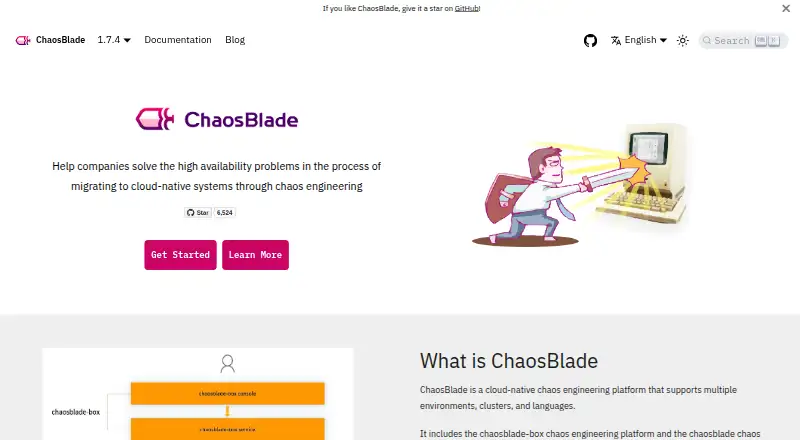
What ChaosBlade is
ChaosBlade is a free, open-source chaos engineering project for exploring system availability risks. It includes the ChaosBlade experiment tool and the ChaosBlade-Box platform. Experiments cover CPU, memory, network, disk, processes, kernels and files, along with multilingual applications and Kubernetes resources. Users can run them through a command-line interface, Kubernetes YAML and CRDs, HTTP server calls or the Box interface. ChaosBlade-Box provides a shared interface for experiments, automated deployment of experiment tools and hosting for ChaosBlade and LitmusChaos. It uses Helm for deployment management and integrates Prometheus monitoring. Safety policies support manual stopping or automatic stopping after a configured timeout. Deployment options include unpacking the CLI on a host or installing the tool and platform on Kubernetes with Helm. Host deployment of the platform lists Java and MySQL requirements; automatic probe installation also requires Ansible and expect. The project is identified as a CNCF sandbox project and lists several community channels.
Good
- Free and open-source.
- Covers infrastructure and Kubernetes experiment scenarios.
- Experiments can run through several interfaces.
- Includes manual and timeout-based stopping policies.
- Integrates Prometheus monitoring.
Watch out
- Host platform deployment requires Java and MySQL.
- Automatic probe installation requires Ansible and expect.
Who it suits
ChaosBlade is aimed at enterprises working on availability concerns during cloud-native adoption. It may suit teams that want to run infrastructure, application or Kubernetes experiments using CLI, HTTP or platform-based methods.
Verdict
ChaosBlade offers a broad set of experiment scenarios and multiple execution methods at no listed cost. Teams considering the Box platform should account for its stated host deployment requirements.
Plans and prices
From ChaosBlade's own pricing page, checked 29 Sep 2001.
| Plan | Price | What it gives you |
|---|---|---|
| ChaosBlade | Free | Open-source chaos engineering tool; supports 3 system platforms, 4 programming-language applications, 200+ experiment scenarios and 3,000+ parameters |
The facts
Each one read from ChaosBlade's own pages, with the date it was checked.
What it does
- Community status
- The project site identifies ChaosBlade as a Cloud Native Computing Foundation sandbox project.checked 29 Sep 2001
- Deployment
- The CLI can be downloaded and unpacked on a host, while the tool and platform also document Kubernetes installation using Helm.checked 29 Sep 2001
- Execution methods
- Experiments can be run through the CLI, Kubernetes YAML and CRDs, HTTP server calls, or the ChaosBlade-Box interface.checked 29 Sep 2001
- Integrations
- ChaosBlade-Box uses Helm for deployment management and integrates Prometheus monitoring.checked 29 Sep 2001
- Intended users
- The project describes its goal as helping enterprises improve system availability during cloud-native adoption.checked 29 Sep 2001
- Notable deployment requirement
- The platform installation guide lists Java and MySQL requirements for host deployment, with Ansible and expect needed for automatic probe installation.checked 29 Sep 2001
- Purpose
- The project aims to help enterprises address high-availability problems during cloud-native adoption through chaos engineering.checked 29 Sep 2001
- Safety controls
- ChaosBlade-Box describes manual stopping and automatic stopping through a configured timeout as policies to help ensure drills are resumed.checked 29 Sep 2001
- Support channels
- The project site links to Gitter, Twitter, Slack and a DingTalk community group.checked 29 Sep 2001
- What it is
- ChaosBlade is an open-source chaos engineering project comprising the ChaosBlade experiment tool and the ChaosBlade-Box platform.checked 29 Sep 2001
Where it runs
- Experiment scenarios
- Scenarios cover basic resources such as CPU, memory, network, disk, processes, kernels and files, as well as multilingual applications and Kubernetes resources.checked 29 Sep 2001
- Platform features
- ChaosBlade-Box provides a unified experiment interface, automated deployment of experiment tools, and hosting for tools including ChaosBlade and LitmusChaos.checked 29 Sep 2001
The company
- Founded
- 2019checked 28 Sep 2001
The full review of ChaosBlade
Overview
ChaosBlade is an open-source chaos engineering project built around an experiment tool and the ChaosBlade-Box platform. It is best suited to cloud-native teams that want to test failures across infrastructure, applications and Kubernetes; the breadth is compelling, but Box’s host deployment adds operational prerequisites.
Key features
Experiments cover CPU, memory, network, disk, processes, kernels and files, as well as multilingual applications and Kubernetes resources. That range lets teams exercise multiple layers of a system rather than focusing on one kind of fault. The ChaosBlade plan describes support for 3 system platforms, 4 programming-language applications, 200+ experiment scenarios and 3,000+ parameters.
Experiments can be run from the CLI, with Kubernetes YAML and CRDs, through HTTP server calls, or in ChaosBlade-Box. This flexibility accommodates both scripted operations and teams that prefer a shared interface. Box provides a unified place to manage experiments, automates deployment of experiment tools, and can host ChaosBlade and LitmusChaos. Helm supports deployment management, and Prometheus integration ties the platform to monitoring.
Box describes manual stopping and automatic stopping after a configured timeout as ways to ensure drills are resumed. These controls offer useful means to end an experiment, though teams still need to plan how they will use them. Experiment scheduling, Kubernetes support, cloud fault injection, network fault injection and blast-radius controls are also supported.
Pricing
ChaosBlade — free. The free, open-source plan includes the experiment tool, with stated support for 3 system platforms, 4 programming-language applications, 200+ scenarios and 3,000+ parameters. There are no paid tiers or seat-based terms in the plan information. That makes it a straightforward fit for teams able to operate self-hosted software; the trade-off is taking responsibility for deployment and operations rather than buying a managed service.
Platforms
ChaosBlade supports API, Linux, macOS, self-hosted, web and Windows environments. The CLI can be downloaded and unpacked on a host, and both the tool and platform document Kubernetes installation using Helm. For host deployment of Box, the installation guide requires Java and MySQL; automatic probe installation also requires Ansible and expect. Those prerequisites matter for teams choosing Box and may make the CLI or Kubernetes route a better fit where the host stack is inconvenient.
Who it's for
ChaosBlade is aimed at enterprises improving system availability during cloud-native adoption, especially teams that need to investigate faults across compute, network, storage, applications and Kubernetes. Its multiple execution methods suit organizations with varied operating workflows, while self-hosting and the Box deployment requirements favor teams with infrastructure capacity to manage the tooling. The project is identified as a Cloud Native Computing Foundation sandbox project and links to Gitter, Twitter, Slack and a DingTalk community group for support.
Pros and cons
- Pros: Broad experiment coverage across basic system resources, applications and Kubernetes helps teams probe more than a single failure layer.
- Pros: CLI, Kubernetes manifests and CRDs, HTTP calls and Box provide several ways to run experiments.
- Pros: Free, open-source availability avoids plan charges, while scheduling, blast-radius controls and Box stopping policies support operational control.
- Cons: Box host deployment requires Java and MySQL, with Ansible and expect needed for automatic probe installation, adding setup dependencies.
- Cons: Self-hosted deployment means teams need to handle installation and operation themselves.
Alternatives
For a broader comparison, see Chaos Engineering Platforms.
- Reliably suits readers looking for a freemium open-source option that says its approach avoids lock-in; its free plan is free for 1 team member.
- Chaos Toolkit is a fit for readers who want a free-forever, Apache License 2.0 open-source CLI.
- Toxiproxy is a free, MIT-licensed open-source TCP proxy for readers whose needs center on that tool.
- Krkn is another free option for readers seeking an alternative without stated pricing or usage limits.
- Chaos Mesh may suit readers who want an open-source cloud-native chaos engineering platform that runs on Kubernetes.
- LitmusChaos offers a choice between free hosted SaaS and an open-source installation on a reader’s own cluster.
- chaosd is a free Apache-2.0-licensed Linux binary for readers whose environment meets its glibc v2.17-or-later requirement.
- FaultMesh is an option for readers who prefer a freemium service, with a free Starter plan for up to 3 services and core fault types.
Verdict
Choose ChaosBlade if your cloud-native team wants a free, self-hosted toolkit with broad experiment coverage and several execution paths. Its range and flexibility are the main reasons to select it; look elsewhere if Box’s host prerequisites or the work of operating self-hosted software are a poor fit.
Getting started
- Open the ChaosBlade website
- Download and unpack the CLI on a host
- For Kubernetes, install the tool and platform with Helm
- For host platform deployment, prepare Java and MySQL
- Add Ansible and expect for automatic probe installation
- Run experiments through the CLI, Kubernetes YAML or CRDs, HTTP calls, or ChaosBlade-Box
Limits worth knowing
The free ChaosBlade plan supports three system platforms, four programming-language applications, more than 200 experiment scenarios, and more than 3,000 parameters.
Questions
Is ChaosBlade free?
Yes. The listed ChaosBlade plan costs 0.00 USD and is open source.
What is ChaosBlade-Box?
ChaosBlade-Box is the platform component for a unified experiment interface, automated tool deployment, and hosting for ChaosBlade and LitmusChaos.
How can experiments be run?
Experiments can run through the CLI, Kubernetes YAML and CRDs, HTTP server calls, or the ChaosBlade-Box interface.
Does ChaosBlade support Kubernetes?
Yes. Kubernetes resources are experiment scenarios, and Kubernetes installation is documented using Helm.
What does the free plan support?
It supports three system platforms, four programming-language applications, more than 200 experiment scenarios, and more than 3,000 parameters.
What is required for host deployment?
The platform installation guide lists Java and MySQL. Automatic probe installation also needs Ansible and expect.
Alternatives to ChaosBlade
- 1

FaultMesh
Free planWebAPISelf-hosted7.2From $49 a month - 2

Gremlin
WebAPILinuxSelf-hosted7.2From $3,750 a month - 3

Reliably
Free planWebLinuxmacOSSelf-hosted7.1From £40 a month - 4
Krkn
Free planWebAPILinuxSelf-hosted6.7Free plan - 5

Chaos Mesh
Free planWebAPISelf-hosted6.5Free plan - 6
Toxiproxy
Free planAPILinuxmacOSSelf-hosted6.5Free plan