kpack
kpack is a Kubernetes-native service that builds OCI container images with Cloud Native Buildpacks.
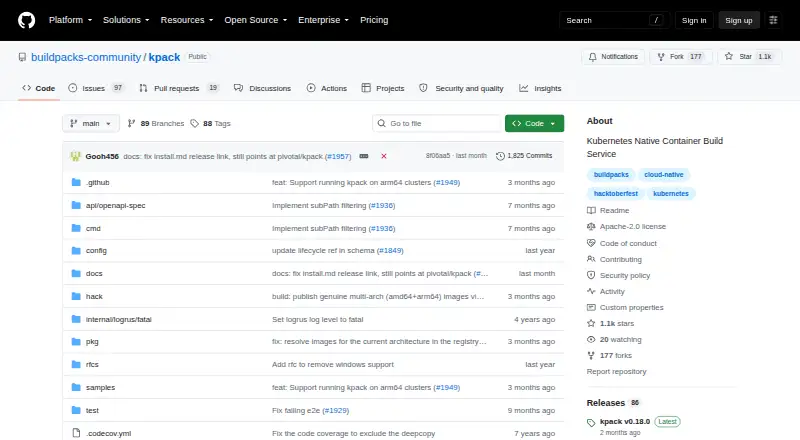
What kpack is
kpack is a Kubernetes-native service that builds OCI container images with Cloud Native Buildpacks. A declarative builder resource defines the buildpack order and operating-system stack. Image resources schedule builds and rebuilds when source code, buildpacks, or stacks change, while a build resource runs a single one-off build. Images publish to a configured image tag; additional tags must use that same registry because cross-registry exporting is unsupported. Image resources support volume-based or registry-based caching. Kubernetes secrets provide credentials for Docker registries and private Git repositories, with documentation examples for Docker Hub, Google Container Registry, and GitHub. kpack uses a daemonless build method and supports multiple cache backends. It is free, open source, and licensed Apache-2.0 for self-hosted API use. Installation requires Kubernetes 1.22 or later, kubectl, cluster-admin permissions, and an accessible Docker V2 registry. SSH host-key checking for Git credentials is disabled by default but can be enabled through a controller environment variable.
Good
- Kubernetes-native OCI image builds
- Automatic rebuilds on source or builder changes
- Daemonless build method
- Volume or registry caching
- Apache-2.0 open source
Watch out
- Requires Kubernetes 1.22 or later
- Needs cluster-admin permissions
- Requires accessible Docker V2 registry
- Cross-registry image tagging unsupported
Who it suits
kpack suits Kubernetes operators who need self-hosted, Cloud Native Buildpacks image builds with declarative resources and automatic rebuilds. It requires cluster administration and registry access.
Verdict
kpack provides declarative, repeatable image building inside Kubernetes, including scheduled rebuilds and configurable caching. Installation and registry requirements make it a fit for teams already operating Kubernetes infrastructure.
Plans and prices
From kpack's own pricing page, checked 4 Oct 2026.
| Plan | Price | What it gives you |
|---|---|---|
| Free / open source | Free | Requires a Kubernetes cluster, kubectl, cluster-admin permissions, and an accessible Docker V2 registry |
The facts
Each one read from kpack's own pages, with the date it was checked.
What it does
- Automatic rebuilds
- Image resources schedule rebuilds when source code or builder buildpacks or stacks change.checked 4 Oct 2026
- Builder configuration
- A declarative builder resource configures the buildpack order and operating system stack used for builds.checked 4 Oct 2026
- Caching
- Image resources support volume-based or registry-based build caching.checked 4 Oct 2026
- Credentials
- Kubernetes secrets can provide credentials for publishing images to Docker registries and accessing private Git repositories.checked 4 Oct 2026
- Image registry
- Built OCI images are published to a configured image tag, and additional tags must use the same registry because cross-registry exporting is unsupported.checked 4 Oct 2026
- Installation requirements
- Installation requires Kubernetes 1.22 or later, kubectl, cluster-admin permissions, and an accessible Docker V2 registry.checked 4 Oct 2026
- Integrations
- The documentation includes examples for Docker Hub, Google Container Registry, and GitHub credentials.checked 4 Oct 2026
- License
- The repository identifies its license as Apache-2.0.checked 4 Oct 2026
- One-off builds
- A build resource can execute a single Cloud Native Buildpacks OCI image build.checked 4 Oct 2026
- Purpose
- kpack is a Kubernetes native container build service that builds OCI images using Cloud Native Buildpacks.checked 4 Oct 2026
- Security behavior
- SSH host key checking for Git credentials is disabled by default and can be enabled through a controller environment variable.checked 4 Oct 2026
- Service bindings
- Legacy Cloud Native Buildpacks service bindings are deprecated in kpack.io/v1alpha2 and are expected to be removed; the docs direct users to Kubernetes Service Binding configuration.checked 4 Oct 2026
- Support
- The project README points users to a weekly working group and the CNCF Slack community.checked 4 Oct 2026
Alternatives to kpack
- 1

Garden
Free planOpen sourceWebAPILinuxmacOS8.3From $50 a month - 2

AWS CodeBuild
Free planWebAPILinuxmacOS7.9From $0.01 a month - 3

Amazon EC2
Free planAndroidiOSWebAPI7.6Free plan - 4
Source-to-Image
Free planOpen sourceLinuxmacOSSelf-hostedWindows7.2Free plan - 5
Dagger
Free planWebLinuxmacOSSelf-hosted7.1From $50 a month - 6
BuildKit
Free planAPILinuxmacOSSelf-hosted6.8Free plan