Kosmos
Kosmos is a structured method for producing nonfiction books that runs inside Claude Code.
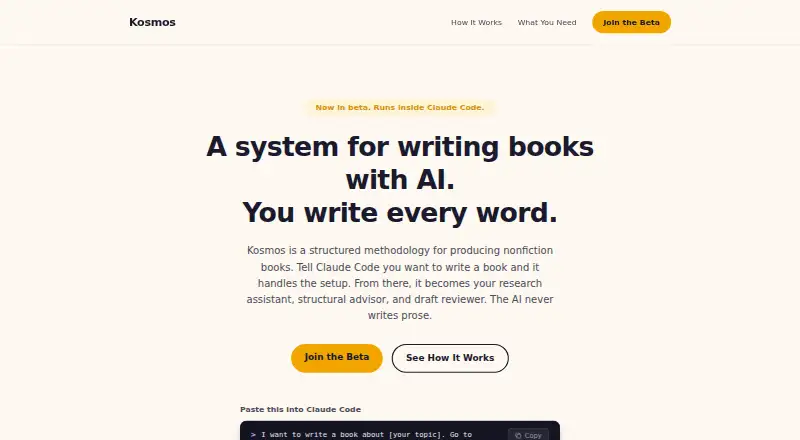
What Kosmos is
Kosmos is a structured method for producing nonfiction books that runs inside Claude Code. Its four phases are ideation, research, structure, and writing. The AI organizes research into tagged entries, tracks coverage across themes, identifies gaps, advises on structure, and reviews drafts; it does not write manuscript prose. When web access is available, it can search for material related to research gaps. During writing, it checks drafts against an eight-point checklist, tracks progress, and reviews consistency. Kosmos includes book outlining, a chapter workspace, and continuity tools, but no rewrite controls. Projects use Markdown files and work as Obsidian vaults. Obsidian is recommended, though any Markdown editor can be used, and the maker says users keep their files if they stop using Kosmos. The beta is free, but users need Claude Code and their own Claude Pro or Max subscription. Beta signup access is manually reviewed and approved.
Good
- Guides authors through four book-production phases.
- Tracks research coverage and highlights gaps.
- Reviews drafts for progress and consistency.
- Projects use Markdown and work as Obsidian vaults.
- Includes outlining, chapter workspace, and continuity tools.
Watch out
- Does not write manuscript prose.
- Requires a separate Claude Pro or Max subscription.
- Beta access requires manual review and approval.
- Rewrite controls are not included.
Who it suits
Kosmos suits nonfiction authors who want a structured book-production process and are willing to share feedback during an early beta. It requires Claude Code and a Claude Pro or Max subscription.
Verdict
Kosmos offers a structured workflow for organizing and reviewing nonfiction book work, while leaving manuscript prose to the author. Its beta access process and Claude subscription requirement are important considerations before signing up.
Plans and prices
From Kosmos's own pricing page, checked 9 Oct 2026.
| Plan | Price | What it gives you |
|---|---|---|
| Beta | Free | Free during beta · requires your own Claude subscription · access approved manually |
The facts
Each one read from Kosmos's own pages, with the date it was checked.
What it does
- Access
- During beta, the maker manually reviews and approves every signup.checked 8 Oct 2026
- AI role
- AI organizes research, tracks coverage gaps, advises on structure, and reviews drafts; it does not write manuscript prose.checked 9 Oct 2026
- Beta access
- During the beta, the maker manually reviews and approves account access.checked 9 Oct 2026
- Beta status
- Kosmos is described as an early beta, and the maker says the tooling is new and feedback is welcome.checked 8 Oct 2026
- Draft review
- AI reviews drafts against an 8-point checklist and checks for consistency.checked 9 Oct 2026
- Editor compatibility
- Obsidian is recommended, and the maker says any Markdown editor works.checked 8 Oct 2026
- File format
- Project files are Markdown and work as an Obsidian vault; the maker says users keep their files if they stop using Kosmos.checked 9 Oct 2026
- Integrations
- Kosmos runs inside Claude Code; Obsidian is recommended, and any Markdown editor can be used.checked 9 Oct 2026
- Intended users
- The maker is seeking authors interested in a structured approach to book production who are willing to provide feedback.checked 9 Oct 2026
- Prerequisite
- Kosmos requires Claude Code and a Claude Pro or Max subscription, which users provide themselves.checked 8 Oct 2026
- Process
- Its four phases are ideation, research, structure, and writing.checked 8 Oct 2026
- Purpose
- Kosmos is a structured methodology for producing nonfiction books that runs inside Claude Code.checked 9 Oct 2026
- Requirements
- The maker says Claude Code requires a Claude Pro or Max subscription.checked 9 Oct 2026
- Research
- Kosmos organizes research into atomic tagged entries, tracks theme coverage, and identifies gaps for further research.checked 8 Oct 2026
- Research organization
- Kosmos organizes research into atomic, tagged entries and tracks coverage across themes.checked 9 Oct 2026
- Setup
- Claude Code handles installation of the kosmos-cli, authentication, and project setup.checked 9 Oct 2026
- Support
- The maker asks beta users to share feedback about what works and what does not.checked 9 Oct 2026
- Web research
- Kosmos can search for material to fill research gaps when web access is available.checked 9 Oct 2026
- Workflow
- The process has four phases: ideation, research, structure, and writing.checked 9 Oct 2026
The company
- Maker
- The maker identifies himself as Joakim Achren and says he has self-published nonfiction books.checked 8 Oct 2026
The full review of Kosmos
Kosmos is a nonfiction book-production workflow that runs inside Claude Code. It suits authors who want rigorous research organization and structural guidance while writing their own prose. The trade-off is a setup that depends on Claude Code, a separate Claude subscription, and approval during the beta.
Overview
Kosmos moves a project through ideation, research, structure, and writing. Its AI role is deliberately supervisory: it organizes material, monitors coverage, advises on structure, and reviews drafts rather than generating manuscript passages. That makes it a strong match for nonfiction authors who want a repeatable process without surrendering authorship, but the wrong choice for anyone shopping for an automated ghostwriter.
The project is built around Markdown files and can function as an Obsidian vault. Obsidian is the recommended editor, although any Markdown editor works. The maker says users keep their files if they stop using Kosmos, which reduces lock-in for authors who want a portable research archive.
Key features
Research and coverage
Kosmos breaks research into small, tagged entries and tracks how thoroughly themes are covered. It can identify gaps that deserve more investigation and, when web access is available, search for material to fill them. This is particularly useful for evidence-heavy nonfiction, where missing support can undermine an otherwise sound outline. Writers who prefer a loose notes folder or who do not want research managed as a distinct phase may find the method restrictive.
Outlining and chapter work
Book outlining and a chapter workspace connect collected material to a planned manuscript. The four-phase sequence gives a project a clear handoff from idea to evidence to structure to draft. That structure should help authors see what belongs in a chapter before they start writing, but it also asks them to follow Kosmos's process rather than improvise.
Draft review
During writing, the AI checks drafts against an eight-point checklist, tracks progress, and checks consistency. These controls are useful for maintaining standards across a long nonfiction project, especially when terminology or arguments recur. Kosmos has no rewrite controls, so the author must interpret the feedback and revise every passage personally.
Claude Code workflow
Claude Code handles installation of the Kosmos CLI, authentication, and project setup. The integration keeps the workflow in one environment, but it also makes Claude Code a hard prerequisite rather than an optional connection.
Pricing
| Plan | Price | What it means |
|---|---|---|
| Beta | free | Free during beta; requires your own Claude subscription and manually approved access. |
The Beta plan includes Kosmos without a software charge, but it does not include Claude itself. Claude Code requires a Claude Pro or Max subscription supplied by the user, so the real cost depends on the Claude plan chosen. Every signup is manually reviewed and approved during the beta, making access less immediate than a conventional free registration. The maker describes the tooling as early beta and asks users to provide feedback, so this plan is best for authors comfortable with an evolving product rather than those needing a settled commercial service.
Platforms
Kosmos is available on the web and runs inside Claude Code. Projects use Markdown and work as Obsidian vaults; Obsidian is recommended, while any Markdown editor can open the files. Markdown export is the stated export format, which favors portable text workflows over proprietary document production.
Who it's for
Kosmos is aimed at authors producing nonfiction who want to organize source material, test theme coverage, plan chapters, and receive consistency checks while keeping writing decisions in their own hands. It is especially suitable for writers willing to work in Markdown and to adopt a staged process. It is not a good fit for fiction-first workflows, for buyers seeking automatic prose generation or rewriting, or for anyone unwilling to maintain a Claude Pro or Max subscription.
Pros and cons
Pros
- Research has a working structure: atomic tags, theme coverage, and gap identification turn scattered notes into a system for finding weak spots.
- Review continues into drafting: an eight-point checklist, progress tracking, and consistency checks address problems that appear after outlining.
- Portable project files: Markdown and Obsidian-vault compatibility let authors retain and edit their files outside Kosmos.
- No additional Kosmos fee during beta: the Beta plan is free, subject to Claude and access requirements.
Cons
- Claude costs are separate: Claude Code and a Claude Pro or Max subscription are required and provided by the user.
- Access is not instant: every beta signup is manually reviewed and approved.
- It does not write or rewrite prose: authors must draft and revise manuscript text themselves.
- The product is early beta: users should expect an evolving tool and participate through feedback.
Alternatives
For a broader comparison of category options, see AI Book Writing Software.
Jenova Creative Fiction Writer is the better choice for writers who want Android, iOS, and web access, with a free tier and paid usage-based upgrades.
Choose Pendraic instead if you want macOS, Windows, or web access, a full editor and worldbuilder, and a free allowance of up to three active books.
Calliope suits authors who prefer a web or API editor with unlimited books on its free editor plan and optional one-time credit top-ups.
BookBud.ai is aimed at a browser workflow that starts with signup credits for a book, cover, and early chapters.
Pick DeepQuill if a desktop application for macOS or Windows is more important than Kosmos's Claude Code workflow.
AI Novel Studio offers a web-based freemium model with starter credits and a one-time full-draft option.
AIWriteBook Audiobook Studio is a web or extension-based alternative with free credits and paid monthly credit allowances.
Bookwiz is a web option with a free tier, limited prompts and autocomplete, and publishing-oriented export formats.
Verdict
Kosmos is a good choice for a nonfiction author who wants disciplined research coverage, structured outlining, and draft review while retaining full control of the manuscript. Its portable Markdown files and free beta access strengthen the case. Look elsewhere if you want generated or rewritten prose, immediate self-serve access, or a workflow that does not require Claude Code and a separate Claude Pro or Max subscription.
Alternatives to Kosmos
- 1

Jenova Creative Fiction Writer
Free planAndroidiOSWebAPI7.9From $20 a month - 2

Pendraic
Free planWebAPImacOSWindows7.7From $14.99 a month - 3

Squibler
Free planWeb7.5From $29.99 a month - 4

Calliope
Free planWebAPI7.4From €99 a year - 5

Novelcrafter
AndroidiOSWeb7.4From $4 a month - 6

BookBud.ai
Free planWeb7.3From $190 a year