KittenTTS
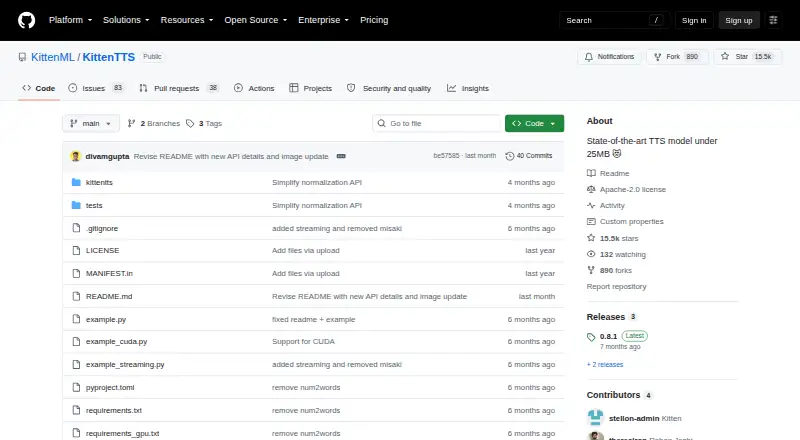
KittenTTS is an open-source text-to-speech library with a CPU-capable 1.7B-parameter KittenTTS 2 model and lighter legacy models.
What KittenTTS is
KittenTTS is an open-source text-to-speech library with a CPU-capable 1.7B-parameter KittenTTS 2 model and lighter legacy models. KittenTTS 2 can clone a voice from a short audio sample without fine-tuning. Its README lists 47 built-in voices and support for 20 languages. Expression tools include emotion and vocal-event tags plus emphasis spans; emotion control is beta, and its effect can vary by voice and sentence. The hosted API offers speech generation, voice cloning, and transcription through OpenAI-compatible HTTP requests, with streaming options. WAV is the listed export format. Users can run it locally or download weights for self-hosting, including on-device, on-premises, or in a VPC. Local KittenTTS 2 requirements include Linux, Windows, or Mac and Python 3.9 or later. The code is Apache 2.0, but model weights have separate terms, and KittenTTS 2 is listed under the Stellon Labs Community License. The Free plan includes 30 free minutes, after which usage rates apply; Pro is $14.99 a month, billed annually.
Good
- CPU-capable 1.7B-parameter model
- Supports 47 voices and 20 languages
- Voice cloning from a short audio sample
- Hosted API includes streaming options
- Weights can be self-hosted
Watch out
- Emotion control is labeled beta
- Long scripts may truncate or repeat in one pass
- Model weights have separate licensing terms
- Free plan includes 30 minutes before usage rates apply
Who it suits
It suits developers and teams building voice agents, customer-support call automation, content creation, or dedicated speech endpoints. It may also fit users who want to self-host or use an API.
Verdict
KittenTTS combines local and hosted speech options with voice cloning and transcription. Check the model-weight terms and plan limits, and split long scripts into sentence-aware chunks.
Plans and prices
From KittenTTS's own pricing page, checked 12 Oct 2001.
| Plan | Price | What it gives you |
|---|---|---|
| Free | Free | 30 free minutes of speech and transcription · Then $15 per 1M TTS characters and $1 per ASR audio hour · 36 voices · 10 languages · 5 ASR sessions and 2 TTS streams at once |
| Pro | $14.99 a month | $24.99 of usage included monthly · TTS: $0.65 per 1M characters · ASR: $0.10 per audio hour · Cancel anytime · $179.88 billed annually |
| Enterprise | Priced on request | Custom usage and rates · Custom API capacity · Private deployment · Invoicing · Dedicated support and onboarding |
The facts
Each one read from KittenTTS's own pages, with the date it was checked.
What it does
- API access
- Yeschecked 20 Sep 2001
- Commercial use
- Yeschecked 20 Sep 2001
- Export formats
- WAVchecked 20 Sep 2001
- Expression controls
- Expression controls include emotion tags, inline vocal-event tags, and emphasis spans; the README labels emotion control beta and says its effect varies by voice and sentence.checked 12 Oct 2001
- Hosted API
- The hosted API provides speech generation, voice cloning, and transcription endpoints, with OpenAI-compatible HTTP requests and streaming options.checked 12 Oct 2001
- Integrations
- The maker lists on-device SDKs for Python, Swift, React Native, Flutter, and Web, and says Kitten-TTS 2 SDKs are coming soon.checked 12 Oct 2001
- Intended users
- The maker describes use cases including voice agents, customer-support call automation, content creation, and dedicated endpoints.checked 12 Oct 2001
- Local requirements
- The README lists Linux, Windows, or Mac and Python 3.9 or later as system requirements for KittenTTS 2.checked 12 Oct 2001
- Model licensing
- The repository code is Apache 2.0, while model weights have separate terms; KittenTTS 2 is listed under the Stellon Labs Community License.checked 12 Oct 2001
- Notable model limitation
- The README says a single-pass whole script can truncate or drift into repetition, so long input is split into sentence-aware chunks.checked 12 Oct 2001
- Privacy and security
- The privacy policy says the company collects service inputs including audio or voice recordings and outputs, and uses technical, physical, and organizational safeguards for personal data.checked 12 Oct 2001
- Privacy limitation
- The privacy policy says personal data may be transferred to jurisdictions with different protection levels, subject to due diligence and appropriate technical and organizational measures.checked 12 Oct 2001
- Self-hosting
- The maker says users can download the weights and self-host, including in a VPC, on-premises, or on-device for enterprise deployments.checked 12 Oct 2001
- Support
- The maker offers commercial integration assistance, custom voice development, enterprise licensing, email support, GitHub Issues, and a Discord community.checked 12 Oct 2001
- Voice cloning
- KittenTTS 2 supports zero-shot voice cloning from a short audio sample without fine-tuning.checked 12 Oct 2001
- Voices and languages
- The README lists 47 built-in voices and support for 20 languages.checked 12 Oct 2001
- What it does
- KittenTTS is an open-source text-to-speech library with a CPU-capable 1.7B-parameter KittenTTS 2 model and lightweight legacy models.checked 12 Oct 2001
Where it runs
- Platforms
- windows,macos,linux,apichecked 20 Sep 2001
The full review of KittenTTS
KittenTTS is an open-source speech toolkit that can run models locally or through a hosted API. It is best for developers and teams adding voices, cloning, or transcription to products, especially when self-hosting matters. The combination is capable, but production users must account for separate weight licensing and usage-based API charges.
Overview
KittenTTS 2 is a CPU-capable 1.7B-parameter model, accompanied by lighter legacy models. Local use requires Linux, Windows, or macOS with Python 3.9 or later, so this is a development component rather than a ready-made consumer reader. Downloadable weights also make deployment in a VPC, on-premises environment, or device possible.
Zero-shot cloning works from a short audio sample without fine-tuning. The project describes 47 built-in voices across 20 languages, although the hosted Free plan narrows that to 36 voices and 10 languages. Emotion tags, inline vocal-event tags, and emphasis spans provide useful delivery controls; emotion remains beta and can vary by voice and sentence.
Key features
The hosted service exposes speech generation, voice cloning, and transcription endpoints through OpenAI-compatible HTTP requests, with streaming support. That lowers integration friction for teams already using compatible clients, while transcription adds an ASR path alongside TTS. On-device SDKs are offered for Python, Swift, React Native, Flutter, and Web; Kitten-TTS 2 SDKs are still forthcoming, so the newest model may require a different integration route.
Long scripts need sentence-aware chunking. A single whole-script pass can truncate or drift into repetition, making automated chunking an operational requirement for audiobooks, long-form narration, and other extended jobs.
The repository code uses Apache 2.0, but model weights have separate terms: KittenTTS 2 is under the Stellon Labs Community License. Review that license before commercial redistribution or deployment. The privacy policy says service inputs, including audio or voice recordings, and outputs are collected, with technical, physical, and organizational safeguards; data may be transferred to jurisdictions with different protection levels.
Pricing
KittenTTS is free and open source for local use, with no free trial because there is no paid local plan. Hosted costs depend on the following tiers.
- Free — free: 30 free minutes of speech and transcription, then $15 per 1M TTS characters and $1 per ASR audio hour. It includes 36 voices, 10 languages, five simultaneous ASR sessions, and two concurrent TTS streams. This suits experiments and small workloads, but the caps and post-quota rates limit sustained production use.
- Pro — $14.99 a month (billed $179.88 billed annually): $24.99 of monthly usage is included, with TTS at $0.65 per 1M characters and ASR at $0.10 per audio hour. It can be cancelled anytime and is the sensible tier for regular API traffic; annual billing is required for the stated $179.88 charge.
- Enterprise — custom pricing: custom usage and rates, API capacity, private deployment, invoicing, dedicated support, and onboarding. Choose it when governance, capacity, or deployment control outweighs the need for a published price.
Platforms
KittenTTS spans Android, iOS, Linux, macOS, Windows, web, API, and self-hosted deployments. Commercial use is supported, and WAV is the stated export format. Self-hosting is particularly relevant to organizations that cannot send voice data to a shared service.
Who it's for
It fits developers building voice agents, customer-support call automation, content-creation pipelines, and dedicated speech endpoints. Teams wanting local inference, OpenAI-compatible hosted calls, or zero-shot cloning have clear reasons to consider it. It is a poor fit for nontechnical users seeking a polished reading application, and long-form creators must accommodate chunking.
Pros and cons
- Pros: CPU-capable local model; zero-shot cloning without fine-tuning; broad stated voice and language coverage; hosted generation, cloning, and transcription; self-hosting in VPC, on-premises, or on-device environments; commercial integration assistance and enterprise support.
- Cons: KittenTTS 2 requires Python 3.9 or later; emotion control is beta and inconsistent; whole-script processing can truncate or repeat; model-weight licensing is separate from the Apache 2.0 code; hosted Free quotas and concurrency limits are restrictive.
Alternatives
Pick iSpeech instead if you want a freemium service with a free trial, broad platform coverage, and a low-cost Plus plan at $2.95 a month.
Vocalware is the better choice for paid, stream-count plans, starting at $99.50 a month for 40,000 streams.
Choose Voice RSS for a simpler freemium API with 350 daily requests on its free tier or 1,000 on Advanced at $5 a month.
Resemble AI suits teams wanting pay-as-you-go credits, one free team seat, and self-hosting options.
TTSReader is an alternative freemium text-to-speech application.
Adobe Firefly is a freemium Adobe platform with limited daily free generations and paid creative-generation tiers.
Pocket TTS is another free, open-source, CPU-based option with a Python API and CLI.
Voice.ai is a freemium service combining voice changing, text to speech, and audio tools with a 5,000-credit monthly Free plan.
Browse more options in Text-to-Speech Software.
Verdict
Choose KittenTTS if you are building speech features and value local or private deployment, voice cloning, and an API that also handles transcription. Look elsewhere if you need a turnkey consumer app, predictable long-script rendering without chunking, or model terms and hosted limits that require less scrutiny.
Getting started
- Visit https://github.com/KittenML/KittenTTS
- Use the hosted API with OpenAI-compatible HTTP requests, or download weights for self-hosting
- For KittenTTS 2 locally, use Linux, Windows, or Mac with Python 3.9 or later
- Select a built-in voice or provide a short sample for zero-shot cloning
- Generate speech and export it as WAV
Limits worth knowing
The Free plan includes 30 free minutes of speech and transcription, then charges 15 USD per 1M TTS characters and 1 USD per ASR audio hour; it also allows 36 voices, 10 languages, five ASR sessions, and two simultaneous TTS streams. Pro costs $14.99 a month, billed 179.88 USD annually, with 24.99 USD of monthly usage included and lower usage rates.
Questions
Is KittenTTS free and open source?
KittenTTS is free and open source. The repository code uses the Apache 2.0 license, while model weights have separate terms.
What does the Free plan include?
Free costs nothing and includes 30 free minutes of speech and transcription, 36 voices, 10 languages, five ASR sessions, and two simultaneous TTS streams.
Can KittenTTS clone voices?
Yes. KittenTTS 2 supports zero-shot voice cloning from a short audio sample without fine-tuning.
What platforms and deployment options are available?
KittenTTS supports Android, iOS, Linux, macOS, Windows, web, API, and self-hosted use. Weights can run in a VPC, on-premises, or on-device.
What integrations does it provide?
The maker lists on-device SDKs for Python, Swift, React Native, Flutter, and Web. The hosted API uses OpenAI-compatible HTTP requests and offers streaming.
Alternatives to KittenTTS
- 1

Voicebox
Free planOpen sourceAndroidiOSWebAPI8.5From $1 a month - 2
iSpeech
Free planOpen sourceAndroidiOSWebAPI8.4$50, paid once - 3
Resemble AI
Free planAndroidiOSWebAPI8.3From $280 a month - 4
Voice.ai
Free planAndroidiOSWebAPI8.2From $5 a month - 5

eSpeak NG
Free planOpen sourceAndroidiOSAPILinux7.8Free plan - 6

FineVoice AI Voice Changer
Free planWebAPImacOSWindows7.8From $6 a month