Kitsu
Kitsu is a production-tracking and collaboration platform for animation, VFX, and game studios.
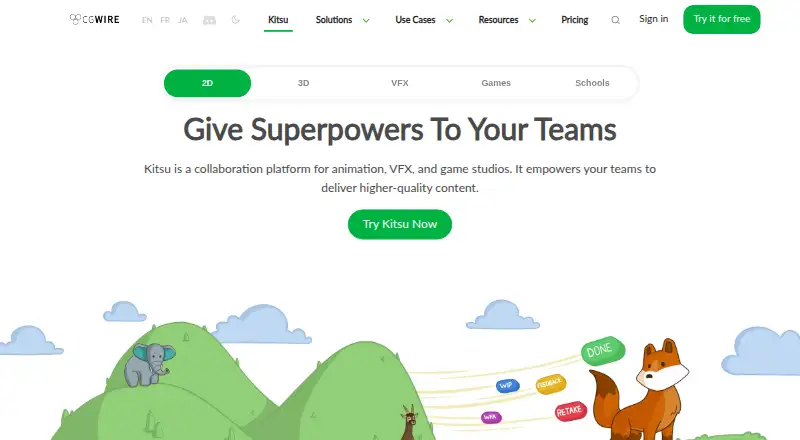
What Kitsu is
Kitsu is a production-tracking and collaboration platform for animation, VFX, and game studios. Teams can schedule tasks, assign them to artists, and balance workloads, while dashboards report progress and an activity feed follows updates to subscribed tasks in real time. Review playlists bring shots and assets together, retaining preview versions for comparison. Kitsu also tracks asset versions, related tasks, and progress, with an asset library for reuse. Budget forecasting and time tracking cover assets and shots. The service provides publishing integrations for content-creation tools, chat notifications, and API clients; named integrations include Blender, Toon Boom Harmony, Unreal Engine, Slack, Discord, and Mattermost. Developers can use its REST API, Python client, JavaScript SDK, and command-line interface. Kitsu is available on the web, Linux, and as AGPL open-source software for self-hosting. Cloud hosting includes updates, backups, monitoring, and video processing, with infrastructure in Europe. Self-hosters manage operations themselves.
Good
- Schedules tasks and balances artist workloads
- Review playlists retain preview versions for comparison
- Tracks asset versions, tasks, and progress
- Provides REST API, Python and JavaScript tools, and CLI
- Self-hosted edition is AGPL open source
Watch out
- Self-hosting puts operations and upgrades on the customer
- Trial runs on low-end hardware by default
- Intensive preview workloads may require extra storage costs
Who it suits
Kitsu suits production teams in animation, VFX, or games that need task planning, review, asset tracking, and production reporting. It also fits studios that want an API or self-hosted option and can manage their own infrastructure.
Verdict
Kitsu brings planning, review, asset tracking, and reporting into one production workflow for creative studios. Choose between managed hosting and self-hosting based on whether your team wants to handle infrastructure and operations.
Plans and prices
From Kitsu's own pricing page, checked 15 Oct 2026.
| Plan | Price | What it gives you |
|---|---|---|
| Self-hosted | Free | AGPL open source · customer-provided infrastructure and operations |
| Agency | €20 a month | 1–20 users · basic support · <48h response · 100GB storage · annually |
| Production | €30 a month | 1–100 users · premium support · <24h response · 3TB storage · search engine · playlist builder · annually |
| Studio | €35 a month | 1–300 users · diamond support · <12h response · 10TB storage · search engine · playlist builder · annually |
| Artist Schools | €3,999 a year | up to 100 students · annually |
| Enterprise | Priced on request | unlimited users · on-premise installation · SSO · contractor synchronization · multiple instances and regions · staging · media encryption |
The facts
Each one read from Kitsu's own pages, with the date it was checked.
What it does
- Activity feed
- Real-time activity feeds let users follow production changes and subscribe to task-status notifications.checked 15 Oct 2026
- API
- Kitsu provides REST API access, a Python client, a JavaScript SDK, and a command-line interface.checked 30 Sep 2026
- Architecture
- The stack uses a Vue frontend, Flask-based Zou API and event service, PostgreSQL, Redis, FFmpeg and Meilisearch.checked 15 Oct 2026
- Asset library
- Studios can maintain reusable asset libraries to avoid duplicate assets.checked 15 Oct 2026
- Asset management
- Kitsu tracks asset versions, related tasks, and progress, and provides an asset library for reuse.checked 30 Sep 2026
- Breakdown lists
- Breakdown lists associate assets with shots and provide readiness statistics.checked 15 Oct 2026
- Budget and time
- Features include budget forecasting and artist time tracking across assets and shots.checked 30 Sep 2026
- Budget forecasting
- VFX workflows include scenario testing that compares current costs with budget forecasts.checked 15 Oct 2026
- Cloud hosting
- CGWire says Kitsu Cloud infrastructure runs in Europe and that hosting operations include updates, backups, monitoring, and video processing.checked 30 Sep 2026
- Documentation depth
- The developer site includes guides for authentication, permissions, publishing, asset management, automation, search, plugins, deployment, backups and migrations.checked 15 Oct 2026
- Extensibility
- Developers can use event listeners, custom actions and plugins with backend routes and embedded UI.checked 15 Oct 2026
- Founder report
- Frank Rousseau’s 2026 project review says Kitsu serves about 500 studios, mainly independent productions, and that five people work on it full time.checked 15 Oct 2026
- Hardware requirements
- Recommended minimums range from 2 cores and 4GB RAM for 1–10 users to 8 cores and 30GB RAM for 81–200 users.checked 15 Oct 2026
- Identity options
- Self-hosted deployments document LDAP or Active Directory, SAML 2.0 and OpenID Connect authentication.checked 15 Oct 2026
- Integrations
- Official developer documentation lists Blender, Toon Boom Harmony, Unreal Engine, Slack, Discord and Mattermost integrations.checked 15 Oct 2026
- License
- The Kitsu application repository is published under AGPL-3.0.checked 15 Oct 2026
- Limit: feature maturity
- A Reddit discussion from six years ago said client-facing review tools were close to ready but not yet fully sufficient.checked 15 Oct 2026
- Limit: support access
- A Reddit user says the abandoned forum was difficult to use and that chat support told them it was limited to paying customers.checked 15 Oct 2026
- News: public links
- The April 27, 2026 changelog introduced public playlist links allowing guests to comment, annotate, update statuses and manage checklists without accounts.checked 15 Oct 2026
The company
- Company adoption
- The company’s GitHub profile says more than 300 studios use Kitsu, while its product site claims more than 500 studios and 25,000 active users.checked 15 Oct 2026
- Company founded
- LinkedIn lists CGWire as founded in 2017 with headquarters in Paris.checked 15 Oct 2026
- Company size
- LinkedIn lists CGWire as a privately held information-technology company with 2–10 employees.checked 15 Oct 2026
- Founded
- 2018checked 28 Sep 2026
- Headquarters
- Paris, Francechecked 28 Sep 2026
The full review of Kitsu
Kitsu is a production-tracking and collaboration platform built for animation, VFX, and game studios. It is best suited to teams coordinating artists, shots, and assets through a structured pipeline. Its central advantage is keeping planning, review, asset history, and reporting in one system, while buyers must choose between managed hosting costs and self-hosting responsibilities.
Overview
Kitsu combines task scheduling, workload balancing, shot and asset review, version tracking, production dashboards, time tracking, and budget forecasting. That studio focus makes it more appropriate than a generic task manager when production status and media history need to remain connected. Cloud hosting is operated in Europe, with updates, backups, monitoring, and video processing handled by CGWire. The AGPL open-source edition supports self-hosting, but the customer must run infrastructure and take care of backups, monitoring, security, and upgrades.
Key features
Planning and production visibility
Teams can schedule tasks, assign them to artists, and balance workloads. Dashboards show production progress, while a real-time activity feed follows changes to subscribed tasks. Production leads get both a broad status view and a stream of task-level changes, which is more useful for active studio coordination than static project lists.
Review and asset history
The review engine builds playlists for shots and assets and retains preview versions for comparison. Kitsu tracks asset versions, related tasks, and progress, then places reusable material in an asset library. Proofing and approvals, asset versioning, and a client portal make the workflow suitable when feedback and approval records must stay tied to production items.
Time, budget, and integrations
Budget forecasting and artist time tracking cover both assets and shots, giving managers a way to compare planned work with recorded effort. Publishing integrations connect digital content creation tools, while notifications can reach Slack, Discord, and Mattermost. Developer documentation also names Blender, Toon Boom Harmony, and Unreal Engine. REST API access, a Python client, a JavaScript SDK, and a command-line interface make Kitsu a stronger fit for studios that need to connect it to existing pipeline tools.
Hosting and privacy
Cloud customers receive managed operations, and CGWire says it will not sell personal data and can sign a non-disclosure agreement when required. Self-hosting offers control and avoids a managed subscription, but it shifts every operational task to the studio. The trial includes all features and unlimited users for 14 days, although it runs on low-end hardware unless a stronger setup is arranged. Studios with very heavy preview workloads should budget for possible extra storage costs.
Pricing
Kitsu has a freemium structure. The Self-hosted plan is free and open source, with self-managed infrastructure, backups, monitoring, security, and upgrades. It suits technically capable studios that want control and can staff operations.
Agency costs €20 / month / user, billed annually, for 1–20 users. It includes mutualized hosting, 100GB storage, and basic support with a response time under 48 hours. This is the entry cloud option for smaller teams, but the user cap and storage allocation constrain larger or media-heavy productions.
Production costs €30 / month / user, billed annually, for 1–100 users. It adds high availability, a search engine, playlist builder, 3TB storage, and premium support under 24 hours. It is the more appropriate tier for established studios whose review library and availability requirements exceed Agency.
Studio costs €35 / month / user, billed annually, for 1–300 users. It includes the Production features, 10TB storage, and diamond support under 12 hours. The modest price increase buys substantially more storage, capacity, and faster support for larger operations.
Artist Schools costs 3999€ a year for up to 100 students. Enterprise uses custom pricing and adds unlimited users, on-premise installation, single sign-on, contractor synchronization, multiple instances and regions, a staging environment, and media encryption.
Platforms
Kitsu is available on the web and Linux, with an API and self-hosted deployment options. Its API clients and command-line interface also support integration into studio pipelines.
Who it's for
Kitsu is a strong choice for animation, VFX, and game studios that need workload planning, production reporting, review approvals, asset versioning, and time tracking in one workflow. It also suits organizations with developers who can use the API or maintain a self-hosted installation. A general-purpose team seeking simple task management may find its production orientation unnecessary, while teams unwilling to operate infrastructure should favor the managed plans.
Pros and cons
- Pros: Planning, review playlists, preview comparison, asset history, reporting, budgets, and time tracking are joined in one production workflow.
- Pros: REST, Python, JavaScript, and CLI interfaces support custom pipeline integration, including named tools such as Blender and Unreal Engine.
- Pros: European managed hosting and an AGPL self-hosted edition give studios a choice between convenience and control.
- Cons: Self-hosting requires the studio to handle infrastructure, security, backups, monitoring, and upgrades.
- Cons: Cloud plans are billed annually per user, and Agency is limited to 20 users and 100GB storage.
- Cons: Intensive preview workloads may create additional storage costs beyond the included quotas.
Alternatives
Creative Project Management Software is the broader category to browse when Kitsu's studio-specific workflow is not the right match.
Choose Celtx instead for a free studio with one project and cloud-based script editors, including real-time collaboration across a wider range of consumer platforms.
Dart is a better fit for teams wanting a free personal tier with up to four teammates, unlimited tasks and documents, and AI task features.
Pick Wrike for general work management, with a free tier offering unlimited users, 2GB storage, and 200 active tasks per account.
Ziflow suits proof-focused teams needing unlimited proofs and reviewers on its free plan, with two users and 2GB storage.
Frame.io is an alternative for media collaboration centered on projects, review media, and camera-to-cloud workflows.
Krock.io offers a free one-user workspace with 2GB storage and unlimited reviewers.
QuickProof is a free web option for temporary image reviews, with shared links publicly accessible and content deleted after seven days.
Runnit is another freemium web and API option with a free tier for up to five people and 1GB storage.
Verdict
Choose Kitsu if your animation, VFX, or game studio needs production planning, review approvals, asset history, and reporting connected in one pipeline. Look elsewhere if you only need lightweight project management or cannot take on the operational burden of self-hosting and the recurring per-user cost of managed plans.
Alternatives to Kitsu
- 1

Wrike
Free planAndroidiOSWebAPI8.4From $10 a month - 2

Frame.io
Free planAndroidiOSWebAPI8.3From $15 a month - 3

Celtx
Free planAndroidiOSWebExtension8.2From $11.24 a month - 4

Dart
Free planAndroidiOSWebAPI7.9From $8 a month - 5
Autodesk Flow Production Tracking
AndroidiOSWebAPI7.8 - 6

Krock.io
Free planWebAPIExtensionmacOS7.8From $10 a month