Kerno
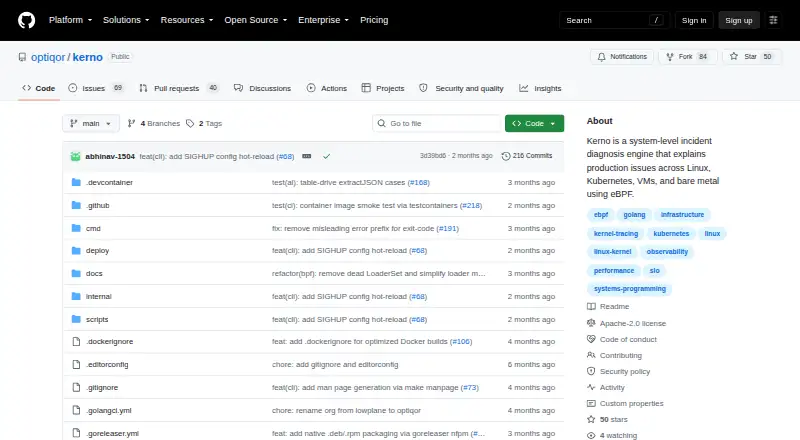
The facts below are what the maker publishes about Kerno, checked and dated. Our editors have not written about it yet.
The facts
Each one read from Kerno's own pages, with the date it was checked.
What it does
- Deployment
- Kerno can run as a Kubernetes DaemonSet or as a binary on bare metal, VMs, EC2, and GCE; Docker images are published for Linux amd64 and arm64.checked 8 Oct 2001
- Diagnosis rules
- The engine evaluates 11 deterministic rules covering issues such as disk I/O bottlenecks, OOM events, TCP retransmits, scheduler contention, and file descriptor leaks.checked 8 Oct 2001
- Incident reports
- The `kerno doctor` command collects 30 seconds of kernel data and returns ranked findings with causes, evidence, ETAs, and suggested fixes.checked 8 Oct 2001
- Integrations
- The project lists Prometheus metrics and ServiceMonitor support, Kubernetes pod enrichment, optional Anthropic, OpenAI, and Ollama providers, and systemd enrichment.checked 8 Oct 2001
- Kernel requirement
- The quick start requires Linux kernel 5.8 or later with BTF; Helm or raw manifest deployment requires cluster-admin.checked 8 Oct 2001
- License
- The repository identifies Kerno as licensed under Apache License 2.0.checked 8 Oct 2001
- Monitoring
- Its watch commands cover TCP connections and retransmits, OOM kills, and file descriptor leak detection.checked 8 Oct 2001
- Network policy limitation
- The README cautions that standard Kubernetes NetworkPolicy resources generally do not restrict Kerno because it uses host networking, unless host-firewall configuration is used.checked 8 Oct 2001
- Permissions
- The documented Kubernetes security posture lists CAP_BPF, CAP_PERFMON, CAP_SYS_PTRACE, CAP_NET_ADMIN, and CAP_DAC_READ_SEARCH, and says the hot path does not require CAP_SYS_ADMIN.checked 8 Oct 2001
- Privilege requirement
- Kerno needs elevated privileges or documented Linux capabilities to load eBPF programs into the kernel.checked 8 Oct 2001
- Purpose
- Kerno is an eBPF-based incident diagnosis engine for production issues across Linux, Kubernetes, VMs, and bare metal.checked 8 Oct 2001
- Requirements
- Kubernetes use requires Linux kernel 5.8 or later with BTF, and raw manifests or Helm installation require cluster-admin access.checked 8 Oct 2001
- Roadmap limits
- The roadmap lists OpenTelemetry export and Grafana dashboards for v0.2, Slack and PagerDuty integrations for v0.3, and a managed Optiqor Cloud offering for v1.0.checked 8 Oct 2001
- Security
- The project says Kerno makes no outbound network calls by default and that AI integration is opt-in through the configured provider.checked 8 Oct 2001
- Security details
- The security policy says Kerno's eBPF programs are read-only observers and that it does not log file contents, environment variables, authentication tokens, or network payloads.checked 8 Oct 2001
- Security posture
- The README says Kerno makes no outbound network calls by default and that AI integration is opt-in through a configured provider.checked 8 Oct 2001
- Support
- The security policy directs general questions to GitHub Discussions and vulnerability reports to [email protected], with acknowledgment targeted within 48 hours.checked 8 Oct 2001
- Tracing
- Kerno supports syscall latency, disk I/O latency, and CPU scheduler delay tracing.checked 8 Oct 2001
Alternatives to Kerno
- 1
Kubeshark
Free planOpen sourceWebAPILinuxmacOS8.1From $0.40 a month - 2
Metoro Kubernetes Profiling
Free planWebAPILinuxSelf-hosted7.5From $20 a month - 3
Coroot
Free planWebAPILinuxSelf-hosted7.1From $1 a month - 4

groundcover
Free planWebLinuxSelf-hosted7.1From $30 a month - 5

Elastic Observability
WebAPILinuxmacOS6.9 - 6

DeepFlow
Free planAndroidWebAPILinux6.7Free plan