
Julius AI
Julius AI analyzes user data from natural-language prompts, writing and running code to compute answers.
What Julius AI is
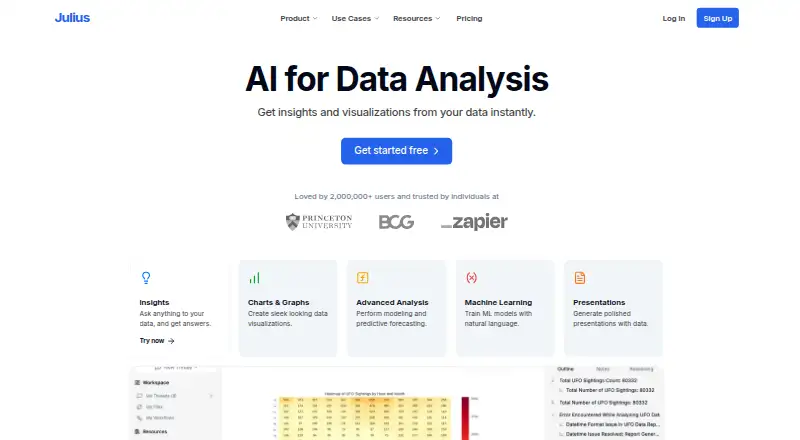
Julius AI analyzes user data from natural-language prompts, writing and running code to compute answers. It can clean data, create visualizations, run statistical analysis and modeling, and produce forecasts. Supported inputs include Excel and CSV files, Google Sheets, images, PDFs, Word documents, and text files. Listed connectors include databases and cloud warehouses such as Postgres, BigQuery, Snowflake, MySQL, SQL Server, and Supabase, as well as Google Ads, Meta Ads, Google Drive, and OneDrive. Julius can turn analysis and research into charts, presentations, reports, websites, images, and videos. It works in a browser and has Android and iPhone apps for mobile chat. The free plan includes daily credits, limited AI creation features, and a Google Drive connector. Plus costs $20 a month; Pro, Max, and Business are listed at $45.00, $200.00, and $450 a month respectively. Enterprise pricing is not listed. Julius states that it is SOC 2 Type II compliant, that code runs in isolated environments, and that personal information is not used to train its AI models. Practical data capacity may depend on what fits in 32 GB of sandbox RAM.
Good
- Natural-language prompts can drive data analysis
- Supports spreadsheets, documents, images, and PDFs
- Connectors include databases, warehouses, and cloud drives
- Browser access plus Android and iPhone apps
- Free plan includes daily credits and Google Drive connector
Watch out
- Free plan has limited AI creation features
- Practical data capacity may depend on 32 GB sandbox RAM
- Enterprise pricing is not listed
Who it suits
Julius AI suits people who want to ask questions about files or connected data in natural language and receive computed analysis. Its Business plan is intended for collaborating teams, while Enterprise targets organizations with multiple teams or added security needs.
Verdict
Julius AI combines data analysis, code execution, and several output formats in browser and mobile apps. The free plan is limited, and practical data capacity depends on the sandbox environment.
Plans and prices
From Julius AI's own pricing page, checked 30 Sep 2026.
| Plan | Price | What it gives you |
|---|---|---|
| Free | Free | Free daily credits · limited AI creation features · Google Drive connector · $0 / month |
| Plus | $20 a month | 2,000 credits monthly · 1 seat · unlimited file storage formats and charts · email/community support · $20 / month; $16 / month with yearly billing |
| Pro | $45 a month | 5,000 credits monthly · 1 seat · expanded context window · priority email support · $45 / month; $37 / month with yearly billing |
| Max | $200 a month | 25,000 credits monthly · larger context window · permanent file storage · priority access at high traffic times · $200 / month; $166 / month with yearly billing |
| Business | $450 a month | 60,000 credits monthly · up to 50 team members · Postgres, BigQuery, Snowflake and more connectors · unlimited custom agents and scheduled report runs · $450 / month; $375 / month with yearly billing |
| Enterprise | Priced on request | Unlimited credits · custom data connectors · additional security features including SSO, audit logging and fine-grained RBAC · Contact Us |
The facts
Each one read from Julius AI's own pages, with the date it was checked.
What it does
- AI training
- Julius's privacy policy says it does not use personal information to train its artificial intelligence models.checked 30 Sep 2026
- Code execution
- For data questions, Julius writes and runs code so answers can be computed from the user's data.checked 30 Sep 2026
- Data analysis
- Julius analyzes data from natural-language prompts and can clean data, create visualizations, run statistical analysis, modeling and forecasts.checked 30 Sep 2026
- Integrations
- Listed connectors include Postgres, BigQuery, Snowflake, MySQL, SQL Server, Supabase, Google Ads, Meta Ads, Google Drive and OneDrive.checked 30 Sep 2026
- Mobile access
- Julius says it runs in a browser and offers iPhone and Android apps for chatting on mobile.checked 30 Sep 2026
- Outputs
- Julius can turn analysis and research into charts, presentations, reports, websites, images and videos.checked 30 Sep 2026
- Privacy controls
- Julius says user files are access-controlled, code runs in isolated environments, and data deleted in the app is erased from its servers.checked 30 Sep 2026
- Scale limit
- Julius says it does not enforce a row-count or data-size limit, though practical limits may depend on what fits in 32 GB of sandbox RAM.checked 30 Sep 2026
- Security
- Julius states it is SOC 2 Type II compliant and that customer data connected through its data connectors stays in the customer's cloud.checked 30 Sep 2026
- Support
- The pricing page lists email and community support on Plus and priority email support on Pro.checked 30 Sep 2026
- Supported files
- The data-analysis page lists Excel and CSV files, Google Sheets, images, PDFs, Word documents and text files as supported formats.checked 30 Sep 2026
- Who it serves
- Julius describes the Business plan as intended for teams collaborating on creation and analysis, while Enterprise targets organizations with multiple internal teams or additional security needs.checked 30 Sep 2026
Money
- Free plan
- Yeschecked 19 Sep 2026
The company
- Headquarters
- 149 New Montgomery Street, 4th Floor, San Francisco, CA 94105, United Stateschecked 28 Sep 2026
- Team collaboration
- Yeschecked 19 Sep 2026
The full review of Julius AI
Julius AI is a browser-based data analysis tool with iPhone and Android apps for mobile chatting. It suits people who want to ask questions of their data in plain language and turn the results into more than charts, provided its credit limits fit their workload.
Overview
Julius interprets natural-language prompts, writes and runs code against user data, and can clean, analyze, model, and forecast it. That combination makes it useful for moving from a question to a computed result without writing the analysis code yourself. Its output range—reports, presentations, websites, images, and videos as well as charts—also suits users who need to present findings in different formats.
It accepts spreadsheets, database connections, documents, images, and other common file types. Julius says it does not impose a row-count or data-size cap, but practical capacity still depends on what can fit in its 32 GB sandbox RAM. That distinction matters for large datasets: no published size ceiling does not guarantee every workload will fit.
Key features
Analysis and output
Ask questions in natural language and Julius writes and runs code to calculate answers from the data. It can also clean data, create visualizations, and perform statistical analysis, modeling, and forecasting. This breadth is valuable when one tool needs to support both exploration and communication; users who need only spreadsheet charts may not need the wider output set.
Supported imports include XLS, XLSX, CSV, Google Sheets, JPEG, PNG, PDF, DOCX, and TXT. Listed connectors include Postgres, BigQuery, Snowflake, MySQL, SQL Server, Supabase, Google Ads, Meta Ads, Google Drive, and OneDrive. SQL connections and AI visualizations are supported, and exports include CSV and Excel.
Security and data handling
Julius states that it is SOC 2 Type II compliant, that data connected through its connectors remains in the customer's cloud, and that files are access-controlled. It also says code runs in isolated environments, deleted in-app data is erased from its servers, and personal information is not used to train its AI models. These controls may matter to teams handling sensitive data, though Enterprise is the plan that includes additional security features such as SSO, audit logging, and fine-grained RBAC.
Pricing
Julius has a free plan and paid monthly tiers. The credit allowance is the clearest practical difference between the lower plans, while seats and collaboration capacity change substantially at Business.
- Free: free, billed $0 / month. It includes daily credits, limited AI creation features, and the Google Drive connector. It is a low-commitment way to try basic work, but limited creation features make it a poor fit for sustained or varied analysis.
- Plus: $20 a month, billed $20 / month or $16 / month with yearly billing. It includes 2,000 credits monthly, one seat, unlimited file storage formats and charts, and email/community support. This fits an individual with regular but bounded needs; the single seat and monthly credits constrain team use and heavy workloads.
- Pro: $45 a month, billed $45 / month or $37 / month with yearly billing. It raises the allowance to 5,000 monthly credits and adds an expanded context window and priority email support, while remaining limited to one seat. It is the stronger individual option for larger-context tasks, not a collaboration tier.
- Max: $200 a month, billed $200 / month or $166 / month with yearly billing. It provides 25,000 monthly credits, a larger context window, permanent file storage, and priority access during high-traffic periods. This suits an individual with heavier ongoing usage who values retained files and access priority; it does not add listed team seats.
- Business: $450 a month, billed $450 / month or $375 / month with yearly billing. It includes 60,000 monthly credits, up to 50 team members, connectors including Postgres, BigQuery, and Snowflake, and unlimited custom agents and scheduled report runs. Julius positions it for teams collaborating on creation and analysis, and its seat allowance makes it the first listed plan built for group use.
- Enterprise: custom pricing, billed Contact Us. It includes unlimited credits, custom data connectors, and additional security features including SSO, audit logging, and fine-grained RBAC. Julius targets organizations with multiple internal teams or additional security needs.
Platforms
Julius runs in a browser and offers iPhone and Android apps for chatting on mobile. The mobile apps extend access to conversations, while the core data workflow is described as browser-based.
Who it's for
Julius is best suited to individuals who want code-backed answers to data questions without composing the code themselves, especially when they also need reports or other presentation formats. Business is aimed at teams that need shared analysis, custom agents, and scheduled reports. Organizations requiring custom connectors or stronger access controls should consider Enterprise.
It is less compelling for occasional users whose needs exceed the free plan but do not justify a monthly subscription, or for workloads that exceed practical sandbox capacity. Individuals should also weigh the one-seat limit on Plus, Pro, and Max before choosing a plan for shared work.
Pros and cons
- Pro: Natural-language prompts can trigger code execution, so answers are computed from the user's data rather than limited to conversational explanation.
- Pro: Broad imports and database, cloud-storage, and advertising connectors accommodate varied data sources.
- Pro: Analysis can become charts, reports, presentations, websites, images, or videos, giving users several ways to communicate results.
- Con: Free access has daily credits and limited AI creation features, so it may not sustain regular work.
- Con: Plus, Pro, and Max each include one seat, which rules them out as shared team plans.
- Con: The lack of a row-count or data-size limit does not remove practical constraints: workloads still depend on fitting within 32 GB of sandbox RAM.
Alternatives
Consider these alternatives if their deployment model, audience, or pricing structure better matches the work:
- Pyramid Analytics offers a free Community Edition for three users and supports web, Windows, Linux, iOS, and Android, making it worth considering when broader platform coverage or a small multi-user free tier matters.
- Databricks Notebooks has a free web edition with one serverless workspace and limited compute size and usage; choose it if that constrained serverless workspace model fits better.
- Hex offers a free Community plan with any data source, all cell types, small compute, and an agent trial, plus a free trial; it is an option when that starter setup suits the work.
- Zoho Analytics has an Always Free plan for two users, 10,000 rows, and five workspaces, which may better fit small, bounded datasets and a two-person setup.
- Akkio offers an enterprise AI analytics platform with custom pricing based on needs; consider it when an enterprise-focused, customized arrangement is preferable.
- Yellowfin BI is a paid option whose pricing is based on named users, for readers considering a named-user purchasing model.
- Panorama is another paid option.
- TIBCO Spotfire costs $3,000 a year per user excluding tax and offers a free trial; consider it if that annual per-user plan and trial suit your evaluation.
For broader comparisons, browse Augmented Analytics Software, AI Data Analysis Tools, and AI Website Builders.
Verdict
Choose Julius AI if you want natural-language data questions backed by code execution, a wide set of data inputs, and flexible ways to present results. Its strongest case is the span from analysis to finished output; look elsewhere if you need shared seats below Business, expect work to exceed the sandbox's practical capacity, or want more than the free plan without a recurring cost.
Getting started
- Visit https://julius.ai/home/ai-for-data-analysis in a browser, or use the Android or iPhone app for mobile chat.
- Start with the Free plan, which includes daily credits and a Google Drive connector.
- Provide data using supported files or a listed connector.
- Ask a data question in natural language so Julius can write and run code.
- Choose a paid plan if you need its listed credits, support, storage, collaboration, or other plan features.
Limits worth knowing
The Free plan includes daily credits and limited AI creation features. Plus costs $20 a month and includes 2,000 monthly credits and one seat; practical data capacity may depend on what fits in 32 GB of sandbox RAM.
Questions
Does Julius AI have a free plan?
Yes. Free includes daily credits, limited AI creation features, and a Google Drive connector.
What do the paid plans cost?
Plus is $20 a month, Pro $45.00, Max $200.00, and Business $450.00. Enterprise pricing is by contact.
Which platforms can I use?
Julius runs in a browser and offers Android and iPhone apps for mobile chat.
What data sources does it support?
Inputs include Excel and CSV, Google Sheets, images, PDFs, Word documents, and text files. Listed connectors include databases, cloud warehouses, advertising platforms, Google Drive, and OneDrive.
Does Julius support teams?
Yes. Business supports up to 50 team members, and Enterprise targets organizations with multiple internal teams or additional security needs.
Does Julius impose a data-size limit?
It says it does not enforce a row-count or data-size limit, though practical capacity may depend on what fits in 32 GB of sandbox RAM.