
Hex
Hex is a hosted data platform for exploring information, asking questions, and building data applications.
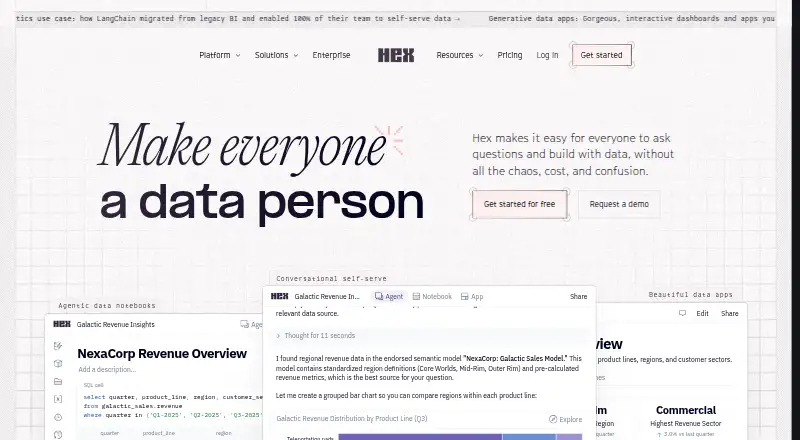
What Hex is
Hex is a hosted data platform for exploring information, asking questions, and building data applications. It brings together notebooks, conversational self-service, and app creation, with support for SQL, Python, and R. Its agent is designed to ground responses in organizational context and can connect with Claude, Codex, Cursor, Slack, MCP, a CLI, APIs, or custom agents. Users can create data apps from prompts, with code underneath and controls for the finished app. Context Studio and Evals offer visibility into topics, trends, and answer-quality warnings. Hex connects to data warehouses and local TXT, CSV, JSON, Parquet, Avro, and XLSX files, as well as metadata, semantic-layer, catalog, machine-learning, and workflow tools. Airflow, Dagster, and dbt integrations can trigger analytical flows and app runs from data pipelines. Real-time collaboration and version history are supported. Community is free; Professional costs $36 per Editor per month and Team costs $75 per Editor per month. A 14-day trial is available. Community and Professional include up to five published apps, while Team and Enterprise allow unlimited published apps.
Good
- Supports SQL, Python, and R.
- Connects data warehouses and many file formats.
- Supports real-time collaboration and version history.
- Team and Enterprise allow unlimited published apps.
Watch out
- Community and Professional cap published apps at five.
- Professional costs $36 per Editor per month.
- Team costs $75 per Editor per month.
Who it suits
Hex describes Community as suited to hobbyists and small projects, Professional to individuals, and Team to companies working together on data. Enterprise is aimed at organizations needing advanced security, governance, and support.
Verdict
Hex combines notebooks, conversational data work, and app building with broad data and workflow connections. The free Community plan is limited to five published apps; paid tiers raise that limit.
Plans and prices
From Hex's own pricing page, checked 29 Sep 2026.
| Plan | Price | What it gives you |
|---|---|---|
| Community | Free | Connect any data source · all cell types · small compute · Hex agent trial |
| Professional | $36 a month | Hex agent · standard credits · up to 5 published apps · 30-day version history · medium compute · per Editor / month |
| Team | $75 a month | Extended credits · unlimited published apps · scheduled runs and alerts · unlimited version history · advanced compute add-ons · per Editor / month |
| Enterprise | Priced on request | Everything in Team · audit logs · OIDC SSO · BYOK · dedicated support · optional single tenant and HIPAA add-ons · Custom |
The facts
Each one read from Hex's own pages, with the date it was checked.
What it does
- AI agent
- Hex says its agent grounds answers in organizational context and can connect with Claude, Codex, Cursor, Slack, MCP, a CLI, APIs, or custom agents.checked 29 Sep 2026
- Context tools
- Context Studio and Evals provide visibility into topics, trends, and warnings about answer quality.checked 29 Sep 2026
- Integrations
- Hex connects to data warehouses, local files including TXT, CSV, JSON, Parquet, Avro, and XLSX, metadata and semantic-layer tools, catalogs, machine-learning tools, and workflow orchestrators.checked 29 Sep 2026
- Intended users
- Hex describes Community as for hobbyists and small projects, Professional for individuals, Team for companies collaborating on data, and Enterprise for organizations needing advanced security, governance, and support.checked 29 Sep 2026
- Orchestration
- Hex says Airflow, Dagster, and dbt integrations can trigger analytical flows and app runs from data pipelines.checked 29 Sep 2026
- Security
- The Trust Center lists SOC 2 Type II, HIPAA, PCI, GDPR, CCPA, EU-US DPF, Swiss-US DPF, and UK-US DPF badges.checked 29 Sep 2026
- Security controls
- Enterprise plan features include audit logs, OIDC SSO, OAuth database connections, and Bring Your Own Key.checked 29 Sep 2026
- Support
- The pricing comparison lists email support on Community and Professional, priority SLA support options on Team, and Enterprise SLA support options including Slack and Microsoft Teams where offered.checked 29 Sep 2026
- What it does
- Hex is a data platform for asking questions and building with data, including notebooks, conversational self-serve, and data apps.checked 29 Sep 2026
Where it runs
- App building
- Hex says users can build data applications from prompts, with code underneath and controls for the finished app.checked 29 Sep 2026
The company
- Company scale
- Hex says its system supports over 2,000 customers globally, including leading AI labs and regulated banks.checked 29 Sep 2026
- Headquarters
- San Francisco, California, United Stateschecked 28 Sep 2026
Money
- Free plan
- Yeschecked 20 Sep 2026
- Plan limits
- Community and Professional include up to five published apps, while Team and Enterprise include unlimited published apps.checked 29 Sep 2026
The full review of Hex
Hex brings analysts and data users into a shared environment for notebooks, conversational analysis, and data apps. It is best suited to teams that want to connect analytical work to recurring workflows and user-facing applications. The trade-off is a five-app ceiling on its two lower paid tiers; teams that publish more need Team or Enterprise.
Overview
Hex is a hosted data platform built around asking questions of data and turning analysis into applications. SQL, Python, and R support a range of analytical work, while real-time collaboration makes it a stronger fit for shared projects than for someone seeking only a private notebook. Its broad connections to data systems and workflow tools are the main reason to consider it over a narrower query or notebook tool.
Execution is hosted, and the platform supports GPU compute. That removes the need to manage execution infrastructure, but Hex is not the choice for organizations that require a self-hosted platform.
Key features
Hex combines notebooks with conversational self-serve, letting technical users work in code while others ask questions through a more approachable interface. Its agent is designed to ground answers in organizational context and can connect with Claude, Codex, Cursor, Slack, MCP, a CLI, APIs, or custom agents. Context Studio and Evals help teams inspect topics, trends, and warnings about answer quality. These are useful safeguards for organizations adopting conversational data work, though they do not remove the need to judge answers carefully.
Users can build data apps from prompts while retaining code underneath and controls over the finished app. That combination suits teams that want to move from analysis to a controlled, reusable interface. Jupyter Notebook (.ipynb) and Hex YAML (.yaml) formats, version history, and real-time collaboration support shared development; the amount of version history depends on plan.
Connections span data warehouses, local TXT, CSV, JSON, Parquet, Avro, and XLSX files, metadata and semantic-layer tools, catalogs, machine-learning tools, and workflow orchestrators. Airflow, Dagster, and dbt integrations can trigger analytical flows and app runs from data pipelines, which makes Hex relevant when analysis is part of a repeatable data process rather than a one-off query.
The Trust Center carries SOC 2 Type II, HIPAA, PCI, GDPR, CCPA, EU-US DPF, Swiss-US DPF, and UK-US DPF badges. Enterprise adds audit logs, OIDC SSO, OAuth database connections, and Bring Your Own Key. Organizations that need those specific controls should look at Enterprise rather than assume they come with lower tiers.
Pricing
Hex uses a freemium model, with a 14-day trial. Community costs nothing and targets hobbyists and small projects. It connects to any data source and includes all cell types, small compute, and a Hex agent trial. The free plan is a low-commitment way to explore the platform, but the agent is only a trial and the compute is small.
Professional costs $36 a month, billed per Editor / month. It is aimed at individuals and includes the Hex agent, standard credits, up to five published apps, 30-day version history, and medium compute. It adds lasting agent access and more capacity, but the app cap makes it a poor fit for a growing portfolio of published tools.
Team costs $75 a month, billed per Editor / month. It is intended for companies collaborating on data and adds extended credits, unlimited published apps, scheduled runs and alerts, unlimited version history, and advanced compute add-ons. It is the clearest step up for teams that publish several apps or need recurring runs; the price is per Editor, so it is not a flat team-wide charge.
Enterprise uses custom pricing for organizations that need advanced security, governance, and support. It includes an Explorer seat add-on, audit logs, OIDC SSO, Bring Your Own Key, a single-tenant add-on, and dedicated support. Team and Enterprise both remove the five-app limit, while Enterprise is the tier for the stated security controls. Community and Professional have email support; Team offers priority SLA support options, and Enterprise offers SLA support options including Slack and Microsoft Teams where offered.
Platforms
Hex is available on the web and through an API. Its hosted execution model and connections to external tools make it suited to teams working across a data stack, rather than users seeking an on-device or self-hosted application.
Who it's for
Choose Hex if analysts and business users need to share data work, build controlled apps from it, and connect those apps or analytical flows to data pipelines. Community suits hobbyists and small projects; Professional fits individuals; Team suits companies collaborating on data; Enterprise fits organizations that need advanced security, governance, and support. Look elsewhere if you need more than five published apps but cannot justify Team, or if self-hosting is a requirement.
Pros and cons
- Pros: Notebooks, conversational analysis, and app building sit in one platform, supporting a path from exploration to reusable data tools.
- Pros: Broad data connections and Airflow, Dagster, and dbt orchestration make it useful when analytical work must connect to existing pipelines.
- Pros: Real-time collaboration and version history support shared work, with unlimited history on Team.
- Cons: Community and Professional stop at five published apps, which can constrain users publishing multiple tools.
- Cons: The listed advanced security controls are Enterprise features, so organizations that need them face a custom-priced tier.
- Cons: Hosted execution rules out teams that require self-hosting.
Alternatives
Julius AI is worth considering for someone who wants a web, Android, or iOS option with a free daily-credits plan and Google Drive connector; its free plan has limited AI creation features.
Databricks Notebooks may suit teams focused on notebooks in a web-based environment, with a free edition that provides one serverless workspace and limited compute size and usage.
Zoho Analytics is an alternative for users who can work within its self-hosted platform and free-plan limits of two users, 10,000 rows, and five workspaces.
Predict.ai offers a free plan with 500 credits per month, one workspace, one seat, one goal per workspace, one shared deployment, and 1 GB monthly ingestion.
Vizly is another web-based option; its free plan permits zero messages per month, while its Basic plan costs $19.99 a month for up to 200 messages per month, best-in-class models, and custom prompting.
Obviously AI may fit users whose needs center on predictions and CSV-based data: its free plan includes 1,200 predictions, one seat, unlimited models, and CSV-only uploads up to 10 MB, with up to 10,000 rows of data.
Pyramid Analytics is an alternative for readers seeking availability across web, Windows, Linux, iOS, and Android.
Yellowfin BI is a paid alternative with availability across web, desktop, and mobile platforms.
Compare category options in Augmented Analytics Software, Notebook Software, Data Science Platforms, SQL Query Tools, and Coding Playgrounds.
Verdict
Hex is a strong choice for collaborative data teams that want to move from notebooks and conversational questions to governed, pipeline-connected apps. Its breadth of integrations and app-building tools justify a look from teams standardizing analytical workflows. The main reasons to look elsewhere are the five-app cap below Team, custom Enterprise pricing for advanced controls, or a requirement for self-hosting.
Getting started
- Visit https://hex.tech/ to access Hex on the web or through its API.
- Choose Community, Professional, Team, or Enterprise for the intended use.
- Use the 14-day trial if evaluating a paid plan.
- Connect a data warehouse or supported local data file.
- Build notebooks or data apps using SQL, Python, or R.
Limits worth knowing
Community includes small compute and an agent trial, with up to five published apps. Professional also allows up to five published apps; its listed features include medium compute. Team and Enterprise include unlimited published apps.
Questions
Is Hex free?
Yes. Its Community plan is free.
Is there a free trial?
Yes, Hex lists a 14-day trial.
Which platforms and languages does Hex support?
It is available on web and via API, and supports SQL, Python, and R.
What are the published-app limits?
Community and Professional include up to five published apps. Team and Enterprise include unlimited published apps.
What security controls are listed for Enterprise?
Enterprise features include audit logs, OIDC SSO, OAuth database connections, and Bring Your Own Key.
Alternatives to Hex
- 1

Zoho Analytics
Free planSelf-hosted7.3Free plan - 2

Aible
Free planWebSelf-hosted6.9From $1,000 a year - 3

Wren AI
Free planWebAPISelf-hosted6.9From $179 a month - 4

ThoughtSpot
AndroidiOSWeb6.8From $25 a month - 5

Clavio
Free planWeb6.7From $19 a month - 6

Actian AI Analyst
WebAPI6.4From $499 a month