
JHipster
JHipster is a free platform for generating, developing, and deploying web applications and microservice architectures.
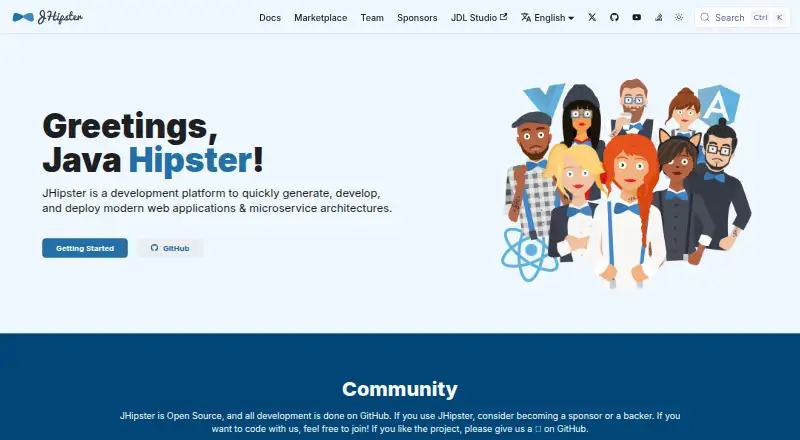
What JHipster is
JHipster is a free platform for generating, developing, and deploying web applications and microservice architectures. It can build frontend projects with Angular, React, or Vue, alongside backends using Spring Boot with Java or Kotlin, Micronaut, Quarkus, Node.js, or .NET. Mobile app support is available through Ionic and React Native. JHipster supports Docker and Kubernetes, with deployment options including AWS, Azure, Google Cloud Platform, Heroku, and OpenShift. Users can generate projects with JHipster Online, install locally through NPM, or use a Docker container. Online generation avoids installing JHipster itself, but normal development of the generated application still requires Java and NPM. The local NPM installation guide specifies Java 21 LTS or later and an LTS 64-bit Node.js version. Listed integrations include CI/CD options such as Jenkins, GitLab CI, CircleCI, Azure Pipelines, and GitHub Workflows, plus databases and messaging systems including MySQL, PostgreSQL, Oracle, MongoDB, Kafka, and Pulsar. Authentication documentation covers JWT, session-based authentication, OAuth 2.0, and OpenID Connect; Keycloak is the default OIDC server configured with JHipster. The security guidance says to replace generated default user and admin passwords in production. JHipster directs users to GitHub for questions, issues, contributions, and community connections.
Good
- Supports Angular, React, and Vue frontends.
- Supports Java, Kotlin, Node.js, and .NET backends.
- Offers JHipster Online, NPM, and Docker use.
- Supports Docker, Kubernetes, and several deployment targets.
- Documents multiple authentication approaches.
Watch out
- Normal development of generated apps still requires Java and NPM.
- Local NPM installation requires Java 21 LTS or later.
- Local installation requires an LTS 64-bit Node.js version.
- Production setup requires changing generated default passwords.
Who it suits
JHipster suits developers generating web applications or microservices with a choice of frontend and backend technologies. It may also fit teams looking for Docker or Kubernetes deployment options and listed integrations for CI/CD, databases, messaging, and authentication.
Verdict
JHipster provides a free way to generate and develop applications across a broad set of listed technologies. Online generation avoids installing JHipster, but developing the resulting app still requires Java and NPM.
Plans and prices
From JHipster's own pricing page, checked 29 Sep 2026.
| Plan | Price | What it gives you |
|---|---|---|
| JHipster | Free | Open source development platform |
The facts
Each one read from JHipster's own pages, with the date it was checked.
What it does
- Authentication
- JHipster documents JWT, session-based authentication, OAuth 2.0, and OpenID Connect; Keycloak is the default OIDC server configured with JHipster.checked 29 Sep 2026
- Backend
- Supported backend technologies include Spring Boot with Java or Kotlin, Micronaut, Quarkus, Node.js, and .NET.checked 29 Sep 2026
- Data and messaging
- The homepage lists integrations including MySQL, PostgreSQL, Oracle, MS SQL, MongoDB, Cassandra, Couchbase, Kafka, and Pulsar.checked 29 Sep 2026
- Deployment
- JHipster supports Docker and Kubernetes and lists deployment support for AWS, Azure, Google Cloud Platform, Heroku, and OpenShift.checked 29 Sep 2026
- Frontend
- Supported frontend technologies include Angular, React, and Vue, with mobile app support through Ionic and React Native.checked 29 Sep 2026
- Installation
- JHipster can be used through JHipster Online, local NPM installation, or a Docker container.checked 29 Sep 2026
- Integrations
- The homepage lists CI/CD options including Jenkins, GitLab CI, CircleCI, Azure Pipelines, and GitHub Workflows.checked 29 Sep 2026
- Local requirements
- The installation guide specifies Java 21 LTS or greater and an LTS 64-bit Node.js version for local NPM installation.checked 29 Sep 2026
- Online limitation
- JHipster Online generates an application without installing JHipster, but generated applications still require Java and NPM for normal development.checked 29 Sep 2026
- Purpose
- JHipster generates, develops, and deploys modern web applications and microservice architectures.checked 29 Sep 2026
- Security setup
- JHipster's security documentation says to change the generated default user and admin passwords in production.checked 29 Sep 2026
- Support
- The project directs users to ask questions, report issues, contribute, and connect with the community through GitHub.checked 29 Sep 2026
The company
- Founded
- 2013checked 23 Sep 2026
The full review of JHipster
Overview
JHipster is an application generator and development platform for web applications and microservice architectures. It suits developers and teams who want a scaffold that can span several frontend and backend stacks. Its breadth is useful when a project needs that flexibility, but it does not spare teams the work of choosing and maintaining an architecture.
Key features
Scaffolding and stack choices
Project scaffolding, custom templates, schema-to-code generation and a CLI give teams several ways to shape an application from the start. Frontend choices include Angular, React and Vue, with mobile app support through Ionic and React Native. On the backend, JHipster supports Spring Boot with Java or Kotlin, Micronaut, Quarkus, Node.js and .NET. This range is a strength for teams with established preferences; a project committed to one narrow stack may not need so many choices.
Data, security and delivery
JHipster lists integrations for MySQL, PostgreSQL, Oracle, MS SQL, MongoDB, Cassandra, Couchbase, Kafka and Pulsar. Authentication options include JWT, session-based authentication, OAuth 2.0 and OpenID Connect, with Keycloak as the default configured OIDC server. The generated default user and admin passwords need to be changed before production use, so generation is a starting point for security configuration, not a replacement for it.
Docker and Kubernetes support, alongside deployment options for AWS, Azure, Google Cloud Platform, Heroku and OpenShift, help teams carry generated applications toward deployment. Listed CI/CD options include Jenkins, GitLab CI, CircleCI, Azure Pipelines and GitHub Workflows. Users can start with JHipster Online, a local NPM installation or a Docker container. Online generation avoids installing JHipster itself, but ordinary development of the generated application still requires Java and NPM. Local NPM installation requires Java 21 LTS or later and an LTS 64-bit Node.js version.
Pricing
JHipster is free: its JHipster plan costs nothing and is described as an open source development platform. That makes it a practical option for individual developers and teams who can work with the community project and do not need a paid plan. No paid tier is needed to access the core generator described here.
Platforms
JHipster is available for Linux, macOS and Windows, as well as through the web and self-hosted setups. The online route lowers the barrier to generating a project, while local installation or Docker provides an option for teams that want to work from their own development environment.
Who it's for
JHipster is best for developers and teams building full web applications or microservice architectures who want a customizable starting point across frontend, backend, data and deployment choices. It is a weaker fit for people looking for a finished application without development work: even projects generated online require Java and NPM for normal development, and the generated defaults still need appropriate production configuration.
Pros and cons
- Pro: Broad frontend and backend choices let teams scaffold around a range of established technologies rather than a single fixed stack.
- Pro: Custom templates, schema-to-code generation and a CLI provide ways to adapt the generated project to different workflows.
- Pro: Free access and online generation make it possible to create a project without first installing JHipster locally.
- Con: Online generation does not remove the Java and NPM requirements for developing the resulting application.
- Con: The range of stack, database and deployment options calls for technical decisions; scaffolding does not determine the right architecture for a team.
- Con: Generated default user and admin passwords must be changed before production.
Alternatives
For API-focused generation, OpenAPI Generator is a free option for API clients, server stubs, documentation and configurations. TypeSpec is another free choice; TypeSpec describes itself as a Microsoft-built, community-supported project. quicktype is a free option whose repository identifies it as open source under the Apache-2.0 license.
Teams comparing broader development tooling can also consider Nx, whose free Hobby plan includes 50,000 credits reset monthly, five contributors and 10 concurrent CI connections. Stainless offers a free plan capped at five generators, five seats and 25 endpoints, with 100 preview builds per month and a rate limit of 25 per day. Speakeasy has an Enterprise plan with custom pricing and features including SaaS catalog integrations, custom server creation, an OAuth 2.1 proxy with DCR, real-time logs and SLA-backed support. Backstage is a free open-source framework. Micronaut Launch is a free alternative.
Browse more options in Code Generators.
Verdict
Choose JHipster if you want a free, customizable scaffold for a full application and value having multiple technologies and deployment paths to choose from. Its strongest advantage is that breadth; its main drawback is that developers still need to make the architectural and production-security decisions, and meet the Java and NPM requirements to continue beyond generation.
Alternatives to JHipster
- 1
SQLDelight
Free planOpen sourceAndroidiOSWebAPI7.9Free plan - 2
Fern
Free planOpen sourceWebAPILinuxmacOS7.8Free plan - 3
Swagger Codegen
Free planOpen sourceWebAPILinuxmacOS7.6Free plan - 4
APIMatic
Free planWebAPIExtensionLinux7.4From $99 a month - 5
Symfony MakerBundle
Free planOpen sourceAPILinuxmacOSSelf-hosted7.4Free plan - 6

quicktype
Free planWebAPILinuxmacOS7.3From $19 a month