Fern
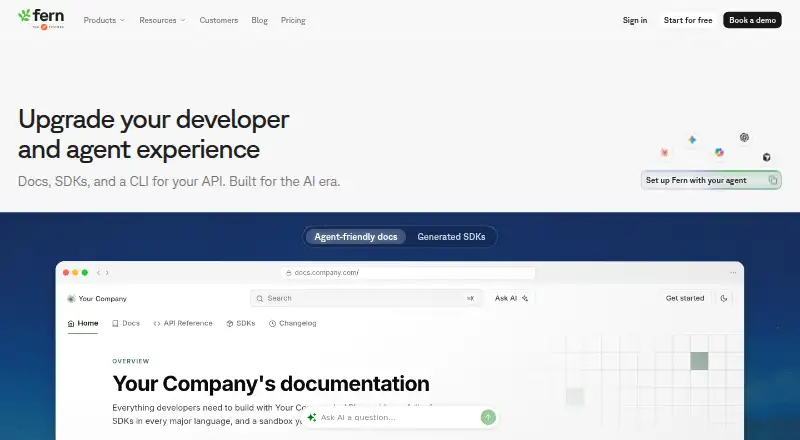
Fern Docs builds interactive documentation websites from Markdown and API specifications, while Fern also generates strongly typed client libraries.
What Fern is
Fern Docs builds interactive documentation websites from Markdown and API specifications, while Fern also generates strongly typed client libraries. It can create API references from OpenAPI, AsyncAPI, gRPC, and other specifications. Documentation features include an API Explorer, web editor, changelog pages, version and product switching, and localization. Generated SDKs include IDE support, schema validation, and idiomatic method names. Fern offers AI search, a writing agent, AI translations, and an MCP server. Its Free plan includes one site, 10 team members, 1,000 pages, 250 AI credits per month, and 2,000 page generations per month. Listed integrations include PostHog, Google Analytics, Segment, Mixpanel, FullStory, Intercom, Postman, and Context7. Documentation access can use password protection, SSO, JWT, or OAuth, with role-based access control. Fern supports custom domains, version history, and content analytics. The trust center lists SOC 2 Type II, GDPR, and CCPA. Enterprise adds self-hosting on dedicated infrastructure, dedicated support, and an uptime SLA.
Good
- Creates API references from several specification formats
- Generates strongly typed client libraries
- Free plan includes 250 AI credits monthly
- Supports SSO, JWT, OAuth, and role-based access
Watch out
- Free plan is limited to one site
- Free plan limits team members, pages, and generations
- Self-hosting is an Enterprise capability
Who it suits
Fern may suit teams producing API documentation and client libraries from specifications. The access controls, analytics, AI tools, and enterprise self-hosting options may also fit organizations with varied documentation needs.
Verdict
Fern combines interactive API documentation with SDK generation, AI tools, and access controls. Its free plan has defined usage limits, while self-hosting and dedicated support are Enterprise capabilities.
Plans and prices
From Fern's own pricing page, checked 14 Oct 2026.
| Plan | Price | What it gives you |
|---|---|---|
| Free | Free | 10 team members · 1,000 pages · 250 AI credits/month · 2,000 page generations/month · 1 site · custom domain/subpath · API Explorer · web editor · Ask Fern · Fern Agent · MCP server · version/product switching · Free forever; $0/mo |
| Enterprise | Priced on request | Everything in Free · SSO/SCIM/advanced RBAC · multiple repositories and docs instances · custom CSS/JavaScript/React · custom layouts · advanced analytics/data exports · dedicated infrastructure · self-hosting · uptime SLA · dedicated support · Tailored pricing terms |
The facts
Each one read from Fern's own pages, with the date it was checked.
What it does
- Access control
- Fern supports documentation access through password protection, SSO, JWT, or OAuth, with role-based access control.checked 5 Oct 2026
- Accessibility
- Fern documents WCAG 2.1 AA contrast, keyboard navigation, and screen-reader support for documentation sites.checked 14 Oct 2026
- Acquisition continuity
- Fern said it would continue operating as an independent product after joining Postman, with its product, brand, and roadmap unchanged.checked 14 Oct 2026
- Acquisition news
- Postman announced its acquisition of Fern on January 8, 2026; Postman said Fern had a 25-person team and more than 200 customers at that time.checked 14 Oct 2026
- AI features
- Ask Fern answers documentation questions with citations, while Fern Agent can propose documentation changes as pull requests.checked 14 Oct 2026
- AI tools
- Fern offers AI search, a writing agent, AI translations, an MCP server, and 250 AI credits on the Free plan.checked 5 Oct 2026
- API Explorer
- Published documentation can include an API Explorer that sends real requests with prefilled authentication.checked 14 Oct 2026
- API references
- Fern generates interactive API references from OpenAPI, AsyncAPI, gRPC, GraphQL, OpenRPC, and related specifications.checked 14 Oct 2026
- CLI requirements
- The current CLI installation documentation requires Node.js 22 or newer and supports npm or Homebrew installation.checked 14 Oct 2026
- Compliance
- Fern's trust center lists SOC 2 Type II, GDPR, and CCPA, with a SOC 2 report and penetration-test summary available by request.checked 14 Oct 2026
- Content analytics
- Yeschecked 20 Sep 2026
- Current CLI release
- The CLI changelog lists version 5.157.2 on October 14, 2026, including a fix for OpenAPI tag section naming.checked 14 Oct 2026
- Custom domain
- Yeschecked 20 Sep 2026
- Custom integrations
- Enterprise customers can add unsupported analytics, support, session-recording, and tag-management tools through custom JavaScript.checked 14 Oct 2026
- Documentation
- Fern Docs builds interactive documentation websites from Markdown and API specifications.checked 5 Oct 2026
- Documentation authoring
- Docs can be edited through GitHub pull requests, an in-browser Fern Editor, an IDE, Slack, or Fern Agent.checked 14 Oct 2026
- Documentation features
- Docs features include an API Explorer, web editor, changelog pages, version and product switching, and localization.checked 5 Oct 2026
- Independent assessment: Thoughtworks
- Thoughtworks reported positive initial impressions because Fern reduces documentation toil, while criticizing the need for proprietary configuration despite OpenAPI conversion support.checked 14 Oct 2026
Where it runs
- CLI platforms
- Fern says its CLI generator compiles signed binaries for macOS, Linux, and Windows.checked 5 Oct 2026
The company
- Company
- Fern identifies itself as Birch Solutions, Inc., a Postman company, and says it was born in Brooklyn, New York.checked 5 Oct 2026
- Company facts
- LinkedIn lists Fern as founded in 2022, headquartered in Brooklyn, New York, privately held, and employing 11–50 people.checked 14 Oct 2026
- Company identity
- Fern's legal entity is Birch Solutions, Inc., and its current parent is Postman.checked 14 Oct 2026
Money
- Free plan
- Yeschecked 20 Sep 2026
- Free plan limits
- The Free plan includes 10 team members, 1,000 pages, 250 AI credits per month, and 2,000 page generations per month.checked 5 Oct 2026
The full review of Fern
Fern is a documentation and SDK-generation platform for teams building APIs. It suits developers who want interactive API references alongside strongly typed client libraries. Its appeal is breadth; its main caveat is that several advanced capabilities sit behind custom-priced Enterprise.
Overview
Fern turns Markdown and API specifications into documentation websites, with API references generated from OpenAPI, AsyncAPI, gRPC, and other specifications. It also generates client libraries with IDE support, schema validation, and idiomatic method names. That combination makes Fern a strong fit when docs and SDKs need to be managed together, rather than a simple choice for teams seeking only a general-purpose knowledge base.
Key features
Documentation includes an API Explorer, web editor, changelog pages, version and product switching, and localization. These features give teams ways to present and maintain API material for different products and audiences without limiting the site to static reference pages.
AI features include search, a writing agent, translations, and an MCP server. The Free plan supplies 250 AI credits per month, so its AI allowance is useful for measured use, not an unlimited workflow. Listed integrations include PostHog, Google Analytics, Segment, Mixpanel, FullStory, Intercom, Postman, and Context7.
Access controls include password protection, SSO, JWT, OAuth, and role-based access control. Fern's trust center lists SOC 2 Type II, GDPR, and CCPA, and provides access requests for its SOC 2 report, penetration test summary, and information security policy. Custom domains, version history, and content analytics are also supported.
Pricing
| Plan | Price | What it includes |
|---|---|---|
| Free | free; billed Free forever | 10 team members, 1,000 pages, 250 AI credits per month, 2,000 page generations per month, and 1 site |
| Enterprise | Custom pricing | SSO, SCIM, and advanced RBAC; multiple repos and docs instances; advanced analytics and data exports; dedicated infrastructure with self-hosting available; uptime SLA and dedicated support |
The Free plan's generous team allowance makes it practical for a small team evaluating or maintaining one site, but its page, generation, and AI quotas set clear ceilings. Enterprise is aimed at organizations needing multiple documentation instances, stronger access administration, dedicated infrastructure, or contractual support and uptime commitments. There is no paid middle tier in these plans, so teams that outgrow Free will need to consider a custom-priced Enterprise arrangement.
Platforms
Fern supports API, Linux, macOS, self-hosted, web, and Windows environments. Its CLI generator compiles signed binaries for macOS, Linux, and Windows. Self-hosting is an Enterprise capability, so it is not part of the Free plan's deployment options.
Who it's for
Fern is best suited to API teams that want interactive documentation, SDK generation, and access controls in one platform. The Free plan can serve smaller teams with a single site and usage within its quotas. Organizations that need self-hosting, multiple docs instances, SCIM, advanced analytics exports, or dedicated support should expect an Enterprise conversation. It is less compelling for teams that need only lightweight process documentation rather than API-focused docs and SDKs.
Pros and cons
- Pros: One platform covers interactive API references and strongly typed SDK generation, with support for several API specification formats.
- Pros: The Free plan includes 10 team members and meaningful monthly page-generation and AI-credit allowances, plus a custom domain and one site.
- Pros: Password, SSO, JWT, OAuth, and role-based controls support both public and restricted documentation use cases.
- Cons: Free is capped at one site, 1,000 pages, and 2,000 monthly page generations, which may constrain larger or high-traffic documentation projects.
- Cons: Self-hosting, multiple instances, SCIM, advanced analytics exports, and dedicated support require custom-priced Enterprise.
- Cons: AI use is bounded by 250 credits per month on Free, limiting its fit for teams that expect sustained AI-assisted writing or translation.
Alternatives
Mintlify is worth considering for teams seeking a similar documentation platform with a free Starter plan that includes five editor seats, a custom domain, web editor, authentication, MCP server, and API playground; its Pro plan is 450.00, so compare its seat allowance and paid-tier cost against Fern's free quotas and Enterprise needs.
Tango is a better fit for capturing and sharing browser workflows: its free plan supports five shared workflows, browser capture, link and embed sharing, and up to 10 users per workspace.
GitBook may suit an individual who wants a free documentation site, unlimited page views, and 10 GitBook Agent messages per week; its free plan includes one user.
Scribe is an alternative documentation tool.
AutomaDocs may suit a developer seeking repository-based AI documentation: its free plan includes one repository, 50 AI chat messages per month, core doc generation, GitHub integration, and auto-sync on push.
Documentation.AI is another freemium documentation option.
InkLoom may appeal to teams prioritizing unlimited pages and one free user per project, with a free subdomain and community support.
CodeDocs AI is a freemium alternative for code documentation.
For category comparisons, explore AI Documentation Generators, Technical Documentation Software, API Documentation Tools, Developer Documentation Software, Code Generators, and Knowledge base software.
Verdict
Choose Fern if your team wants API documentation and SDK generation together, with a free plan broad enough to start a single-site project and access controls for restricted docs. Look elsewhere if you need self-hosting or larger-scale administrative features without moving to custom-priced Enterprise, or if your documentation needs are not centered on APIs.
Getting started
- Visit the Fern website.
- Start with the Free plan, which includes one site.
- Provide Markdown or API specifications such as OpenAPI, AsyncAPI, or gRPC for documentation.
- Use the generated documentation site and API Explorer.
- Generate client libraries if needed.
Limits worth knowing
The Free plan includes one site, 10 team members, 1,000 pages, 250 AI credits per month, and 2,000 page generations per month. Self-hosting on dedicated infrastructure is an Enterprise capability.
Questions
Does Fern have a free plan?
Yes. The Free plan is free forever and includes one site, 10 team members, 1,000 pages, 250 AI credits per month, and 2,000 page generations per month.
What specifications can Fern use for API references?
Fern supports OpenAPI, AsyncAPI, gRPC, and other specifications.
Can Fern documentation be access-controlled?
Yes. Access options include password protection, SSO, JWT, or OAuth, along with role-based access control.
Does Fern support self-hosting?
Self-hosting on dedicated infrastructure is listed as an Enterprise capability.
What integrations are listed for Fern?
Listed integrations include PostHog, Google Analytics, Segment, Mixpanel, FullStory, Intercom, Postman, and Context7.
What security and compliance information does Fern provide?
Its trust center lists SOC 2 Type II, GDPR, and CCPA, and provides access requests for its SOC 2 report, penetration test summary, and information security policy.
Alternatives to Fern
- 1

Supabase
Free planAndroidiOSWebAPI7.6From $25 a month - 2
Swagger Codegen
Free planOpen sourceWebAPILinuxmacOS7.6Free plan - 3

Xano
Free planAndroidiOSWebAPI7.5From $85 a month - 4

Hasura
Free planWebAPILinuxSelf-hosted6.9Free plan - 5
PocketBase
Free planAndroidiOSWebAPI6.9Free plan - 6

TypeSpec
Free planWebExtensionLinuxmacOS6.9Free plan